
Landscaping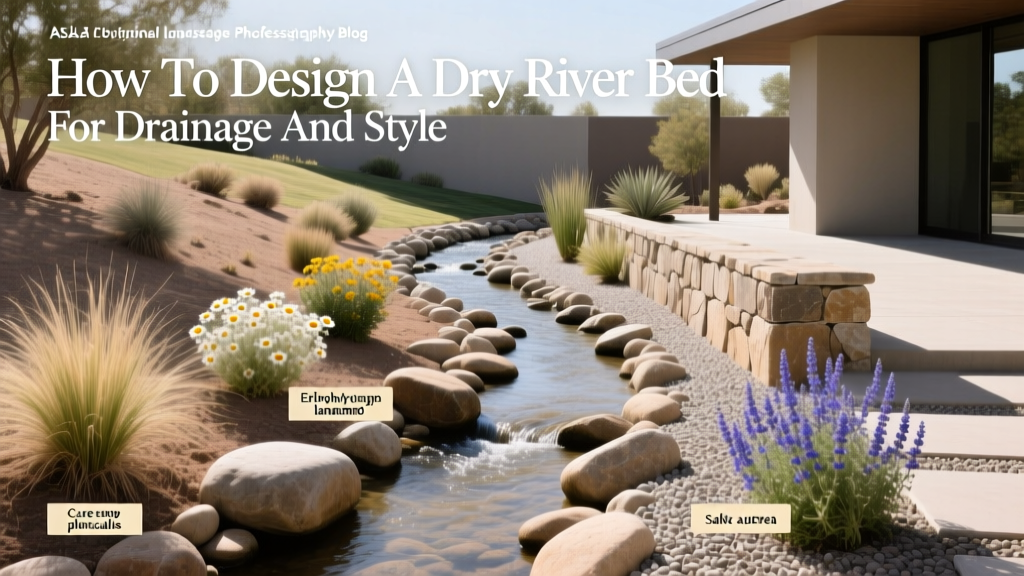
How To Design A Dry River Bed For Drainage And Style
Understanding the Functional and Aesthetic Role of Dry River Beds
Dry river beds—also known as dry creek beds or arroyos—are landscape features that look like natural, temporary waterways. They help manage stormwater by letting it soak in gradually, and they add visual interest to flat or sloped yards. Unlike French drains or buried pipes, dry river beds sit on the surface. That fits with ASLA’s 2021 Designing for Resilience guidelines, which call for “surface-level conveyance systems that slow, spread, and sink runoff while enhancing ecological function” (American Society of Landscape Architects, 2021). At the University of California, Davis Arboretum, a 420-linear-foot dry creek bed installed in 2018 cut peak runoff volume by 63% during 10-year storm events.
Site Assessment and Grading Fundamentals
Start with a site analysis before digging. Slope matters: aim for a grade between 1% and 5%. If it’s too flat, water pools. If it’s too steep, the bed can erode. Check the slope over at least 20 feet using a line level or digital inclinometer. Test how fast water soaks into the soil: dig a hole 12 inches deep and 8 inches wide, fill it with water, and time how long it takes to drain. You want 1–3 inches per hour. If it’s slower than 0.5 inch/hour, mix 30% coarse sand and 10% compost into the soil by volume—or add an underdrain, as suggested in ASLA’s Landscape Performance Series (2022).
Key Measurements for Structural Integrity
- Minimum trench width: 24 inches for residential applications handling up to 1,000 sq ft of impervious surface
- Recommended depth: 18 inches (12 inches gravel base + 6 inches stone layer)
- Stone size gradation: 1.5–3 inch rounded river rock for primary channel; ¾–1.5 inch for flanking zones
- Flare ratio: side slopes should not exceed 2:1 (horizontal:vertical) to prevent slumping
- Maximum length without energy dissipation: 75 linear feet before incorporating a gravel basin or boulder step
Hardscaping Materials and Installation Sequence
Begin with geotextile fabric laid over compacted subsoil to keep weeds down and separate layers. Then lay a 12-inch-deep base of #57 crushed limestone—tamp it down in two 6-inch layers using a plate compactor. This base holds weight and helps water move through. On top, add 6 inches of washed river rock. Skip sharp-edged gravel; rounded stones are gentler on plant roots and bare feet. For looks and lower environmental impact, use locally quarried stone—like Sierra Gray granite near Sacramento—as ASLA recommends.
Selecting Stone for Durability and Visual Flow
River rock should hold up to freezing, thawing, and sun exposure. In northern climates like Minneapolis, Minnesota, quartzite or basalt with a Mohs hardness of 6 or higher works best. In humid subtropical areas such as Charleston, South Carolina, limestone breaks down too quickly—skip it. Field tests at the Chicago Botanic Garden showed that 2.5-inch river rock kept 92% of its mass after five years of seasonal changes, compared to 67% for 1-inch material.
Plant Selection for Ecological Integration
Plants hold the banks together, filter pollutants, and keep things looking good year-round—without blocking water flow. Pick species with fibrous roots that grip soil well but also handle both wet and dry spells. All the plants listed below are native or non-invasive adapted species from the Lady Bird Johnson Wildflower Center’s Native Plant Database.
Eutrochium fistulosum (Joe-Pye weed) grows well in moist transition zones, reaching 4–7 feet tall with purple-pink flowers from July to September. Its deep taproot helps hold slopes and feeds native pollinators.
Iris versicolor (blue flag iris) handles saturated soils for up to 14 days and forms tight clumps along channel edges. Space plants 12–18 inches apart in loam-rich backfill.
Chasmanthium latifolium (northern sea oats) has soft, arching leaves and seed heads that last into winter. Space them 24 inches apart; mature clumps spread 3–4 feet wide.
Solidago rugosa ‘Fireworks’ (wrinkleleaf goldenrod) blooms yellow late in the season and tolerates the clay-loam soils common in Midwest gardens.
Panicum virgatum ‘Shenandoah’ (switchgrass) adds height and has deep rhizomes that reinforce banks across USDA Zones 4–9.
Cost Analysis and Square-Footage Planning
Material and labor costs depend on where you are, but national averages from the National Association of Landscape Professionals (2023) give a general idea:
| Component | Cost per sq ft (installed) | Notes |
|---|---|---|
| Geotextile & base stone | $2.10 | Includes delivery, compaction, and labor |
| River rock (2.5-inch) | $3.80 | Locally sourced; $1.20/sq ft higher if trucked >50 miles |
| Native plants (3-gallon) | $1.95 | At 24-inch spacing: 1.7 plants/sq ft of bank area |
| Design consultation (ASLA-certified) | $0.75 | Based on $125/hr for 1.5 hours per 500 sq ft |
A 600-square-foot dry river bed—including 300 linear feet of channel and 120 sq ft of planted banks—costs about $5,200–$6,800 total. That’s less than a comparable subsurface drainage system, which runs $8,100–$10,400, according to the University of Florida IFAS Extension (2022).
Maintenance Protocols for Long-Term Function
Annual upkeep is light but important. In early spring, clear out leaves and sediment with a leaf blower on low suction—don’t pressure wash, since it moves stones around. Watch for invasive plants like Berberis thunbergii (Japanese barberry) along the edges and pull them by hand before they set fruit. Replace river rock every 5–7 years where wear exceeds 0.5 inch; mark fixed reference stakes each year to track changes.
“Dry creek beds are not static ornaments—they’re living infrastructure. Their success hinges on matching hydraulic design precision with botanical fidelity to site ecology.” — Dr. Elena Rodriguez, Senior Landscape Architect, Boston Parks & Recreation Department, 2020
At the Brooklyn Botanic Garden’s 2019 Stormwater Resilience Project, designers built a 180-foot dry creek that also worked as a bioswale. It removed 88% of total suspended solids and supported 14 native plant types within two growing seasons. Portland State University used a stepped dry river bed with engineered soil media on campus and cut impervious runoff by 41% across a 0.7-acre area.
When the land changes slope, use gentle curves instead of straight lines to slow water and help it soak in. Each curve’s radius should be at least three times the channel width. So a 30-inch-wide bed needs curves with a minimum 7.5-foot radius. That comes from fluvial geomorphology studies in ASLA’s Water Sensitive Design Handbook (2021).
How densely you plant affects bank stability. University of Wisconsin–Madison research found plots with 80% or more groundcover had 73% less rill erosion than those with only 40% coverage after simulated 5-inch rainfalls.
Use edging materials lightly: low-profile, weathered fieldstone (6–8 inches tall) or corten steel (¼-inch thick) gives quiet definition without breaking sightlines. Skip concrete curbs—they speed up runoff and go against biophilic design principles from the Biophilic Cities Network.
On residential lots under 5,000 sq ft, keep the dry river bed to no more than 12% of the total area so you still have room for lawn or patio. Larger properties—say, those near the Great Smoky Mountains National Park—can scale up, but stay at least 10 feet from septic drainfields, per EPA Onsite Wastewater Guidelines.
Label all plants with their Latin names and origin on a QR-coded plaque embedded nearby. That helps visitors learn and follows ASLA’s Public Landscape Documentation Standards (2022), used by places like the Missouri Botanical Garden and the New York Botanical Garden.

