Pest Control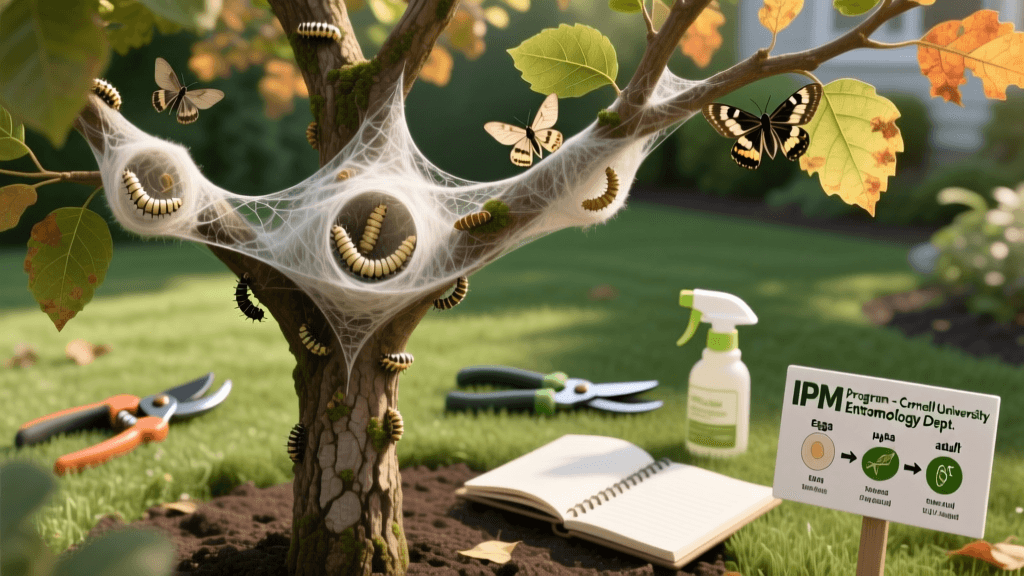
How To Eliminate Fall Webworms In Ornamental Trees
Understanding the Fall Webworm Lifecycle and Behavior
Fall webworms (Hyalophora cecropia) are native North American moths. Their caterpillars build obvious, silken nests at the ends of branches on more than 100 kinds of deciduous trees—walnut, hickory, cherry, crabapple, and birch among them. They show up in mid- to late summer and stick around into early fall. Adult moths crawl out of pupal cocoons in the soil between late May and early July, depending on where you are and how warm it’s been. Females lay egg masses—400 to 500 eggs each—on the undersides of leaves. Those eggs hatch in about a week to 10 days, and the caterpillars start feeding right away. That feeding stage lasts 4 to 6 weeks.
The caterpillars build communal webs as they eat, pulling new leaves into the structure as it grows. The web isn’t meant to keep predators out—it helps hold moisture and smooth out temperature swings. Caterpillars go through six growth stages, or instars. By the sixth, they’re 35–40 mm long, with thick white or tan hairs and black or reddish heads. In late September through October, they drop to the ground and spin brown, fuzzy cocoons in leaf litter, soil cracks, or under loose bark. To wake up from winter dormancy, the pupae need at least 1,200 hours below 10°C (University of Kentucky Entomology, 2021).
Accurate Identification: Distinguishing Fall Webworms from Similar Pests
Mistaking them for other pests means treatments won’t work. Fall webworms often get mixed up with eastern tent caterpillars (Malacosoma americanum) and bagworms (Thyridopteryx ephemeraeformis). Here’s how to tell them apart:
- Nest location: Fall webworm nests sit at branch tips and wrap around leaves; tent caterpillar nests form in branch forks near the trunk.
- Timing: Fall webworms are active from July through October; tent caterpillars show up March through May.
- Larval coloration: Full-grown fall webworms have pale yellow bodies with two rows of black or red bumps and long white hairs; tent caterpillars are shiny black with a white stripe down the back and blue marks along the sides.
- Web texture: Fall webworm silk looks loose and lacy; tent caterpillar silk is dense and felt-like.
Bagworms make individual, movable cases—not shared webs—and mostly feed on evergreens like juniper and arborvitae. Knowing which insect you’re dealing with before spraying avoids unnecessary pesticide use and fits with Integrated Pest Management (IPM) guidelines from Cornell University Cooperative Extension.
When to Step In
Treatment works best when timed right. The earliest caterpillar stages—first through third instars—are easiest to control. At that point, the caterpillars are small (5–12 mm), sensitive to sprays that work on contact or when eaten, and haven’t built thick, impenetrable webs yet. Start checking trees in early July in southern states like Georgia, and wait until mid-August in northern areas like Maine. Pheromone traps hung 1.5 meters off the ground can help track adult moth flights; a spike in trap catches usually means eggs will hatch within 7–10 days (Penn State Extension, 2022). Once webs grow past 30 cm across or hold caterpillars longer than 20 mm, chemical sprays lose much of their punch.
Early-Season Cultural Tactics
Cutting out infested branches works well—if done before the caterpillars hit 15 mm. Snip 30–45 cm beyond the edge of the web, then destroy the clippings by soaking them in soapy water or sealing them in plastic bags for landfill disposal. Don’t burn or compost them—pupae can survive both. Natural enemies help too: parasitoid wasps like Hyposoter fugitivus and Brachymeria intermedia can kill up to 60% of caterpillars in untreated areas, especially when broad-spectrum insecticides aren’t used.
Organic Control Options with Verified Efficacy
For organic landscapes or places like school grounds and community gardens, a few biopesticides work reliably without harming helpful insects. Bacillus thuringiensis var. kurstaki (Btk) is still the top choice for young caterpillars. Spray it on leaves at label rates—say, 1–2 tsp per gallon of water—and reapply every 5–7 days because sunlight breaks it down fast and rain washes it off (it lasts about 48 hours on leaves in full sun). Spinosad products (like Entrust SC) stick around longer—up to 7 days—and can handle fourth-instar caterpillars, though using them too often may lead to resistance.
Neem oil (with at least 0.5% azadirachtin) interferes with molting and feeding but needs full coverage of both the web and surrounding leaves. Field trials at the University of Vermont’s Horticulture Research Center found 72% of second-instar caterpillars died within 7 days after a 1.5% v/v spray. Horticultural oils—dormant or summer-grade—usually don’t work well against fall webworms because the web shields them and they move quickly away from treated spots.
Chemical Controls for Severe Infestations
If a mature tree has more than 15 active webs—or if it’s lost over 25% of its leaves—targeted synthetic insecticides might be needed. Carbaryl (Sevin SL), lambda-cyhalothrin (Scimitar CS), and bifenthrin (Talstar P) all knock caterpillars down fast. Carbaryl stays active on leaves for 10–14 days, while pyrethroids like lambda-cyhalothrin and bifenthrin fade in 3–5 days but are riskier for bees and aquatic bugs. Spray early in the morning or late in the evening to spare bees, and skip flowering plants or water bodies within 3 meters.
Active Ingredients and Their Environmental Profiles
Picking the right active ingredient means weighing how well it works, how safe it is, and what the rules say. The table below compares common options:
| Active Ingredient | Mode of Action (IRAC Group) | Residual Activity (Days) | Bee Hazard (Contact LD50, μg/bee) | Soil Half-Life (Days) |
|---|---|---|---|---|
| Bacillus thuringiensis var. kurstaki | 11 | 2–4 | >100,000 | Not applicable |
| Spinosad | 5 | 5–7 | 0.022 | 10–15 |
| Carbaryl | 1A | 10–14 | 0.025 | 20–40 |
IRAC Group numbers help avoid resistance by switching up how sprays work from season to season. For example, using Btk in early July and spinosad in early August puts less pressure on the population than using carbaryl twice in a row.
Integrating Fall Webworm Management into Broader IPM Frameworks
Good pest management doesn’t stop at one bug. The University of Florida IFAS IPM program stresses watching for thresholds, protecting natural enemies, and tweaking the habitat. Keep trees healthy with regular watering—especially during dry spells in July and August—mulch to hold soil moisture, and go easy on nitrogen fertilizer, which makes leaves richer in nitrogen and can speed up caterpillar growth by up to 30%. Some trees handle webworms better than others: ‘Prairie Sentinel’ hackberry or ‘Regent’ honeylocust resist damage better than favorites like black walnut.
Working together across a neighborhood helps, too. In 2020, Portland, Oregon ran a monitoring effort across 12 ZIP codes. Over three years, reported webworm complaints dropped 41%, and city pesticide spending fell 67%. Ohio State University Extension’s “Webworm Watch” citizen science project trained more than 850 volunteers to log nest locations and caterpillar stages via a mobile app. That data built detailed maps used to fine-tune regional spray advice.
Cleaning up fallen leaves matters, too. Raking and removing them in November gets rid of up to 80% of overwintering pupae in yards, according to field work at Michigan State University’s Trevor Nichols Research Complex. Leaving leaves in place supports wildlife but raises local pest numbers—so decisions should match your goals for the site.
And remember: light to moderate webworm activity rarely hurts a tree. A healthy, mature ornamental tree can lose up to 40% of its leaves in a season and still grow normally, with no higher risk of dying (USDA Forest Service, 2019). Treat only when webs become a nuisance—blocking sidewalks, for example—or when defoliation repeats year after year and starts threatening the tree’s health.
“The goal of IPM is not eradication—but intelligent, proportionate response grounded in biology, ecology, and economics.” — Dr. Deborah G. McCullough, Michigan State University Department of Entomology, 2020
Thinking this way turns pest management from crisis mode into steady, informed care. Watching closely, acting on real data, and respecting how ecosystems work helps keep ornamental trees strong, attractive, and ecologically useful for years to come.