Lawn Care
How To Fix Bare Patches In Your Lawn
Diagnosing Bare Patches Before You Reach for the Seed Bag
Bare patches in a lawn rarely have just one cause. If you skip figuring out why they’re there and go straight to seeding, you’ll likely waste seed, money, and time. Get down on your knees and take a close look at the soil and any grass still hanging on around the dead spot. Is the soil hard and gray? Is there a white fungal mat near the base of the stems? Are the grass crowns still there but the blades gone—maybe from pets, mowing, or something else? Each of these points to a different next step, and skipping this step is what most homeowners get wrong.
The University of Georgia Cooperative Extension Service (2022) lists the five most common causes of bare patches in home lawns: soil compaction, fungal disease, insect damage, chemical burn, and shade stress. Which one you’re dealing with changes everything—from whether you need to aerate before reseeding to whether you should use a fungicide before laying sod.
Soil Preparation: The Step That Determines Everything
Grass seed placed on unprepared soil germinates about 40 to 60 percent less often than seed placed on loosened, amended ground, according to the Penn State Extension Turfgrass Program (2021). That’s why so many patch repairs fail in the first season.
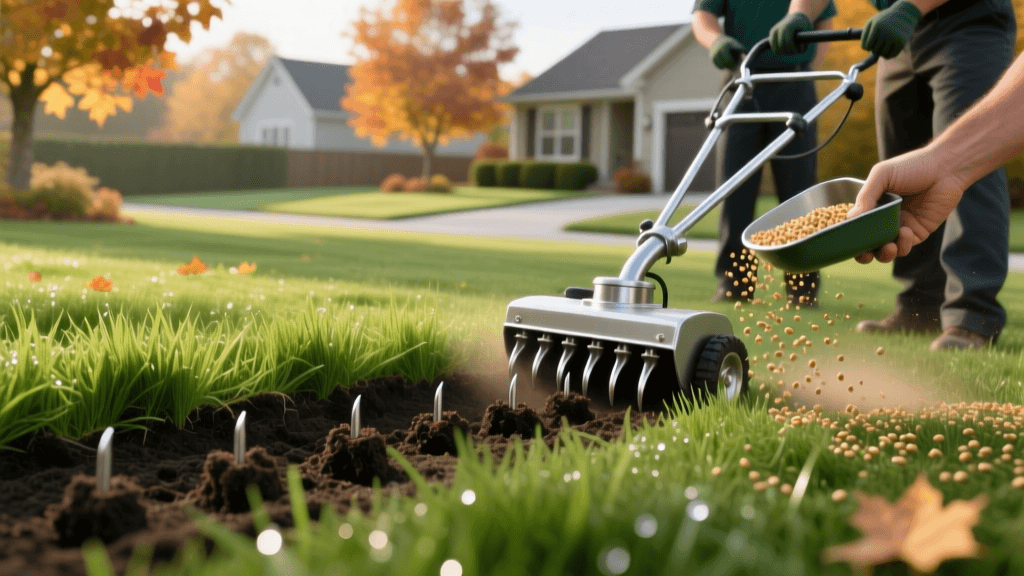
Start by clearing away dead material. Use a stiff-tined rake to pull out dead grass, thatch, and debris until you see bare mineral soil. If the patch is smaller than 12 inches across, a hand cultivator works fine. For patches larger than 3 square feet, a garden fork or core aerator will save your back and break up compaction more effectively.
Testing and Amending Your Soil
Send a soil sample to your state’s land-grant university extension lab before adding anything. Most labs charge $10 to $20 per sample and send results back within two weeks. The report tells you your soil pH, organic matter level, and key nutrient levels. Cool-season grasses like Kentucky bluegrass (Poa pratensis) and tall fescue (Festuca arundinacea) grow best when soil pH stays between 6.0 and 7.0. Warm-season grasses like bermudagrass (Cynodon dactylon) and zoysiagrass (Zoysia japonica) handle pH from 5.8 to 7.0 but struggle below 5.5.
If your pH is too low, add pelletized limestone at the rate listed in your soil report—usually 25 to 50 pounds per 1,000 square feet for a moderate correction. If pH is too high, elemental sulfur at 5 to 10 pounds per 1,000 square feet will lower it over the course of a growing season. Work amendments into the top 4 to 6 inches of soil instead of just spreading them on top.
Loosening Compacted Soil
Compaction shows up most often in high-traffic areas, along fence lines, or where water pools after rain. Use a core aerator to pull plugs 2 to 3 inches deep, spacing passes about 2 inches apart across the bare area and extending 6 inches into the healthy turf nearby. Leave the plugs on the surface to break down naturally—or rake them in if appearance matters. After aerating, spread a quarter-inch layer of compost over the area to help with both drainage and moisture retention.
Choosing the Right Grass Species and Seed
Match your seed to your existing lawn and local climate. Patching a Kentucky bluegrass lawn with perennial ryegrass (Lolium perenne) gives you a color and texture mismatch that lasts years. If you’re not sure what grass you have, take a sample to your local cooperative extension office—or use a turfgrass identification guide from the National Turfgrass Evaluation Program (NTEP), which tests hundreds of cultivars across dozens of sites in the U.S.
For cool-season lawns in the transition zone and northern states, here are typical seeding rates for bare patches:
| Grass Species | Seeding Rate (lbs/1,000 sq ft) | Germination Time (days) | Best Seeding Window |
|---|---|---|---|
| Kentucky Bluegrass | 2–3 | 14–30 | Late Aug – Oct |
| Tall Fescue | 6–8 | 7–14 | Late Aug – Oct |
| Perennial Ryegrass | 6–9 | 5–10 | Late Aug – Oct |
| Bermudagrass (hulled) | 1–2 | 10–21 | Late Apr – Jun |
| Zoysiagrass | 1–2 | 14–21 | Late May – Jul |
When buying seed, check the label for a germination percentage of at least 85 percent and zero weed seed. The label is a legal document—any reputable product includes those numbers. Scotts EZ Seed Patch and Repair and Jonathan Green Black Beauty Ultra meet those standards and come with starter fertilizer already coated on the seed, so you don’t need to apply it separately.
Sod as an Alternative to Seed
For patches bigger than 4 square feet in places people notice—like near a front walk or patio—sod often makes more sense than seed. It takes 2 to 3 weeks to settle in, compared to 6 to 8 weeks for seeded patches. It also covers the soil right away, cutting down on erosion and weeds. Cut sod pieces to fit the bare area exactly, press the edges snugly against the surrounding turf, and roll the patch with a lawn roller to remove air pockets under the roots. Water every day for the first two weeks, then switch to deeper, less frequent watering.
Fertilizing the Repair Area
New seedlings and fresh sod both do better with a starter fertilizer high in phosphorus, which helps roots grow. A product labeled 10-18-10 or 12-24-12, applied at the rate on the bag—usually 3 to 4 pounds per 1,000 square feet—gives young grass enough phosphorus without burning tender roots with too much nitrogen.
Avoid using regular lawn fertilizer with a lot of nitrogen on freshly seeded areas. More than 1 pound of actual nitrogen per 1,000 square feet can burn seedlings and give weeds a head start. Wait until the new grass has been mowed at least twice before switching to a maintenance fertilizer.
Six to eight weeks after establishment, apply a balanced slow-release fertilizer like Milorganite (6-4-0) or a polymer-coated urea product at 0.5 to 0.75 pounds of actual nitrogen per 1,000 square feet. Slow-release formulas keep growth steady and cut down on nitrogen washing into storm drains—a concern that’s led some towns in the Chesapeake Bay and Great Lakes regions to limit fast-release nitrogen.
Watering Protocols for Successful Establishment
Water is the one thing you can control most directly in patch repair. Seed needs to stay moist from the moment it hits the soil until it sprouts and grows to at least 1 inch tall. In practice, that means light, frequent watering—two or three times a day in warm, dry weather—just enough to wet the top half-inch of soil without puddling or runoff.
Once seedlings hit 1 inch, water once a day—enough to soak the soil 2 to 3 inches deep. After the first mowing, shift to the standard deep-and-infrequent schedule for mature turf: 1 to 1.5 inches of water per week, delivered in one or two sessions. This pushes roots downward instead of letting them stay shallow and vulnerable to heat or drought.
"Irrigation frequency during germination is more important than total water volume. A seed that dries out completely even once during the first 10 days after germination begins will not recover. Consistency is everything." — Dr. Grady Miller, North Carolina State University Department of Crop and Soil Sciences, speaking at the 2023 Turfgrass Producers International Annual Conference.
If you’re repairing patches in late summer or early fall—the best time for cool-season grasses—and afternoon temperatures climb above 85°F, the soil surface can dry out in under an hour. In those cases, a light midday watering in addition to morning and evening sessions helps—until nighttime temps drop below 65°F most nights.
Mowing, Traffic, and Long-Term Prevention
Don’t mow a seeded patch until the new grass reaches one-third above your usual mowing height. For tall fescue kept at 3.5 inches, wait until seedlings are about 4.5 to 5 inches tall before the first cut. Use a sharp blade, and avoid turning the mower on the new patch for the first few mowings—the sideways pressure can pull up seedlings that haven’t rooted firmly yet.
Keep foot traffic off repaired areas for at least four weeks after seeding or two weeks after sodding. Temporary fencing, stakes and string, or even a few potted plants placed nearby can steer people away without costing much.
Stopping future bare patches means fixing what caused the first one. If compaction is the issue, plan to core aerate every fall for cool-season lawns or every spring for warm-season lawns. If shade is the problem, try overseeding with a shade-tolerant type like Creeping Red Fescue (Festuca rubra) or talk to an arborist about selective pruning to let in more light. If dog urine is causing spots—a telltale green ring around a brown center—training your pet to use a specific area or rinsing the spot with water right after they go are the only reliable fixes.
- Aerate cool-season lawns every fall when soil temperatures sit between 50°F and 65°F, giving grass time to recover before winter dormancy.
- Overseed the whole lawn—not just bare patches—every two to three years to keep turf thick and crowd out weeds.
- Check your irrigation system once a year; if one sprinkler head puts out 30 percent more water than its neighbors, it creates soggy spots that invite disease and root problems.
- Sharpen mower blades at least twice a season; dull blades tear grass instead of cutting cleanly, opening doors for disease.
- Test your soil every three years and adjust pH or nutrients before thinning or yellowing shows up.
Bare patches almost always point to a gap in care—not bad luck. A lawn that gets consistent attention—right mowing height, timely feeding, deep watering, and yearly aeration—rarely develops big bare spots unless something unusual happens, like extreme weather or a pest outbreak. The steps here work, but the real goal is to make them unnecessary by building a dense, tough stand of grass that holds up to stress, resists weeds and disease, and bounces back fast.
- Figure out why the bare patch appeared before buying anything.
- Clear away dead material and loosen the soil to at least 4 inches deep.
- Test soil pH and amend it before seeding or sodding.
- Pick a seed variety that matches your current lawn and your region.
- Use starter fertilizer at the label rate and water regularly until the grass is established.
- Wait to mow until new grass reaches one-third above your target height.
- Fix the original cause so it doesn’t happen again in the same spot.
The Rutgers New Jersey Agricultural Experiment Station and the Texas A&M AgriLife Extension Service both offer free, state-specific turfgrass calendars. These line up fertilizing, aeration, overseeding, and pest control with local weather patterns—so you’re not guessing when to act, and your repair efforts line up with when grass is most ready to grow.