Pest Control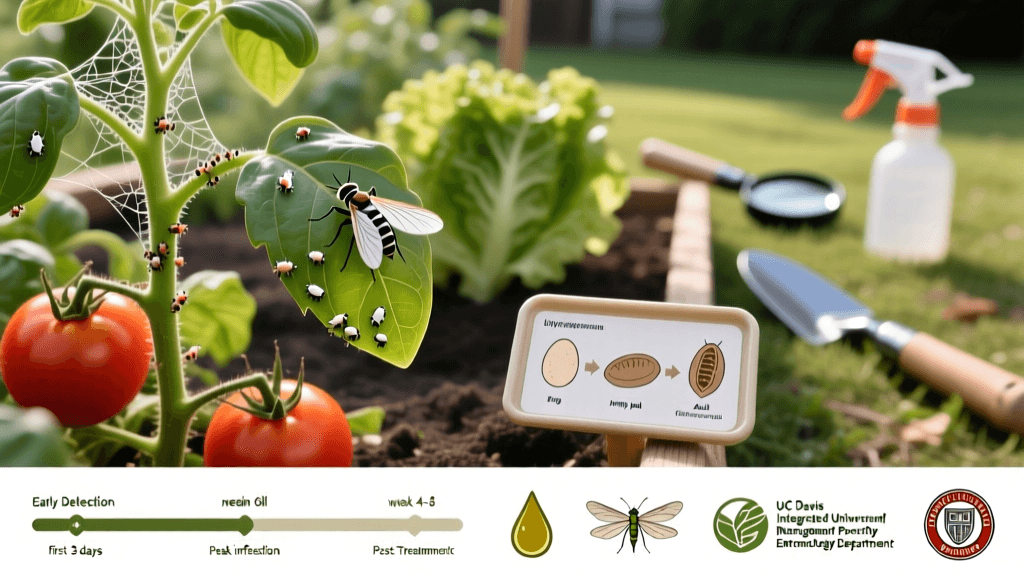
How To Get Rid Of Whiteflies On Vegetables
Identifying Whitefly Infestations Before They Spread
Whiteflies are sap-sucking insects that can seriously hurt vegetable gardens. In heavy infestations, they’ve been shown to cut yields by 30 to 50 percent, according to the University of California Statewide Integrated Pest Management Program (UC IPM, 2022). The two types you’ll most likely see on vegetables are the silverleaf whitefly (Bemisia argentifolii) and the greenhouse whitefly (Trialeurodes vaporariorum). Both feed on the undersides of leaves, pulling sap from the phloem and leaving behind sticky honeydew. That honeydew encourages sooty mold and can interfere with photosynthesis.
Catch them early — it makes a real difference in keeping numbers down. Check the undersides of leaves on tomatoes, peppers, squash, cucumbers, and brassicas at least twice a week when the weather warms up. A 10x hand lens helps spot the flat, oval nymphs, which are nearly invisible without magnification. Adult whiteflies are about 1 to 2 mm long and covered in white waxy powder. If you shake the plant, they’ll fly up in a little cloud. Yellow sticky traps hung just above the plant canopy — one per 100 square feet — give an early heads-up and help estimate how many are around.
Look for yellowing leaves, stunted growth, and a shiny, sticky film on upper leaf surfaces. On squash and cucumbers, even a few silverleaf whiteflies can cause irregular silvering of the leaf tissue — a physiological response, not direct feeding damage. Tomato plants hit hard by Bemisia may ripen unevenly, with green or yellow shoulders showing up no matter the variety.
The Whitefly Lifecycle and Why Timing Matters
Whiteflies go through several stages, and knowing when each appears helps time treatments right. Females lay 200 to 400 eggs over two or three weeks, usually in circular patterns on the undersides of young leaves. Eggs hatch in 5 to 10 days, depending on temperature. The first instar nymph — called a crawler — is the only one that moves. It travels a short distance before settling and feeding. Stages two through four stay put and look like tiny scales. The fourth instar, sometimes called the pupal stage, is where the insect changes into an adult over 6 to 10 days.
From egg to adult takes about 18 to 25 days at 77°F (25°C), but shrinks to as few as 14 days at 86°F (30°C). That’s why populations spike during summer heat waves. At 60°F (15°C), development slows way down, and outdoor populations rarely reach damaging levels. The University of Florida Institute of Food and Agricultural Sciences (UF/IFAS, 2021) points out that in warm areas like Florida and California’s Central Valley, whiteflies can complete 11 to 15 generations each year — which is why rotating control methods matters.
Overlapping Generations and Treatment Resistance
You’ll usually find eggs, nymphs, and adults all on the same plant at once. Most insecticides kill adults and crawlers but don’t touch eggs or the scale-like nymphs. That’s why two or three sprays, spaced 5 to 7 days apart, are standard. Skip a follow-up, and the surviving nymphs mature and restart the cycle within about two weeks.
Silverleaf whiteflies across the southern U.S., parts of Europe, and much of Southeast Asia now resist pyrethroid insecticides. The Insecticide Resistance Action Committee (IRAC) lists this as a top-tier concern and advises rotating among different modes of action to keep products working. Repeating the same chemical all season is one of the main reasons resistance spreads.
Monitoring Thresholds for Treatment Decisions
Just seeing whiteflies doesn’t always mean you need to spray. What counts as “too many” depends on the crop and how it’s sold. For fresh-market tomatoes, UC IPM suggests starting treatment when you find five or more adults per leaflet on at least 20 percent of sampled plants. Processing tomatoes have a higher threshold because cosmetic damage isn’t as important. For squash sold directly to customers, even low numbers may warrant action due to the silvering issue. Keeping a written log of trap catches and leaf inspections helps spot trends and predict when you’ll cross those thresholds.
Organic and Biological Control Methods
Managing whiteflies organically means mixing physical barriers, beneficial insects, and low-toxicity sprays. No single organic method knocks them out completely, but layering a few approaches often keeps numbers low enough to avoid serious damage — especially in home gardens and small market plots.
Reflective silver or aluminum mulch laid down at transplanting can cut down on whitefly landings. It seems to confuse their host-finding behavior. Research from the Vegetable Research Station at Bradenton, Florida found that reflective mulch reduced whitefly numbers by 60 to 80 percent compared to bare soil in the first four weeks after transplanting. The effect fades as the plant canopy grows and covers the mulch, but by then the plants are often big enough to handle some feeding.
Beneficial Insects as Biological Controls
Several parasitic wasps target whitefly nymphs and are available for gardeners and greenhouse growers. Encarsia formosa works well against greenhouse whitefly and is typically released at 1 to 5 wasps per square meter each week, starting before populations build. Eretmocerus eremicus does better against silverleaf whitefly and handles warmer temperatures. Both are sold by biological control suppliers and approved for certified organic use.
Lacewing larvae (Chrysoperla spp.) and minute pirate bugs (Orius insidiosus) eat whitefly eggs and crawlers. You can support these predators by cutting back on broad-spectrum sprays and planting insectary plants like sweet alyssum, dill, and fennel near your vegetable beds. The Rodale Institute found that vegetable plots with diversified plantings and insectary borders had 40 percent or more fewer whiteflies than monoculture plots.
Insecticidal soap (potassium salts of fatty acids) and neem oil (with azadirachtin as the active ingredient) are the most reliable organic contact sprays for whiteflies. Neither lasts long on the plant — they only work on direct contact with soft-bodied insects — so full coverage of the leaf undersides is key. Spray in the early morning or evening to reduce the chance of leaf burn and catch adults when they’re less active. Repeat every 5 to 7 days for at least three rounds.
Chemical Controls and Active Ingredient Selection
When organic options aren’t enough or populations have already climbed too high, synthetic insecticides offer faster results. Choosing the right one means balancing effectiveness with resistance risk. The table below lists common chemical classes, their IRAC mode-of-action group, and how well they work on different life stages.
| Active Ingredient | IRAC Group | Efficacy vs. Adults | Efficacy vs. Nymphs | Residual Activity |
|---|---|---|---|---|
| Imidacloprid | 4A (Neonicotinoid) | High | High (systemic) | 14–21 days |
| Spiromesifen | 23 (Tetronic acid) | Moderate | High (ovicidal) | 10–14 days |
| Pyriproxyfen | 7C (IGR) | Low (sterilant) | High (disrupts molting) | 14–21 days |
| Bifenthrin | 3A (Pyrethroid) | High | Low | 7–10 days |
| Flupyradifurone | 4D (Butenolide) | High | High (systemic) | 14–21 days |
Neonicotinoids like imidacloprid move through the plant and kill nymphs feeding on treated tissue. But they’re risky for pollinators, especially on flowering vegetables. Use them only as a soil drench before flowering — never as a foliar spray on blooming plants. Always read the label: pre-harvest intervals (PHIs) range from 0 days for some formulations to 21 days for others.
Insect growth regulators (IGRs) such as pyriproxyfen interfere with juvenile hormone, stopping nymphs from maturing and reducing egg-laying by adults. They act slower than contact sprays but carry less resistance risk and are easier on beneficial insects. Spiromesifen kills eggs as well as nymphs, making it a good choice when you see lots of freshly laid eggs.
Switch IRAC groups with every application. For example, a three-spray plan might start with a Group 23 product (spiromesifen), follow up seven days later with a Group 7C product (pyriproxyfen), and finish seven days after that with a Group 4D product (flupyradifurone). This hits multiple life stages while limiting resistance pressure.
Integrated Pest Management Strategies for the Vegetable Garden
Integrated Pest Management (IPM) brings together biological, cultural, physical, and chemical tools to manage pests in ways that limit economic loss, health risks, and environmental harm. It started taking shape in the 1970s through work by the University of California, Cornell University, and the USDA, and is now the approach recommended by land-grant university extension programs across the U.S.
Cultural practices are the backbone of any IPM plan for whiteflies. Pull out and destroy heavily infested plants instead of composting them — nymphs can finish developing on detached leaves. At season’s end, till crop debris into the soil right away to remove overwintering spots. Don’t overdo nitrogen fertilizer; whiteflies prefer lush, tender growth. And drip irrigation keeps leaves dry, which makes them less appealing to landing adults.
- Put fine-mesh insect netting (0.8 mm or smaller) over transplants as soon as you plant them. It blocks adults during the most vulnerable early stage.
- Rotate vegetable families between beds each year — don’t grow tomatoes, peppers, or eggplant in the same spot two years in a row.
- Keep weeds pulled, especially those in the Malvaceae and Euphorbiaceae families, which can harbor silverleaf whiteflies.
- Check nursery-bought transplants carefully before putting them in your garden — they’re a common way whiteflies get introduced.
- Use yellow sticky traps to monitor, replacing them every two weeks and writing down the counts to track population changes over time.
Plants under water stress suffer more from whitefly feeding because they can’t replace lost sap as easily. Keeping soil moisture steady — with mulch and regular watering — helps both plant health and pest control. A 2- to 3-inch layer of organic mulch smooths out soil temperature swings, holds moisture, and gives shelter to ground beetles that eat whitefly pupae that fall to the soil.
- Spray insecticidal soap or neem oil in the early morning, when temps stay below 85°F, to lower the risk of leaf burn and catch adults while they’re resting.
- Angle your sprayer upward to coat the undersides of leaves — that’s where nymphs feed and eggs are laid. Spraying from above misses most of them.
- Add a spreader-sticker adjuvant to neem oil when spraying brassicas or squash, whose waxy leaves can repel the spray.
- Wait at least 48 hours after a chemical spray before releasing beneficial insects, giving residues time to break down.
The North Carolina State University Extension Service (NC State Extension, 2023) notes that no single tactic will wipe whiteflies out of a garden for good. IPM isn’t about zero pests — it’s about keeping numbers low enough that they don’t cause unacceptable damage, whether economic or cosmetic. Tolerating a low background level while supporting natural enemies often works better long-term than repeated sprays aiming for total elimination.
Writing things down matters more than most people think. Jotting down which crops had problems, when numbers peaked, what you sprayed, and what happened builds a useful record over time. Growers who keep simple logs — even just a notebook or spreadsheet tracking trap counts, spray dates, and active ingredients — tend to make smarter decisions than those relying on memory alone. After two or three seasons, patterns in your garden often become clear.