Pest Control
How To Identify And Control Fall Armyworms In Lawns
Understanding Fall Armyworm Biology and Lawn Vulnerability
Fall armyworms (Spodoptera frugiperda) aren’t native to the United States, but they’ve been showing up in turfgrass regularly since they were first found in Florida in 1957. They don’t survive winter north of USDA Hardiness Zone 9, so places like Ohio, Pennsylvania, and New York see new arrivals each year—carried north on wind currents from breeding areas in the South. In the Deep South, they can complete up to six generations a year; farther north, it’s usually one or two. The larvae feed mostly at night and hide in thatch or soil cracks during the day, which makes spotting them early tough.
Lifecycle Stages and Identification Markers
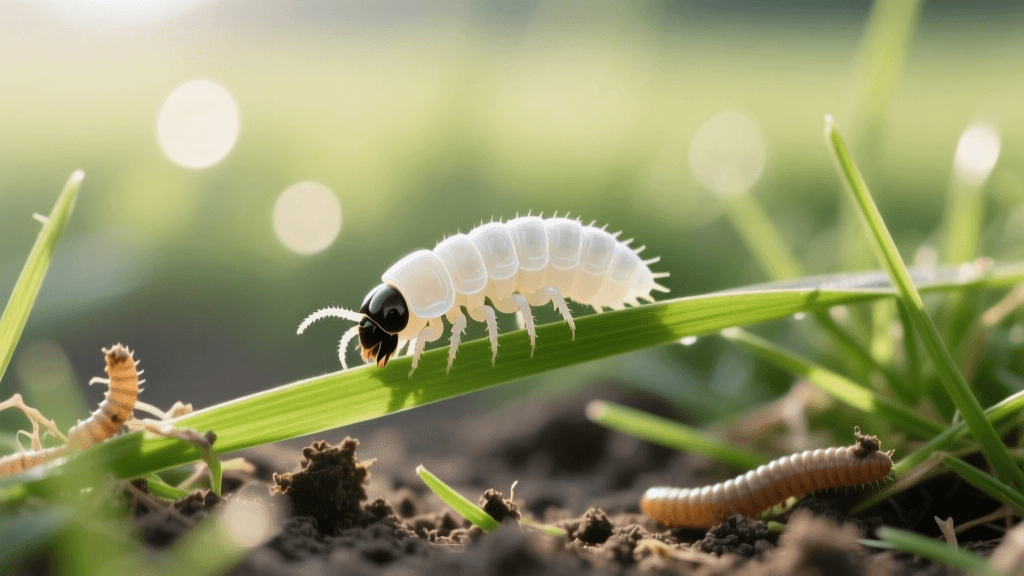
Telling fall armyworms apart from other pests means knowing what to look for at each stage. Eggs are laid in clusters of 100–200, covered with grayish-brown moth scales, and are about 0.4 mm across. Young larvae are pale green with a dark head and a small inverted “Y” on the front—best seen with a 10× hand lens. As they grow through six stages over 2–3 weeks, they go from 1.5 mm to 30–40 mm long, and their color shifts from light green to brown or dark gray, often with stripes running lengthwise. They pupate 2–7 cm down in the soil, inside little earthen cells; the pupae are reddish-brown and 14–18 mm long. Adult moths have a 32–40 mm wingspan, and males show white spots on the front wings.
Visual Clues for Early Infestation Detection
Start checking lawns in late June and keep going through early October—exact timing depends on where you are, but activity lines up with how many degree-days (above 50°F) have piled up. In Georgia, first-generation larvae often show up by mid-May (350–450 DD50), while in Illinois, pressure usually peaks between July 15 and August 25. Watch for uneven brown patches that look like drought stress—but the soil underneath stays moist. Try the “soap flush test”: mix 2 tablespoons of liquid dish soap in a gallon of water and pour it over a 1-square-foot patch of turf. If larvae are there, they’ll crawl out within 5 minutes. Use a hand lens to double-check: look for black granular frass near grass bases and chewed leaf edges where only the outer layer remains—the “window-pane” effect.
Integrated Pest Management Framework for Turf
Managing fall armyworm means watching closely, acting only when needed, and using a mix of tactics. University of Florida IFAS Extension says to treat only when you find more than 5 larvae per square foot in healthy warm-season grasses like bermudagrass or zoysiagrass—or more than 3 per square foot in stressed or cool-season lawns. Keep mowing height at 2–3 inches to build a thicker canopy. Hold off on heavy nitrogen fertilizer during peak migration months (July–September). Water deeply but less often to keep thatch from building up, since larvae do best in thick, moist thatch over 0.5 inches deep.
Organic Control Options and Efficacy Data
Biological and botanical options work well when larval numbers stay moderate. Bacillus thuringiensis var. kurstaki (Bt-k) works against young larvae (1st–3rd stage) but breaks down fast in sunlight—so apply it at dusk and reapply every 5–7 days. Field trials at Texas A&M AgriLife Research Station in Dallas found 78% control 7 days after applying 1.0 tsp per 1000 sq ft, compared to 92% with chlorpyrifos (0.5 oz/1000 sq ft). Spinosad products (like Conserve SC) cover more stages and last up to 10 days. Neem oil (azadirachtin) interferes with molting but only works well if you get full coverage—especially under leaves and where thatch meets soil. If coverage is spotty, effectiveness drops below 65%.
- Apply Bt-k when temps are between 65–85°F and humidity is above 60%—that helps the spores take hold
- Use a calibrated backpack sprayer set to deliver 2–4 gallons per 1000 sq ft for even coverage
- Don’t spray if rain is expected within 6 hours—runoff can cut field performance by as much as 40%
- Switch active ingredients each year to slow resistance—pyrethroid resistance has already shown up in over a dozen states (USDA ARS, 2022)
- Pair organic treatments with parasitoid wasps: Trichogramma pretiosum reduced egg hatching by 55–70% in trials at Clemson University’s Pee Dee Research and Education Center
Chemical Intervention Protocols and Resistance Management
When larval counts cross the threshold—especially with big larvae over 25 mm—synthetic insecticides may be the only practical option. Pyrethroids like bifenthrin or lambda-cyhalothrin act quickly but kill lots of beneficial insects too, sometimes triggering outbreaks of other pests. Chlorfenapyr (e.g., Phantom) lasts longer—14–21 days—and is gentler on non-target species, though it takes 3–4 days to fully kill. Dusk is usually the best time to spray: larvae climb up grass blades to feed, and UV breakdown is lowest. Always calibrate your equipment—University of Kentucky extension data shows 15% of homeowner sprayers put down less than 70% of the labeled rate, often because nozzles are worn or pressure is off.
Application Timing Relative to Degree-Day Accumulation
Hitting the right timing gets easier when you track degree-days. Here’s how larval development lines up with DD50 accumulation in central North Carolina:
| Degree-Day Accumulation (Base 50°F) | Expected Dominant Stage | Recommended Action Window |
|---|---|---|
| 350–450 DD | 1st–2nd instar eggs hatching | Start weekly monitoring; use Bt-k if counts top 3 larvae/sq ft |
| 600–750 DD | 3rd–4th instar feeding peaks | Try spinosad or chlorfenapyr; save pyrethroids for cases where counts exceed 8/sq ft |
| 900–1100 DD | 5th–6th instar; pupation begins | A soil-applied imidacloprid (0.25–0.5 lb ai/acre) might help curb the next generation |
Resistance is real: USDA Agricultural Research Service confirmed field resistance to bifenthrin in fall armyworm populations from Mississippi, Louisiana, and South Carolina in 2022. Rotate among IRAC Group 4A (neonicotinoids), Group 11 (chlorfenapyr), and Group 5 (spinosyns). Don’t use two products from the same group back-to-back.
Post-Treatment Assessment and Long-Term Lawn Resilience
Check how well treatment worked 72–96 hours later by repeating the soap flush test in five random 1-sq-ft spots per acre. Good control cuts live larvae by at least 90% in that window. If counts stay high, look at your application method—common issues include using too little spray (<2 gal/1000 sq ft), clogged nozzles, or not getting spray down into the thatch. For bare or damaged areas, re-seed with endophyte-enhanced grasses like ‘Titan’ tall fescue. The fungi living inside these grasses make alkaloids that cut larval feeding by up to 60%, based on Rutgers University Turfgrass Program field studies.
“Fall armyworm management isn’t about eradication—it’s about tipping the ecological balance in favor of healthy turf. Consistent monitoring, precise timing, and respect for natural enemies are what separate sustainable control from reactive crisis response.” — Dr. David Held, Professor of Entomology, Auburn University (2023)
Keep a seasonal log of every treatment—date, product, active ingredient, rate, and what you saw happen. That helps you adjust next time and gives useful info to your county extension agent. For current regional updates, check the Southeastern IPM Center’s Fall Armyworm Dashboard. It pulls together weather forecasts, trap data from USDA’s National Pest Monitoring System, and scouting reports from land-grant universities including the University of Georgia, North Carolina State University, and the University of Arkansas Division of Agriculture.
Mark key dates on a 12-month calendar: adult moths usually start flying when nighttime temps stay above 60°F for three nights straight; eggs hatch 3–5 days later; and the first signs of turf damage appear 7–10 days after hatch. In coastal South Carolina, moth flights peak July 10–25 each year; in central Ohio, it’s more like August 15–30. Use NOAA’s Climate Prediction Center outlooks and your state’s extension alerts to stay in sync.
Thatch matters: dethatch mechanically when depth hits 0.75 inches—measure with a utility knife and ruler pushed straight into the soil. Core aerate twice a year—once in spring (April–May) and again in early fall (September)—to boost soil oxygen and microbial activity, which speeds up natural breakdown of thatch. Skip broad-spectrum fungicides during armyworm outbreaks. They also knock back helpful fungi like Beauveria bassiana, which normally kills about 15% of larvae in untreated plots (University of Florida IFAS, 2021).
Think about what’s around your lawn: turf next to corn or sorghum fields faces 3–5 times higher risk. Adults lay most of their eggs on grassy weeds and cereal crops before moving to lawns. A simple 10-foot mowed strip along farm borders—and pulling out volunteer grasses like crabgrass and foxtail—cuts larval colonization by 42%, according to a 3-year trial across 17 suburban lawns in North Carolina’s Piedmont region.
Good fall armyworm management comes down to steady observation, using science-based thresholds, and combining several approaches—not just reaching for a spray bottle. When university-backed tools guide your decisions—from tracking degree-days to rotating products—your lawn doesn’t just bounce back. It holds its ground.