Tree Care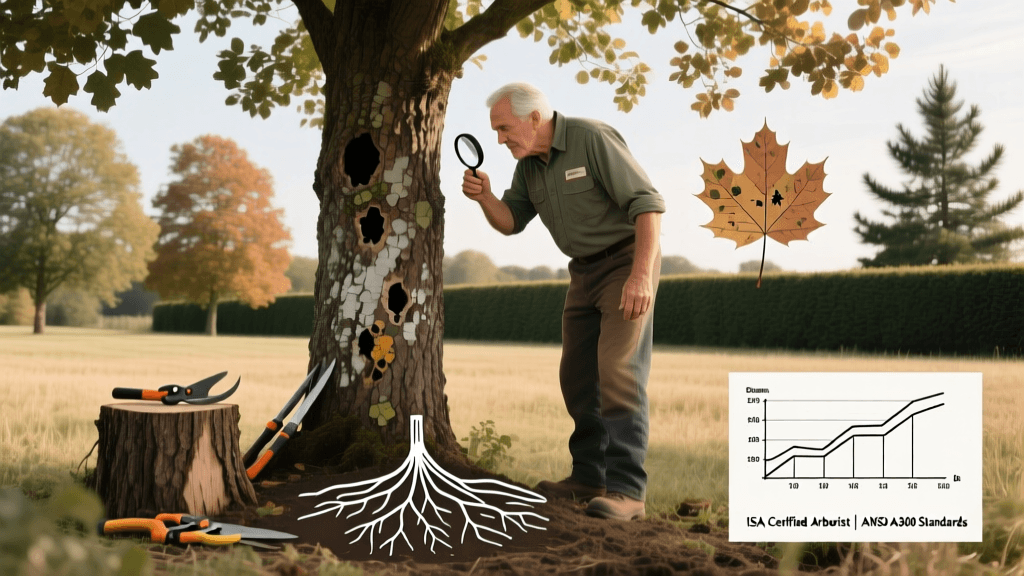
How To Identify Tree Pests And Treat Them
Recognizing the Signs of Tree Pest Infestation
Trees don’t shout when something’s wrong. They show it — quietly, in ways that become clear once you know what to watch for. Spotting trouble early makes a real difference: trees treated at the first sign of pests often recover fully, while those with visible trunk damage or major canopy loss are much harder to save. The International Society of Arboriculture (ISA, 2022) suggests checking trees visually at least twice a year — once in early spring before leaves appear, and again in late summer when many pests are most active.
Begin each inspection at the base. Look for sawdust-like frass near the root collar, small holes in the bark, or sap oozing from the trunk — all possible signs of boring insects. Then scan up the trunk for discolored or cracked bark, odd bumps or swellings, or winding trails just under the surface (galleries), which larvae leave behind as they feed. Finally, check the canopy. Thinning leaves, leaves dropping outside normal season, or foliage that looks speckled, chewed down to the veins, or tightly curled can point to different pests — and different next steps.
Foliage Symptoms and What They Indicate
Leaves with tiny pale dots scattered across the surface — often giving a speckled or bronzed look — usually mean spider mites or certain scale insects are feeding. These pests pierce leaf cells and suck out the contents, leaving empty cells that reflect light differently. On mature oaks (Quercus robur), heavy spider mite activity can cause up to 30% of the leaves to drop by mid-August, cutting into the tree’s ability to make and store energy for winter.
When only the leaf veins remain — a lacy, skeletonized appearance — chewing insects like Japanese beetles (Popillia japonica) or sawfly larvae are likely at work. They eat the tissue between the veins. A group of Japanese beetles can strip the leaves off a young linden (Tilia cordata) in under two days when temperatures are warm. If this happens two years in a row, the tree uses up its stored carbohydrates and becomes more vulnerable to fungi and other problems.
Bark and Structural Symptoms
Bark symptoms often mean the pest has already moved deep into the tree. The emerald ash borer (Agrilus planipennis), first found in Michigan in 2002, tunnels in S-shaped patterns just under the bark of North American ash species (Fraxinus spp.). By the time you see D-shaped exit holes — about 3–4 mm wide — on the outer bark, the tree usually has lost 30–50% of its canopy and may no longer be worth treating.
Small blobs of resin mixed with sawdust (pitch tubes) on pine bark suggest bark beetles are present. Species like the mountain pine beetle (Dendroctonus ponderosae) have killed trees across more than 18 million hectares in British Columbia since the late 1990s, according to the British Columbia Ministry of Forests. On a single landscape pine, pitch tubes plus yellowing needles in the upper crown call for a professional look right away.
Common Tree Pests by Host Species
Pests tend to stick to certain trees. Most have spent generations adapting to particular hosts, so knowing which pests target which species helps you focus your checks and act before numbers climb. The table below lists common pest-host pairings seen in North American and European landscapes.
| Host Tree | Primary Pest | Damage Type | Peak Activity |
|---|---|---|---|
| Ash (Fraxinus spp.) | Emerald Ash Borer | Larval galleries, girdling | June–August |
| Pine (Pinus spp.) | Mountain Pine Beetle | Phloem destruction, blue stain fungus | July–September |
| Oak (Quercus spp.) | Oak Wilt / Spongy Moth | Vascular blockage / defoliation | April–June |
| Elm (Ulmus spp.) | Elm Bark Beetle | Dutch elm disease vector | May–July |
| Hemlock (Tsuga spp.) | Hemlock Woolly Adelgid | Sap extraction, needle drop | October–June |
| Maple (Acer spp.) | Asian Longhorned Beetle | Larval boring, structural failure | July–October |
Treatment Options and Their Appropriate Use
Good pest management follows Integrated Pest Management (IPM), a method supported by the University of California Cooperative Extension and used by most certified arborists. IPM starts with the least disruptive option that still gets the job done. Chemical treatments come into play only when monitoring shows pest numbers have crossed a clear threshold.
Cultural and Mechanical Controls
Start with the basics: choose tree species and varieties known to resist local pests, space them so air moves freely and roots aren’t competing, and keep soil healthy to support strong growth. Trees growing in compacted soil or in pH ranges far from their preference are already stressed — and stressed trees attract more pests. ANSI A300 Part 6 (2012) spells out minimum soil volumes for urban trees: at least 1 cubic meter of loose, uncompacted soil for every centimeter of trunk diameter measured at breast height. That standard is often skipped in city planting projects — and tree health suffers as a result.
Mechanical options include removing and disposing of infested branches or leaves, using sticky bands around trunks to catch crawling insects, and spraying aphids or mites off small ornamental trees with a strong stream of water. Pruning out tent caterpillar egg masses or bagworm cases during winter dormancy can wipe out whole local populations before they hatch. When pruning, follow ANSI A300 Part 1 guidelines: avoid flush cuts, and cut just outside the branch collar to let the tree seal the wound naturally.
Biological Controls
Biological control uses natural enemies — predators, parasitoids, and pathogens — to keep pest numbers down. The USDA Forest Service’s Northeastern Area has released Tetrastichus planipennisi, a wasp that lays eggs inside emerald ash borer larvae, as part of its biological control effort. Field trials in Michigan and Ohio showed 20–40% of larvae were parasitized in established release areas — enough to slow population growth without chemicals.
Bacillus thuringiensis var. kurstaki (Btk) is a soil bacterium whose proteins kill moth and butterfly larvae but don’t harm people, pets, birds, or most beneficial insects. It’s the go-to treatment for spongy moth (Lymantria dispar) outbreaks on oaks and other hardwoods. It works best when applied by air or ground equipment while larvae are small — usually in their first or second stage, less than 6 mm long.
Systemic Insecticide Treatments: Protocols and Precautions
When cultural and biological methods fall short, systemic insecticides — delivered through soil injection, basal bark spray, or trunk injection — may be needed. Trunk injection places the chemical directly into the xylem, where it moves upward with the sap. This method limits exposure to the wider environment. The Arborjet TREE-äge system, used by many ISA-certified arborists in North America, delivers emamectin benzoate at a rate of 10 ml per 2.54 cm of trunk diameter. One application typically controls emerald ash borer for two to three years.
Soil-applied imidacloprid, a neonicotinoid, has been widely used against hemlock woolly adelgid in the eastern U.S. But because it can show up in pollen and nectar, many states restrict its use near streams, ponds, or wetlands. The Connecticut Agricultural Experiment Station (2019) found imidacloprid residues in hemlock pollen at levels of 1–4 ppb after soil drench applications — a reminder to weigh site-specific risks before applying.
Timing matters. Systemic treatments work best when trees are actively moving water — from bud break through mid-summer. If a tree is drought-stressed and not transpiring well, the chemical may not reach the upper branches, leaving them unprotected and wasting the product.
Post-Treatment Monitoring and Long-Term Tree Health
Treatment isn’t the finish line — it’s the start of a new round of watching and recording. After any action, set up regular inspections to check whether it worked and to catch new infestations early. For boring insects, fresh exit holes appearing 12–18 months after a trunk injection suggest the treatment didn’t hold or that nearby untreated trees reinfested the area. For leaf-eating pests, compare photos taken from the same spot over time, or use a densiometer to measure changes in canopy density.
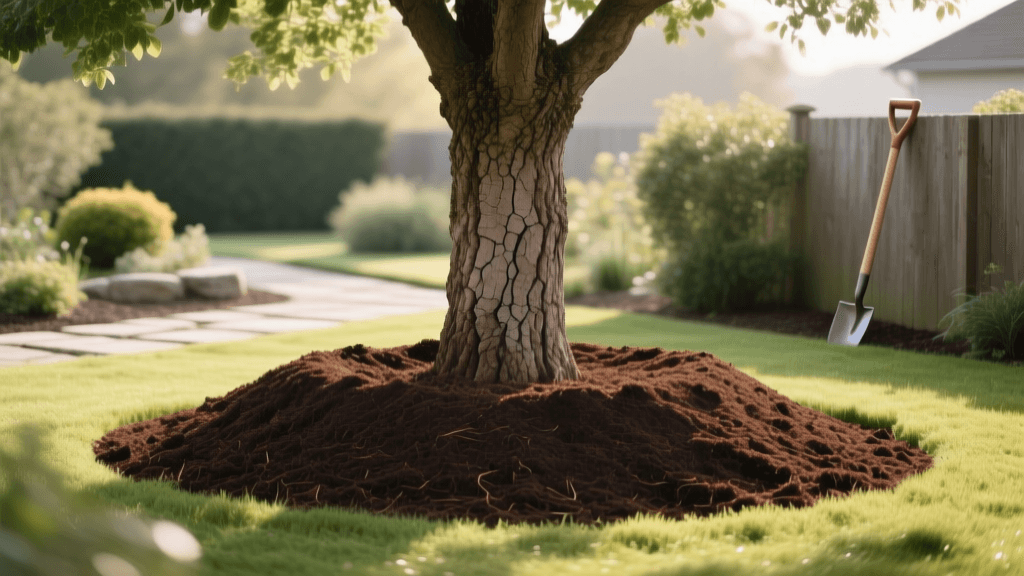
What’s happening underground affects pest resistance more than many realize. Mycorrhizal fungi form partnerships with tree roots and can extend the effective root surface area by up to 700 times — helping the tree pull in more water and nutrients. Soil compaction, mulch piled too deep, and repeated herbicide use all weaken these fungal networks. A 5–10 cm layer of organic mulch spread to the drip line — but kept 10–15 cm away from the trunk — supports healthy soil life, buffers temperature swings, and keeps mowers and string trimmers from wounding the bark.
When replacing trees or planting new ones, think ahead about pests in your area. Where emerald ash borer is established, planting more ash trees makes sense only if you’re prepared to treat them long term. Mixing in species like Kentucky coffeetree (Gymnocladus dioicus), American hornbeam (Carpinus caroliniana), or disease-resistant elms such as 'Princeton' and 'Valley Forge' spreads risk and helps keep the urban forest resilient.
- Inspect trees at least twice annually — spring and late summer — focusing on bark, foliage, and root collar.
- Document findings with dated photographs to establish a baseline and track changes over time.
- Confirm pest identification before selecting a treatment; misidentification leads to ineffective and potentially harmful interventions.
- Consult an ISA-certified arborist for any infestation involving boring insects, systemic disease, or trees with a trunk diameter exceeding 20 cm.
- Report confirmed or suspected detections of regulated pests — emerald ash borer, Asian longhorned beetle, spotted lanternfly — to your state or provincial department of agriculture.
Tree pest management rewards attention, consistency, and good notes. No single step guarantees a pest-free tree — that’s not how nature works — but regular monitoring, solid cultural care, and timely action help most landscape trees stay healthy for decades.
"A tree that is well-sited, properly planted, and maintained in accordance with ANSI A300 standards will, in most cases, resist pest colonization far more effectively than any chemical program applied to a stressed or structurally compromised specimen." — ISA Best Management Practices: Tree Risk Assessment, 2017
- Emerald ash borer: report to USDA APHIS at 1-866-322-4512 or online at emeraldashborer.info
- Asian longhorned beetle: contact the USDA Animal and Plant Health Inspection Service (APHIS) regional office
- Spotted lanternfly: report sightings to your state department of agriculture; populations have spread to 14 U.S. states as of 2023
Catching problems early and working with a qualified arborist usually costs less than removing and replacing a mature tree. A healthy street tree provides roughly $273 in benefits each year — soaking up stormwater, cutting cooling costs, cleaning the air, and boosting property values — according to the USDA Forest Service’s i-Tree tool. Protecting that value with thoughtful, evidence-based care makes practical and ecological sense.