
Landscaping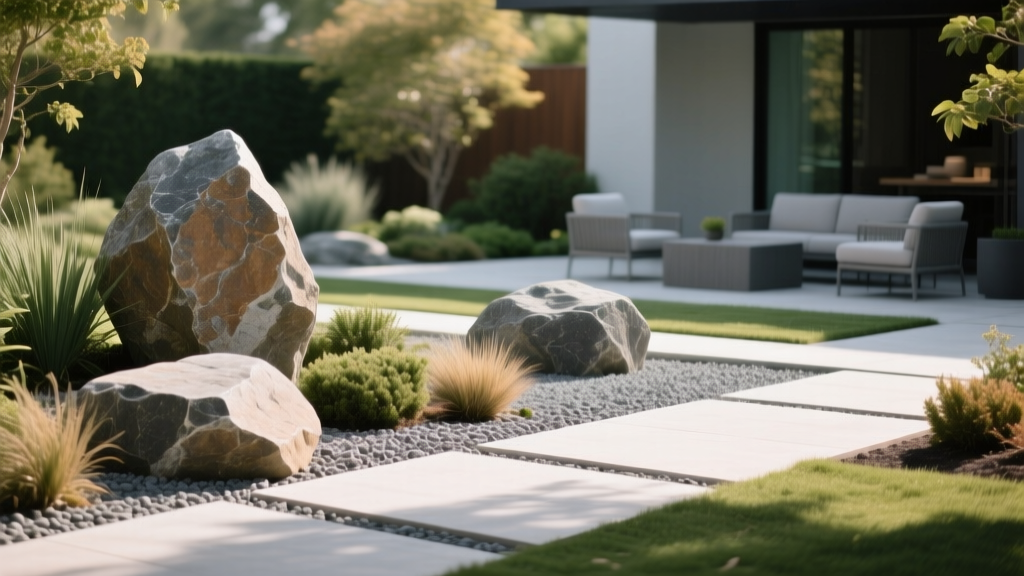
Incorporate Boulders And Rock Features In Modern Landscapes
Strategic Placement and Scale Integration
Boulders function as structural anchors in modern landscape architecture—serving both aesthetic and ecological roles. According to the American Society of Landscape Architects (ASLA) 2022 Design Guidelines, boulder placement must adhere to the principle of *visual weight distribution*, ensuring that large masses are balanced by proportional plantings or hardscape elements to avoid visual dominance. A single 36-inch diameter granite boulder, for example, should be sited within a minimum 120-square-foot zone to allow adequate spatial breathing room and prevent perceptual crowding. In practice, this means spacing boulders at least 8 feet apart when used in clusters, with each rock’s longest axis oriented toward primary sightlines—such as from a living room window or patio seating area.
Scale integration also demands attention to site topography. At the High Line in New York City, designers embedded locally sourced schist boulders into elevated planting beds at varying elevations (ranging from 24 to 48 inches above walkway level) to reinforce the linear rhythm of the structure while accommodating root zones for Salvia nemorosa ‘Caradonna’ and Panicum virgatum ‘Northwind’. This approach exemplifies ASLA’s recommendation to treat stone not as ornament but as *geologic infrastructure*—a concept reinforced in their 2021 publication on resilient urban landscapes.
Material Selection and Sourcing Considerations
Not all rocks perform equally in contemporary landscapes. Granite, basalt, and quartzite offer superior freeze-thaw resistance and low porosity—critical for climates with more than 30 annual freeze-thaw cycles. Limestone and sandstone, while visually warm, degrade faster in acidic soils (pH < 5.5) and require 25% more maintenance over a 15-year horizon, per data from the University of California Cooperative Extension (2023). Transport distance significantly impacts cost: boulders quarried within 50 miles average $180–$220 per ton, whereas those shipped over 200 miles increase to $310–$390 per ton due to fuel surcharges and specialized rigging.
Sourcing ethics matter too. The Landscape Architecture Foundation’s 2020 report emphasized traceability—encouraging specification of stones certified by the Natural Stone Council’s Sustainable Quarrying Program. At the Miller House and Garden in Columbus, Indiana, architect Philip Johnson selected Indiana limestone boulders extracted from LEED-certified quarries, reducing embodied carbon by an estimated 17% compared to conventional extraction methods.
Planting Around Boulders: Ecological Layering
Soil Preparation and Root Zone Management
Before installing boulders, excavate a minimum 18-inch-deep sub-base of compacted gravel (ASTM C33 standard) beneath each stone to prevent settling and ensure drainage. Backfill planting pockets with a 60:40 mix of native soil and compost—not universal potting mix—to support mycorrhizal networks essential for Echinacea pallida, Heuchera americana, and Sedum ternatum. These species thrive in shallow, well-drained substrates adjacent to rock faces where moisture evaporates rapidly.
Root zones must remain undisturbed: maintain a 24-inch radius clearance around boulder bases for woody plants like Cornus sericea ‘Isanti’, whose fibrous roots stabilize slopes without compromising stone integrity. For herbaceous perennials, reduce that buffer to 12 inches—allowing Asclepias tuberosa and Rudbeckia fulgida var. sullivantii ‘Goldsturm’ to colonize crevices naturally.
Seasonal Planting Sequencing
Stagger planting across three seasons to maximize establishment success:
- Fall (September–October): Install slow-establishing natives like Amelanchier laevis and Chasmanthium latifolium
- Spring (April–May): Add drought-tolerant groundcovers including Thymus vulgaris and Phlox subulata
- Early summer (June): Introduce ephemerals such as Trillium grandiflorum beneath shaded boulder overhangs
Hardscape Integration and Functional Utility
Boulders extend beyond ornamentation—they define circulation, manage stormwater, and anchor built elements. At the Chicago Botanic Garden’s Regenstein Center, boulders ranging from 2 to 5 feet in height serve dual roles: guiding pedestrian flow along ADA-compliant 48-inch-wide pathways while directing runoff into adjacent bioswales planted with Iris versicolor and Scirpus cyperinus. Each boulder was set on a 4-inch bed of crushed limestone fines to prevent shifting and allow subsurface water infiltration at rates exceeding 2.5 inches per hour.
For patios and fire pits, embed boulders partially (30–40% below grade) into concrete footings rated for 4,000 psi compressive strength. This prevents thermal expansion cracking during freeze events. A typical 30-inch-diameter boulder requires a footing depth of 24 inches in USDA Hardiness Zone 5b—verified through frost-depth mapping from the USDA Natural Resources Conservation Service (2022).
Cost Planning and Budget Allocation
Project budgets must account for delivery, placement, and long-term stewardship. Below is a representative breakdown for a mid-size residential project (450 sq ft of boulder-integrated landscape):
| Item | Quantity | Unit Cost | Total |
|---|---|---|---|
| Granite boulders (avg. 30–36”) | 6 units | $420–$580 each | $2,520–$3,480 |
| Crane rental (½-day) | 1 | $1,150 flat fee | $1,150 |
| Native plant installation (42 plants) | 42 units | $18–$24/plant | $756–$1,008 |
| Gravel sub-base (2” depth) | 1.8 cu yd | $95/cu yd | $171 |
Contingency (12%) brings total projected range to $5,220–$6,550. Note: projects exceeding 750 sq ft benefit from bulk pricing—reducing boulder unit costs by up to 9% and crane fees by 15%.
Long-term savings accrue through reduced irrigation demand. Landscapes integrating boulders with drought-adapted species use 38% less supplemental water annually than turf-dominated equivalents, according to monitoring data from the Lady Bird Johnson Wildflower Center (2023).
Maintenance Protocols and Longevity
Annual inspection is non-negotiable. Check for soil erosion around boulder bases—especially after >2-inch rainfall events—and replenish mulch layers to maintain a consistent 2-inch depth of shredded hardwood. Avoid high-pressure washing; instead, use soft-bristle brushes and pH-neutral cleaners to remove lichen buildup without damaging mineral surfaces.
Pruning protocols differ by proximity: keep shrubs like Viburnum lentago pruned to a 36-inch canopy radius from boulder edges to preserve air circulation and inhibit fungal growth on shaded rock faces. Perennials require biannual division—every 3 years for Eutrochium fistulosum and every 4 years for Liatris spicata—to prevent overcrowding and root competition.
Structural integrity assessments should occur every 7 years, focusing on settlement indicators such as visible gaps (>¼ inch) between boulder and adjacent hardscape or tilting exceeding 3 degrees from vertical—measured using a digital inclinometer calibrated to NIST standards.
When executed with fidelity to ecological function and design intention, boulder integration transcends trend—it becomes permanent infrastructure. As stated in the ASLA 2022 Climate Action Plan, “Stone, properly placed and ecologically contextualized, is one of the most enduring tools we possess for building climate-resilient public and private landscapes.” At the University of Guelph’s Arboretum, boulders installed in 1998 continue to support mature stands of Acer saccharum and Quercus rubra, demonstrating that thoughtful material selection and planting synergy yield measurable longevity far beyond initial investment horizons.

