Lawn Care
How To Level An Uneven Lawn
Reading Your Lawn Before You Start
An uneven lawn is more than an eyesore. Low spots collect standing water that suffocates grass roots and breeds mosquitoes, while high spots dry out faster than surrounding turf and get scalped under the mower blade. Before you move a single shovelful of soil, walk the lawn after a rain and flag problem areas with marking paint or small stakes. Note whether depressions are shallow (under half an inch), moderate (half an inch to two inches), or severe (over two inches), because each depth range calls for a different correction method.
Soil type matters too. Clay-heavy soils in the Southeast compact easily and heave during freeze-thaw cycles, while sandy soils in coastal regions erode and settle unevenly. A basic soil test from your local cooperative extension office — available for roughly $15 to $20 through services like the North Carolina State University Soil Testing Laboratory or the University of Massachusetts Soil and Plant Tissue Testing Laboratory — will tell you pH, organic matter percentage, and texture class, all of which influence how you approach leveling and what topdressing mix you should use.
Topdressing: The Core Technique for Shallow Depressions
For depressions shallower than half an inch, topdressing is the least disruptive fix. The process involves spreading a thin layer of a sand-soil-compost blend over the low area, working it into the existing turf canopy so grass blades remain exposed to sunlight. Done correctly, the grass grows up through the material within two to three weeks and the surface gradually rises to match the surrounding grade.
Choosing the Right Topdressing Mix
The ideal topdressing blend depends on your existing soil. The Penn State Center for Turfgrass Science recommends matching the particle size distribution of your topdressing material to the native soil to avoid creating a layered profile that impedes drainage. A common starting point is a mix of 70% coarse sand, 15% topsoil, and 15% compost by volume. Avoid using straight topsoil from a garden center, which is often too fine-textured and will compact into a hard layer that roots struggle to penetrate.
For warm-season grasses like Bermudagrass (Cynodon dactylon) or Zoysiagrass (Zoysia japonica), a slightly sandier mix — up to 80% coarse sand — works well because these species spread aggressively through stolons and rhizomes and can push through a denser material. Cool-season grasses like Tall Fescue (Festuca arundinacea) or Kentucky Bluegrass (Poa pratensis) benefit from a higher organic matter content, around 20% compost, to support the deeper root systems they develop in fall.
Application Rate and Timing
Apply topdressing at no more than half an inch per application. Deeper single applications smother grass and create the very dead patches you are trying to eliminate. If a depression requires more than half an inch of correction, plan for two or three applications spaced four to six weeks apart, allowing the grass to fully recover between treatments.
Timing matters. Apply topdressing during the active growing season so the grass can grow through the material quickly. For cool-season grasses, the windows are late August through October and again in April through early May. For warm-season grasses, late spring through midsummer — when soil temperatures are consistently above 65°F — gives the best results. Avoid topdressing during drought stress or extreme heat, when grass is already struggling.
- Spread the mix with a shovel or drop spreader, then use the back of a landscape rake to work it into the turf canopy.
- Drag a stiff push broom across the area to settle material around individual grass blades.
- Water lightly immediately after application to help the material settle and make contact with the soil below.
- Avoid mowing the treated area for at least seven days to let the grass recover and begin growing through the topdressing.
Fixing Moderate Depressions: The Cut-and-Fill Method
Depressions between half an inch and two inches deep require more intervention than simple topdressing. The cut-and-fill method — sometimes called the sod-lift technique — involves cutting the existing turf, folding it back, adding fill material to the exposed soil, and then replacing the sod. This approach preserves the existing grass and avoids the cost and establishment time of reseeding or laying new sod.
Use a flat spade or a sod cutter to make cuts around the perimeter of the depression, then slice horizontally just below the root zone — typically two to three inches deep for most lawn grasses. Fold the sod back like a flap, add your fill material (a mix of native soil and compost works well here), tamp it firm, and replace the sod. Water deeply — at least one inch — immediately after, and keep the area consistently moist for two weeks while the roots re-establish.
Fill Material Considerations
The fill material you add beneath the sod should match the existing soil as closely as possible. If you are working in a region with heavy clay, amend the fill with coarse sand at a ratio of roughly 3 parts clay soil to 1 part coarse sand to improve drainage without creating a sharp textural interface. Research published by the Turfgrass Science program at Rutgers University (2019) found that abrupt textural changes between fill layers and native soil can create perched water tables that keep roots saturated even when the surface appears dry.
Avoid using straight compost as fill beneath sod. Compost continues to decompose after placement, which means the area will settle again over the following months, recreating the depression you just fixed. Use compost as an amendment mixed into native soil, not as a standalone fill.
Addressing Severe Depressions and Grade Problems
Depressions deeper than two inches, or areas where the overall grade slopes toward the house foundation, require more substantial work. In these cases, you may need to remove the existing turf entirely, regrade the soil, and then either reseed or re-sod the area.
Proper grading means establishing a slope of at least 2% away from structures — that is, a two-inch drop for every ten feet of horizontal distance. This is the minimum recommended by most building codes and drainage guidelines to prevent water from pooling against foundations. Use a long straightedge or a laser level to check your grade before replacing any turf.
When regrading large areas, rent a plate compactor to firm the soil after adding fill. Loose, uncompacted fill will settle unevenly over the first year, creating new low spots. Compact in lifts of no more than four inches, and water lightly between lifts to help the soil consolidate.
"Soil settlement after grading is one of the most common reasons homeowners see recurring low spots in their lawns. Proper compaction during the fill process, combined with a waiting period of at least two to four weeks before seeding or sodding, significantly reduces post-installation settling." — University of Georgia Cooperative Extension, Lawn Establishment and Renovation Guide, 2021
Reseeding or Sodding After Leveling
Once the grade is established and the soil is firm, you need to re-establish turf. The choice between seeding and sodding depends on your budget, the time of year, and how quickly you need a functional lawn surface.
Seeding is less expensive — quality tall fescue seed runs roughly $4 to $6 per pound, and a typical lawn repair requires about 6 to 8 pounds per 1,000 square feet for bare-soil areas — but it requires more careful timing and consistent moisture management during germination. Sodding costs more upfront, typically $0.35 to $0.85 per square foot installed, but gives you an immediately functional surface and is more forgiving of minor timing errors.
For seeded areas, apply a starter fertilizer at the time of seeding. Products like Scotts Turf Builder Starter Food for New Grass (12-22-8 analysis) applied at 3.5 pounds per 1,000 square feet provide the phosphorus needed for root development without the high nitrogen levels that can burn young seedlings. Water lightly two to three times per day to keep the seed bed moist until germination, then transition to deeper, less frequent irrigation as the seedlings establish.
| Depression Depth | Recommended Method | Best Timing (Cool-Season) | Best Timing (Warm-Season) |
|---|---|---|---|
| Under 0.5 inches | Topdressing | Sept–Oct or Apr–May | May–July |
| 0.5–2 inches | Cut-and-fill (sod lift) | Aug–Oct or Apr–May | May–Aug |
| Over 2 inches | Full regrade + reseed/sod | Late Aug–Sept | Late May–June |
| Slope toward structure | Regrade + drainage correction | Any active growing period | Any active growing period |
Long-Term Maintenance to Prevent Recurrence
Leveling a lawn is not a one-time fix if the underlying causes are not addressed. Thatch buildup, soil compaction, tree root activity, and poor drainage will recreate uneven surfaces over time. Building a maintenance routine that addresses these factors helps keep your lawn level year after year.
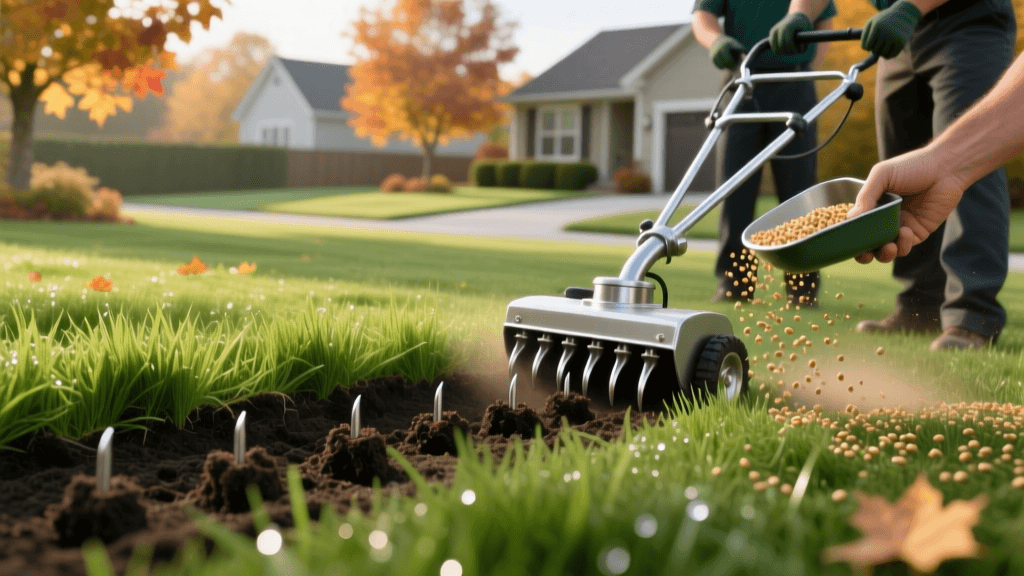
Core aeration is one of the most effective tools for preventing compaction-related settling. Aerating annually in the fall for cool-season grasses, or in late spring for warm-season grasses, pulls plugs of soil roughly half an inch in diameter and two to three inches deep, relieving compaction and improving water infiltration. Follow aeration with a light topdressing application — a quarter inch of your sand-compost blend — to gradually improve soil structure over multiple seasons. According to the Turfgrass Science program at Rutgers University, repeated aeration and topdressing over three to five years can measurably improve the drainage and levelness of compacted home lawns.
Mowing height also plays a role. Scalping — cutting grass too short — weakens root systems and makes turf more susceptible to the kind of thinning and die-off that leads to uneven settling. Keep cool-season grasses at 3 to 4 inches during the growing season, and warm-season grasses at 1.5 to 2.5 inches depending on species. Never remove more than one-third of the blade height in a single mowing.
- Test soil pH annually and maintain it between 6.0 and 7.0 for most lawn grasses. Lime applications of 50 pounds per 1,000 square feet can raise pH by roughly half a unit in clay soils.
- Dethatch when thatch layer exceeds half an inch, using a power rake or vertical mower set to cut just into the thatch layer without disturbing the soil.
- Address drainage issues at the source — downspout extensions, French drains, or dry creek beds — rather than repeatedly filling low spots that will return as long as water continues to pool.
- Overseed thin areas each fall (cool-season) or late spring (warm-season) to maintain dense turf coverage that resists erosion and settling.
Consistent fertilization supports the dense, vigorous turf that holds soil in place and recovers quickly from leveling work. A soil-test-based program is always preferable to a generic schedule, but a reasonable baseline for cool-season grasses is 3 to 4 pounds of actual nitrogen per 1,000 square feet per year, split across fall applications. Warm-season grasses typically need 2 to 4 pounds of actual nitrogen per 1,000 square feet per year, applied during the active growing season from late spring through midsummer. Products like Milorganite (6-4-0, slow-release organic) at 32 pounds per 1,000 square feet provide a gentle, low-burn option suitable for use on recently leveled areas where new roots are still establishing.
Patience is part of the process. A severely uneven lawn rarely becomes perfectly flat in a single season. Plan for two to three years of consistent aeration, topdressing, and attentive mowing before judging the final result. The investment pays off in a surface that drains properly, mows cleanly, and stays healthy through drought and heavy rain alike.