Lawn Care
How To Prevent And Remove Moss In Cool Damp Lawns
Understanding Moss as a Symptom, Not the Problem
Moss in cool, damp lawns—especially across the Pacific Northwest, New England, and the UK’s upland regions—usually shows up where grasses are already struggling: in compacted, acidic, poorly drained, or heavily shaded soils with low fertility. Oregon State University Extension found that moss often appears when soil pH drops below 5.5 and organic matter in the top 4 inches climbs above 8% by weight (OSU Extension, 2021). Unlike grasses, moss doesn’t have true roots, vascular tissue, or stomata. It takes up water and nutrients straight through its leaves, so it handles low-nutrient, high-moisture conditions better than most turfgrasses. That’s why it starts filling in thin spots of fine fescue or Kentucky bluegrass long before most people notice something’s off with their lawn.
Soil Testing and pH Correction: The Foundational Step
Run a soil test before trying any moss control product. Penn State Extension suggests testing every 2–3 years, especially if moss keeps coming back. A typical result for these lawns shows pH between 4.8 and 5.3, aluminum saturation over 15%, and phosphorus under 10 ppm (Penn State Extension, 2022). To raise pH, use calcitic limestone (CaCO₃): for loam soil at pH 5.0, apply 50 lb per 1,000 ft² in early spring or fall. Skip dolomitic lime unless a test confirms magnesium is low—too much magnesium can interfere with potassium uptake in fine fescues. Check the soil again after 90 days; aim for pH 6.2–6.5 if you’re growing Kentucky bluegrass (Poa pratensis) or perennial ryegrass (Lolium perenne).
Timing Liming Applications
- Best window: Mid-October to mid-November in USDA Zones 5–7—this avoids summer heat and lines up with peak earthworm activity, which helps mix the lime into the soil.
- Don’t lime within 3 weeks of seeding fine fescue (Festuca rubra spp.)—higher pH slows germination.
- Never mix lime with ammonium sulfate fertilizers—the reaction releases ammonia gas.
Mechanical and Cultural Remediation Strategies
Core aeration helps more than almost anything else for moss-prone lawns. Use a machine with tines spaced no more than 2 inches apart, pulling plugs 3 inches deep and 0.75 inches wide. Try to get 20–25 holes per square foot. Do this in early September across the Midwest and late April in coastal British Columbia—timing matches when Kentucky bluegrass is actively tillering and crabgrass isn’t yet competing.
After aeration, spread ¼ inch of sieved topsoil blended with compost (C:N ratio around 12:1) to improve surface drainage without burying the grass crowns.
Mowing height makes a real difference. Keep Kentucky bluegrass at 2.5–3.5 inches all year—don’t go below 2 inches, even in summer. For creeping red fescue (Festuca rubra var. rubra), try 3–4 inches to encourage sideways growth and catch more light. Michigan State University Turfgrass Institute tested this: raising mowing height from 1.5" to 3" cut moss cover by 68% over two growing seasons in shaded, compacted plots (MSU TGI, 2020).
Fertilization Protocols for Moss Resistance
Use nitrogen carefully—not heavily. Cool-season grasses need 2.5–3.5 lb N per 1,000 ft² each year, split three ways: 1.0 lb in early September, 1.0 lb in late October (use slow-release ureaformaldehyde), and 0.5–1.0 lb in May. Skip high-soluble nitrogen in spring—it pushes soft, disease-prone growth and drains root reserves. Only add phosphorus if your soil test says it’s truly low (<5 ppm); extra P won’t stop moss and can wash into nearby waterways and feed algae. Potassium matters: apply 1.5 lb K₂O per 1,000 ft² in fall using potassium sulfate (0-0-50) to strengthen cell walls and help with dry spells.
Targeted Moss Control Products and Application Protocols
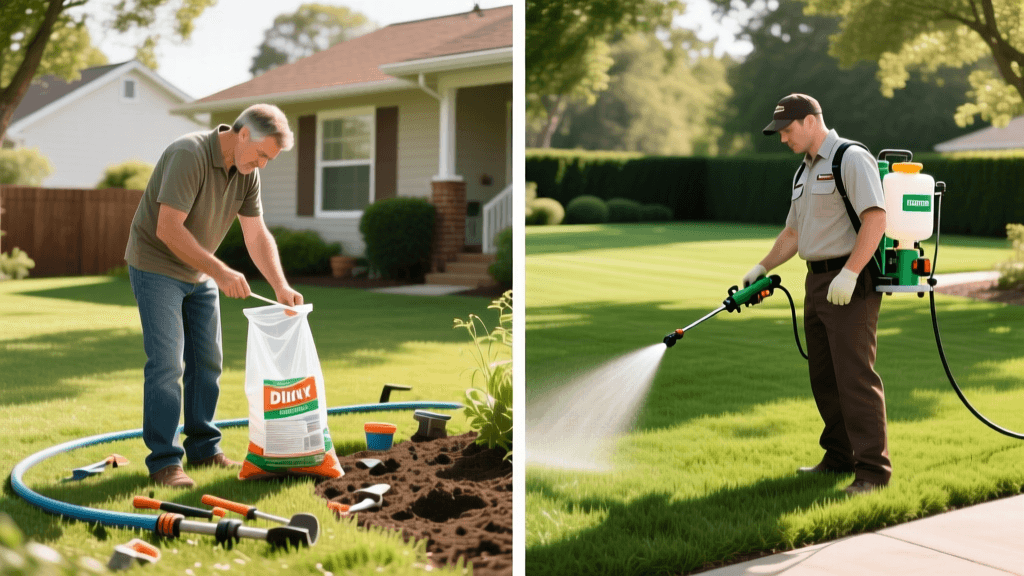
If moss sticks around after fixing soil, drainage, and mowing, contact herbicides can help—but only as one part of the plan. Ferrous sulfate (FeSO₄·7H₂O) still works best and has fewer environmental trade-offs. Mix at 3 oz per gallon of water (about 3.5 lb per 1,000 ft²) and spray with a calibrated backpack sprayer. Best done on dry, calm mornings when temps are 50–70°F and no rain is expected for 48 hours. Moss turns black in 48–72 hours; rake it out 5–7 days later. Repeat only if more than 15% of the area greens back up—too much iron can harm grass roots and make soil more acidic.
Potassium salts of fatty acids (like Safer Brand Moss & Algae Killer) are gentler options near water features. Mix at 6 fl oz per gallon (1.25 qt per acre) and reapply every 14 days until moss fades. This product doesn’t linger, so coverage has to be thorough. Keep it at least 10 feet away from koi ponds—the surfactants can damage gills.
Long-Term Lawn Resilience Through Species Selection
Reseed areas where moss covers more than 30% of the ground. Pick grasses that match your local conditions:
- Shaded, acidic sites (pH <5.8): Chewings fescue (Festuca rubra subsp. commutata) and hard fescue (Festuca longifolia)—both handle pH down to 5.2 and need just 1.0–1.5 lb N per 1,000 ft² per year.
- High-traffic, clay soils: Kentucky bluegrass cultivars ‘Midnight’ and ‘Prosperity’—tested at the University of Minnesota Turfgrass Research Center for dense rhizomes and tolerance to compaction.
- Coastal fog zones (e.g., Portland, OR): Perennial ryegrass blend ‘Barrage’ + ‘Inspire’—held back 92% of moss in OSU trials under 70% shade and 45 inches of rain yearly.
Overseed at 6–8 lb per 1,000 ft² in early fall using a slit-seeder set to 0.25-inch depth. Keep the seedbed moist—not soaked—for 14 days, using micro-sprinklers that deliver 0.1 inch per session, twice daily. Stay off the area for 21 days.
Irrigation Adjustments for Moss Suppression
Water deeply and less often—not shallowly and every day. Cool-season lawns need 1.0–1.25 inches per week total (including rain), applied in one or two sessions. Use a rain gauge: place three across the lawn, average the readings, and adjust sprinkler time based on that. In Seattle, where summer rain averages 1.8 inches per month, hold off watering until after four dry days—and then give the full weekly amount in one morning session between 4–8 a.m. That cuts down on how long grass stays wet. Cornell University found cutting leaf wetness from over 12 hours a day to under 6 hours dropped moss establishment by 83% (Cornell Cooperative Extension, 2019).
“Moss doesn’t invade healthy lawns—it colonizes failures of management. Every square foot of moss is a diagnostic clue about soil structure, light, fertility, or moisture.” — Dr. Becky Griffin, University of Georgia Cooperative Extension, 2021
Monitoring Progress and Adjusting Management
Check moss coverage every three months using a 1-ft² quadrat frame placed randomly in 10 spots. Note percent cover and what else is going on: puddles after rain, thatch thicker than 0.5 inch, or tree canopy density measured with a spherical densiometer (over 80% closure means pruning may help). Keep a log for at least 18 months. If moss comes back in the same spot even after fixing pH and aerating, look for drainage problems underground—French drains or redirected downspouts may be needed.
Check thatch depth once a year. Cut a 2-inch wedge with a sharp knife and measure the brown, spongy layer between green growth and soil. If it’s over 0.5 inch, power-rake in early September at 0.25-inch depth, then overseed right away. Don’t dethatch Kentucky bluegrass in spring—it messes with rhizome recovery.
If shade is the main issue, try selective pruning instead of switching grasses. Take off no more than 25% of live canopy in one year, focusing on lower limbs and crossing branches. In cities like Boston or Vancouver, hire an ISA-certified arborist to prune mature oaks or maples safely.
Test for soil compaction with a penetrometer: push it in at 12 random points. Readings over 300 psi at 3 inches deep mean serious compaction—plan to aerate yearly. Retest every 12 months to see if it’s improving.
Time fertilizer applications using growing degree days (GDD). In Madison, WI, put down the first nitrogen dose when GDD base 32°F hits 250 (usually mid-April), and the fall dose at GDD 2,800 (mid-October). This keeps nitrogen on track with grass growth and cuts leaching.
Log mowing frequency and height each month. Grass needing cutting more than once every 5 days in spring may mean too much nitrogen or not enough potassium. If it goes a whole month without needing a cut in summer, check for drought stress or grubs—a soap flush test will tell.
Before watering, use a digital soil moisture meter at 4-inch depth. For loam soils, water only when readings drop below 25% volumetric water content (VWC).
| Grass Species | Optimal pH Range | Min. Mowing Height (in) | N Requirement (lb/1000 ft²/yr) | Key Moss-Resistance Trait |
|---|---|---|---|---|
| Kentucky bluegrass | 6.0–7.0 | 2.5 | 3.0 | Rhizomatous spread seals bare patches |
| Chewings fescue | 5.2–6.5 | 3.0 | 1.5 | Deep, drought-tolerant roots |
| Perennial ryegrass | 5.8–7.2 | 2.0 | 4.0 | Rapid germination (5–7 days) outcompetes moss |
Finally, don’t treat moss like a stain to scrub off. When it keeps returning, it’s telling you something deeper is out of balance. Fix soil chemistry, drainage, light, and grass choice—with real numbers and local experience guiding each step—and you’ll build turf that holds up, season after season.