Lawn Care
How To Prevent And Treat Leaf Spot Disease In Ryegrass
Understanding Leaf Spot Disease in Ryegrass
Leaf spot disease—mainly caused by the fungi Pyrenophora teres (net blotch) and Bipolaris sorokiniana (common leaf spot)—shows up regularly on cool-season lawns with perennial ryegrass (Lolium perenne) or annual ryegrass (Lolium multiflorum). These grasses are common across the Midwest, Pacific Northwest, and Northeast U.S. because they establish quickly and handle foot traffic well—but they’re also prone to leaf spot when leaves stay wet for long stretches and temperatures stay moderate. You’ll first notice small, dark brown to purple-tinged oval spots on the leaf blades, often surrounded by yellow edges. If left alone, those spots can run together, forming dead streaks and eventually killing off whole leaves. In bad outbreaks, the turf starts thinning within 7–10 days of the first spots appearing, especially when conditions favor the fungus.
Environmental Triggers and Seasonal Timing
Leaf spot spreads most easily when nighttime temperatures sit between 60–75°F (15–24°C) and humidity stays above 85% for more than 10 hours a day. In the Pacific Northwest, it’s worst from late April through early June and again in September. In the Midwest—including at Ohio State University’s Turfgrass Research Farm in Wooster—it peaks in May and October, when dew builds up frequently and light rain pops up often. University of Minnesota Extension found that outbreaks become much more likely when leaf surfaces stay wet for over 30 hours per week for three weeks straight (UMN Extension, 2022).
Mowing Practices That Reduce Risk
Mowing height matters. Keep perennial ryegrass at 2.0–3.0 inches all year—don’t drop below 1.5 inches. Cutting too short stresses the plants, cuts down photosynthesis, and encourages thatch buildup, where fungi can hang out over winter. Mow every 5–7 days during active growth, and never take off more than one-third of the leaf blade at once. Use sharp, clean blades: dull ones tear the leaf edges, giving fungi an easy way in. During outbreaks, wipe down mower decks weekly with a 10% bleach solution or 70% isopropyl alcohol.
Fertilization Strategies for Disease Suppression
Watch your nitrogen. Too much fast-acting nitrogen—like quick-release urea—pushes soft, leafy growth that’s easy for the fungus to infect. Stick to no more than 0.5 lb N per 1,000 sq ft per application in spring and fall. Slow-release options like sulfur-coated urea (SCU) or polymer-coated urea work better—for example, Scotts Turf Builder WinterGuard (22-3-14), applied at 1.5 lbs product/1,000 sq ft to deliver about 0.33 lb N. Potassium helps strengthen cell walls: aim for soil K levels of at least 120 ppm (measured with Mehlich-3 extraction). A fall application of potassium sulfate (00-00-50) at 1.0 lb K₂O/1,000 sq ft in early September can help the grass handle cold and disease better.
Watering Protocols to Minimize Leaf Wetness
When and how much you water makes a real difference. Water only between 4:00–8:00 a.m., so the grass has time to dry before nightfall. Skip overhead watering after 2:00 p.m. During high-risk months (May–June and September), keep total weekly water—including rain—to 1.0–1.25 inches, delivered in one deep soak instead of several light sprinklings. Use a rain gauge or smart controller (like the Rachio 3 with local weather data) to track how much actually falls. At Cornell University’s Long Island Horticultural Research & Extension Center in Riverhead, NY, shifting irrigation from 8:00 p.m. to 5:30 a.m. cut leaf spot cases by 62% (Cornell Cooperative Extension, 2021).
Fungicide Applications: When and How to Use Them
Fungicides aren’t needed unless you’ve confirmed active disease—not as a routine step—unless you’re managing high-value areas like athletic fields or golf course roughs. Start checking your lawn weekly in mid-April. Spray only when more than 15% of leaf blades show fresh, spreading lesions. Rotate fungicide types to slow resistance:
- Group 11 (QoI): Azoxystrobin (Heritage TL), applied at 1.5–2.0 fl oz/1,000 sq ft every 14–21 days
- Group 3 (DMI): Propiconazole (Banner MAXX II), applied at 0.5–0.75 fl oz/1,000 sq ft every 21 days
- Group 7 (SDHI): Fluxapyroxad (Posterity XT), applied at 1.0–1.3 fl oz/1,000 sq ft every 28 days
Always add a non-ionic surfactant (like Kinetic at 0.125% v/v) to help the spray stick. Don’t mix fungicides with broadleaf herbicides while leaf spot is active—adding that stress tends to make things worse. For organic options, copper hydroxide (Blue Shield OH) can be used at 2.0–4.0 lbs/acre (≈0.05–0.10 lbs/1,000 sq ft) every 7–10 days, though it doesn’t hold up as well as synthetic options.
Cultural and Biological Support Systems
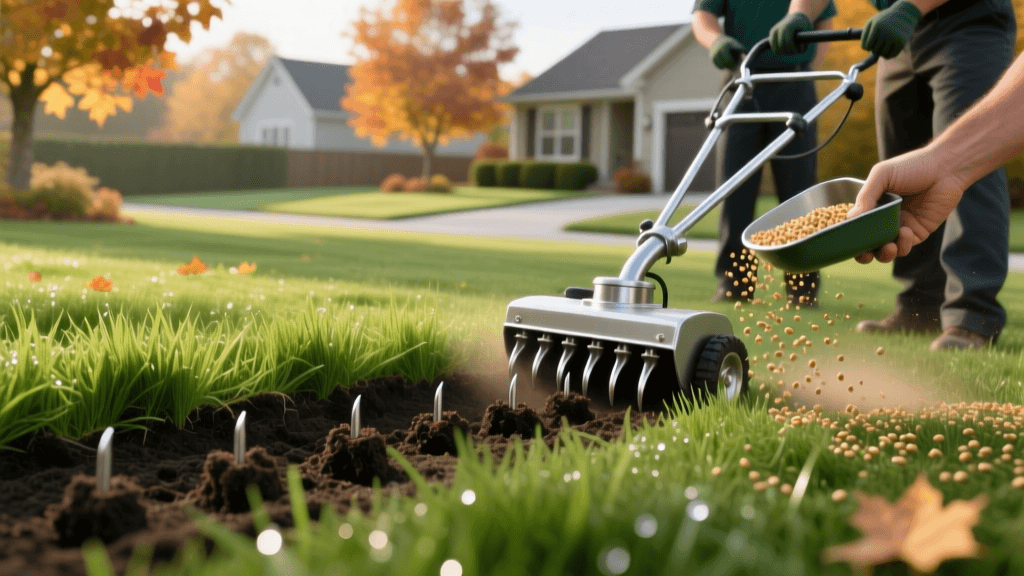
Healthy soil supports healthier grass over time. Core aerate once a year in early fall (September in Zone 5–6) to ease compaction and improve drainage—aim for 20–30 holes per square foot using 0.5-inch tines spaced 2–3 inches apart. Fill in thin patches with certified disease-resistant perennial ryegrass varieties like ‘SR 9500’, ‘Intense’, or ‘Rebound’. All three scored ≤10% leaf spot severity in USDA-ARS National Turfgrass Evaluation Program trials (2020–2023). After aeration, spread a ¼-inch layer of compost to bring in helpful microbes like Trichoderma harzianum, which can help keep pathogens in check.
Monitoring and Threshold-Based Intervention
Use a consistent method: pick 10 random spots per 5,000 sq ft, look at 20 leaves at each, and count how many have active lesions (larger than 3 mm, with water-soaked edges). Here’s what the numbers mean:
- 0–5% infected leaves: Keep watching weekly; tweak mowing or watering if needed
- 6–14% infected leaves: Refine cultural practices; add potassium sulfate
- ≥15% infected leaves: Start a fungicide program with class rotation
Keep notes on date, temperature, rainfall, mowing height, and any fungicides used. That kind of record helps you make calls based on what’s happening in your yard—not just general advice—and lines up with recommendations from Rutgers University’s Turfgrass Program in New Brunswick, NJ.
Regional Considerations and Soil Testing
Soil pH affects how well nutrients move into the plant and how microbes behave. Perennial ryegrass does best when pH sits between 6.0–7.0. In acidic soils—like those across Georgia’s Coastal Plain—lime may help. Calcitic limestone at 50 lbs/1,000 sq ft raises pH by about 0.5 units. Test your soil every two years through your state extension lab—for instance, the University of Wisconsin–Madison Soil and Plant Analysis Lab. Their 2023 regional survey found that 68% of ryegrass lawns with repeat leaf spot problems had low potassium (<100 ppm) and high phosphorus (>50 ppm), which blocks potassium uptake.
“Fungicides alone cannot compensate for poor mowing, improper irrigation, or imbalanced fertility. Integrated management starts with reading the lawn—not the label.” — Dr. James Murphy, Professor of Turf Pathology, Rutgers University (2023)
Resistant cultivars cut disease pressure by up to 40% compared to susceptible ones under the same conditions (USDA-ARS NTEP, 2022). Pair that genetic edge with smart watering, proper mowing, balanced feeding, and fungicides only when thresholds are crossed. This approach dropped average fungicide sprays by 2.3 per season across 120 residential lawns tracked by Ohio State University Extension from 2019–2023.
Avoid walking on infected turf when it’s wet with dew or rain—spores hitch rides on shoes and equipment. After working in affected areas, clean mowers, spreaders, and footwear with a 10% bleach solution. Don’t toss infected clippings in your backyard compost pile; send them to municipal green-waste collection instead.
Perennial ryegrass usually bounces back from leaf spot within 14–21 days once watering and fertilizing are corrected. But if the grass gets hit repeatedly without time to recover, it burns through stored energy, making it more likely to suffer winter drying or summer heat damage. Focus on root-zone health: keep soil organic matter at or above 3%, aim for infiltration rates over 1.0 inch/hour, and avoid extreme pH levels.
In short, prevention means breaking up the disease triangle: host susceptibility (choose resistant varieties), pathogen presence (clean gear, use resistant seed), and environment (manage moisture and airflow). Watch your lawn closely, act based on what you see—not assumptions—and follow university-tested rates instead of max label rates for lasting control.
| Practice | Optimal Specification | Consequence of Deviation |
|---|---|---|
| Mowing height | 2.5 inches (perennial ryegrass) | Below 1.75 inches increases lesion count by 220% (OSU Wooster, 2021) |
| Irrigation window | 4:00–7:00 a.m. | Evening irrigation extends leaf wetness by 6.8 hours avg. (Cornell, 2021) |
| Spring N rate | 0.4–0.5 lb N/1,000 sq ft | 1.0+ lb N increases disease severity index by 3.2 points (UMN, 2022) |
For advice tailored to your area, contact your local Cooperative Extension Service—like the University of California Cooperative Extension in Davis, CA, or Penn State Extension in University Park, PA—or check peer-reviewed resources like “Managing Turfgrass Diseases in the Northern U.S.” (Rutgers Turf Program, 2023). What works in Portland might not work in Pittsburgh—soil type, microclimate, and local pathogen strains all play a part.