Lawn Care
How To Reduce Thatch Buildup In Cool Season Lawns
Understanding Thatch in Cool-Season Turfgrasses
Thatch is a tightly interwoven layer of living and dead organic matter—stems, stolons, rhizomes, and roots—that builds up between the green grass and the soil surface. In cool-season lawns, a thatch layer thicker than ½ inch can slow water movement, limit air flow, create conditions that favor fungal diseases like *Rhizoctonia solani*, and make fertilizers and pesticides less effective. Warm-season grasses often handle up to 1 inch of thatch without trouble, but cool-season types—Kentucky bluegrass (Poa pratensis), perennial ryegrass (Lolium perenne), and fine fescues (Festuca spp.)—start showing problems when thatch passes 0.375 inches (Cornell University Cooperative Extension, 2021).
Mowing Practices That Minimize Thatch Accumulation
Mowing frequency and height play a big part in keeping thatch in check. During active growth, cool-season grasses do best at 2.5–3.5 inches. Cutting shorter than 2 inches stresses the plants, weakens roots, and pushes more stem and stolon growth—which feeds thatch buildup. Penn State’s Turfgrass Program found Kentucky bluegrass mowed at 3 inches built up 28% less thatch over 12 months than plots cut at 1.5 inches.
Clippings and Mulching
Leaving clippings behind doesn’t cause thatch. They’re mostly water and nutrients, and break down quickly if you mow regularly. But if you wait too long and end up with clippings longer than 1.5 inches, they can clump and stall decomposition for a while. To keep things moving:
- Mow every 5–7 days during peak spring growth (April–June in the Midwest)
- Sharpen mower blades every 8–10 hours of use—dull blades tear grass and may trigger more lignin production
- Use mulching mowers with properly adjusted baffles so clippings get chopped fine and spread evenly
Timing and Frequency by Region
In northern Illinois, where Kentucky bluegrass is common on residential lawns, mowing usually starts in early April and runs through October. May brings fast growth, so mowing every 4–5 days helps hold height and keeps stems from stretching. Fine fescue lawns along the Oregon coast grow slower, so mowing every 7–10 days is often enough—but they still need to stay at least 3 inches tall to support healthy microbial activity where thatch meets soil.
Fertilization Strategies to Limit Thatch Development
Too much fertilizer—especially quick-release nitrogen—is one of the main reasons thatch piles up. Extra nitrogen pushes top growth without matching root development or boosting the microbes that break down residue. The University of Minnesota Extension suggests no more than 1.0 pound of actual nitrogen per 1,000 square feet in spring (late April to early May) and 1.5 pounds in fall (early September). Slow-release sources like sulfur-coated urea—such as Scotts Turf Builder WinterGuard (22-0-14), applied at 1.8 lbs N/1,000 ft²—support steady growth without sharp spikes in organic debris.
Only add phosphorus if your soil test shows it’s low—usually below 15 ppm Bray-1 extractable P. Too much phosphorus can hold back the soil microbes that help decompose thatch. Potassium, like potassium sulfate applied at 0.5 lb K₂O/1,000 ft² in late summer, helps strengthen cell walls and improves drought tolerance, which in turn reduces stress-related thatch buildup.
Watering Techniques That Support Thatch Decomposition
How you water affects microbial activity in the thatch layer. Light, frequent watering encourages shallow roots and slows aerobic breakdown. Deep, infrequent watering supports deeper roots and keeps moisture levels steady enough for microbes to work. In Wisconsin, perennial ryegrass lawns that got 1.0–1.25 inches of water per week—applied in one or two sessions—built up 32% less thatch over two growing seasons than those watered daily with 0.25 inches (University of Wisconsin–Madison Turfgrass Science, 2020).
Watering early in the morning (4:00–8:00 a.m.) cuts down how long grass stays wet, lowering the chance of leaf diseases that weaken plants and throw off residue breakdown. Soil moisture sensors placed 2 inches deep help time irrigation right; readings above 25% volumetric water content in the upper soil usually mean there’s enough moisture for microbes without oversaturating.
Mechanical and Biological Thatch Management
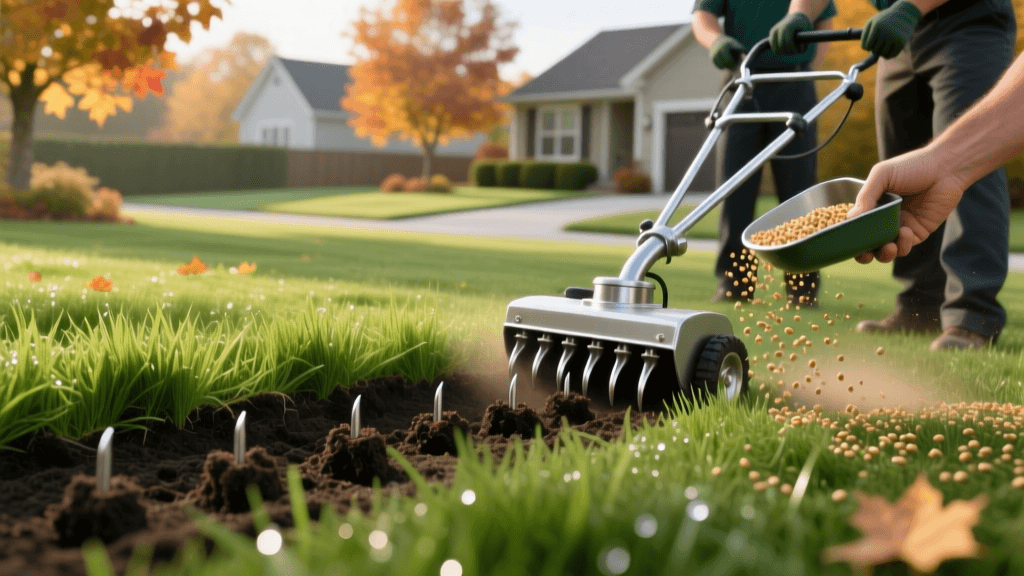
Once thatch hits 0.5 inches or more, mechanical steps are usually needed. Core aeration—using hollow tines to pull out 0.5-inch soil plugs spaced 2–3 inches apart—is the gentlest and most effective option. It lets more oxygen into the thatch layer and drops soil microbes straight into the organic mat. For cool-season lawns in the Northeast and Upper Midwest, early September is the best time: root growth is strong, and soil temperatures sit between 55–75°F.
Power Raking vs. Verticutting
Power raking pulls up surface debris but can damage crowns if set too deep. Verticutting with 0.25-inch blades spaced 0.5 inches apart works better for mature Kentucky bluegrass lawns. Do it in late August or early September, moving at 1.5–2.0 mph, then topdress right away with ¼ inch of compost—like Soil Blend by Vermont Compost Company—to bring in fresh microbes.
Biological Enhancements
Microbial inoculants don’t always deliver consistent results in the field, but Rutgers University found that applying Bacillus subtilis strain QST713 (the active ingredient in Serenade ASO) at the label rate (2–4 fl oz/1,000 ft²) every 14 days in May and September increased thatch breakdown by 19% in fine fescue plots over three years. The effect was strongest when paired with proper mowing and aeration.
Seasonal Maintenance Calendar for Thatch Control
A steady seasonal routine helps stop thatch before it gets thick. The table below outlines key steps for lawns in USDA Hardiness Zones 4–6, based on guidance from Ohio State University Extension and Purdue University Turf Program.
| Month | Key Action | Application Rate / Specification | Notes |
|---|---|---|---|
| April | Soil test & pH adjustment | Lime: 50 lbs/1,000 ft² if pH < 6.0 | Microbes work best when pH is 6.2–6.8 |
| May | First nitrogen application | 1.0 lb N/1,000 ft² (slow-release) | Avoid urea-formaldehyde if soil temp < 50°F |
| September | Core aeration + overseeding | 2–3 inch plug depth; 15–20 plugs/ft² | Follow with 0.5 lb N/1,000 ft² 10 days after aeration |
Sticking with this schedule cut average thatch depth from 0.75 inches to 0.28 inches within two years, according to long-term trials at Michigan State University’s Hancock Research Center.
“Thatch is not inherently harmful—it becomes problematic only when microbial decomposition fails to keep pace with plant residue production. Management must therefore prioritize soil biology as much as aboveground appearance.” — Dr. Eric Watkins, Professor of Turfgrass Science, University of Minnesota, 2022
Soil temperature matters a lot: microbes break down thatch fastest between 65–85°F. Below 50°F, activity drops off. Above 95°F, many helpful actinomycetes start to decline. That’s why late summer—mid-August to mid-September—is the best biological window for thatch-reduction work in cool-season turf.
Grass species make a real difference. Perennial ryegrass rarely builds much thatch under normal care—it’s a bunch-type grass and its residue breaks down fast. New Jersey studies show just 0.15 inches after five years of standard maintenance. Kentucky bluegrass is trickier: older cultivars like ‘Baron’ and ‘Glade’ build thatch 40% faster than newer low-thatch types such as ‘Moonlight’ and ‘Prosperity’, bred for fewer stolons and better lignin breakdown.
Topdressing with compost helps, too: a single ¼-inch layer adds about 2.5 × 10⁹ colony-forming units (CFU) of bacteria and 1.8 × 10⁶ CFU of fungi per gram. These microbes move into the thatch and speed up the breakdown of cellulose and hemicellulose—the tough structural parts that resist decay.
Hold off on fungicides unless you actually see disease. Broad-spectrum products like chlorothalonil can knock out the saprophytic fungi that help decompose thatch. Start with cultural fixes first—and only reach for chemicals when diagnostics from your local extension confirm a problem.
Managing thatch in cool-season lawns comes down to consistency—not dramatic changes. Raising mowing height by half an inch, waiting 10 days before the first spring nitrogen application, or aerating a week earlier than usual all add up over time. You’ll see less organic buildup and a lawn that holds up better under stress.