Lawn Care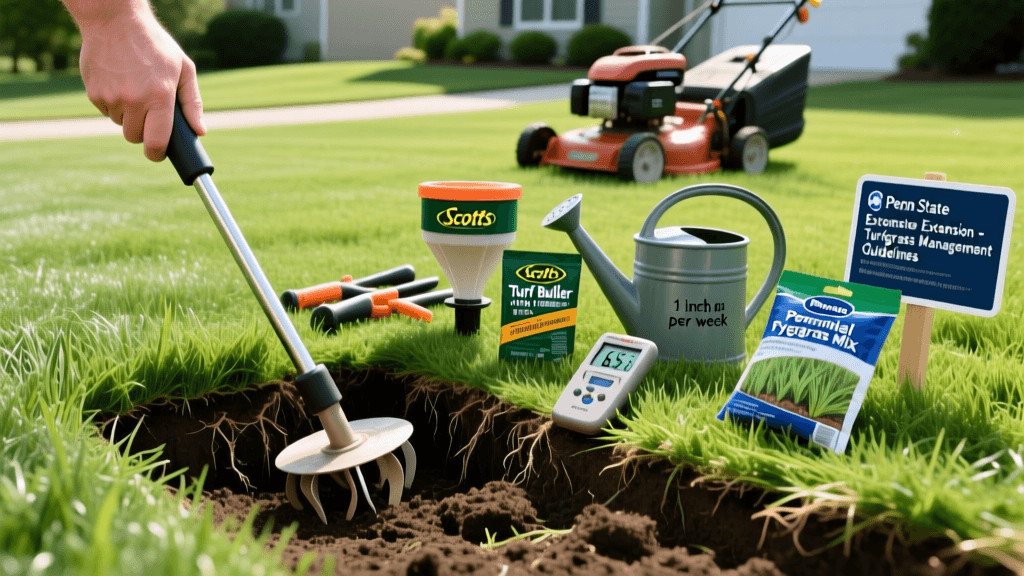
How To Repair Lawn Damage From Compacted Soil
Understanding Soil Compaction and Its Impact on Turf Health
Compacted soil is a common cause of lawn decline in residential landscapes across the United States. When soil particles get pressed together—by foot traffic, heavy equipment, or repeated mowing with underinflated tires—pore space shrinks. That makes it harder for roots to grow down, for air to move through the soil, for water to soak in, and for plants to take up nutrients. Research from Penn State Extension shows that when soil bulk density goes above 1.6 g/cm³, Kentucky bluegrass (Poa pratensis) root growth slows significantly, with rooting depth dropping by as much as 40% within six weeks of sustained compaction (Penn State Extension, 2021).
You might notice water sitting on the surface after light rain, patches of thin grass, more weeds—especially compact-tolerant ones like prostrate knotweed (Polygonum aviculare)—or a surface that feels either spongy or unusually hard. In the Midwest, tall fescue (Festuca arundinacea) lawns show less tillering when soil penetration resistance hits more than 300 psi at a 4-inch depth, according to field trials at the University of Wisconsin–Madison Turfgrass Program.
Diagnosing Compaction: Simple Field Tests You Can Do Today
You don’t need lab equipment to check for compaction. Try these three methods before deciding whether to aerate or add amendments:
- Use a 6-inch-long screwdriver: If you can’t push it into moist soil beyond 2 inches using light hand pressure, compaction is likely.
- Do a percolation test: Dig a 6" × 6" × 6" hole, fill it with water, wait 15 minutes, refill it, and time how long it takes to drain. If it takes longer than an hour for the water to drop half an inch, movement is restricted.
- Check root depth: Dig a 4-inch-deep plug in several spots. Healthy cool-season turf usually has roots 4–6 inches deep; roots shorter than 2 inches suggest long-standing compaction.
At Cornell University’s Long Island Horticultural Research & Extension Center, researchers found that lawns with average root depth under 2.3 inches had a 78% higher chance of going dormant in summer heat—especially creeping bentgrass (Agrostis stolonifera) during July and August.
Core Aeration: Timing, Equipment, and Species-Specific Protocols
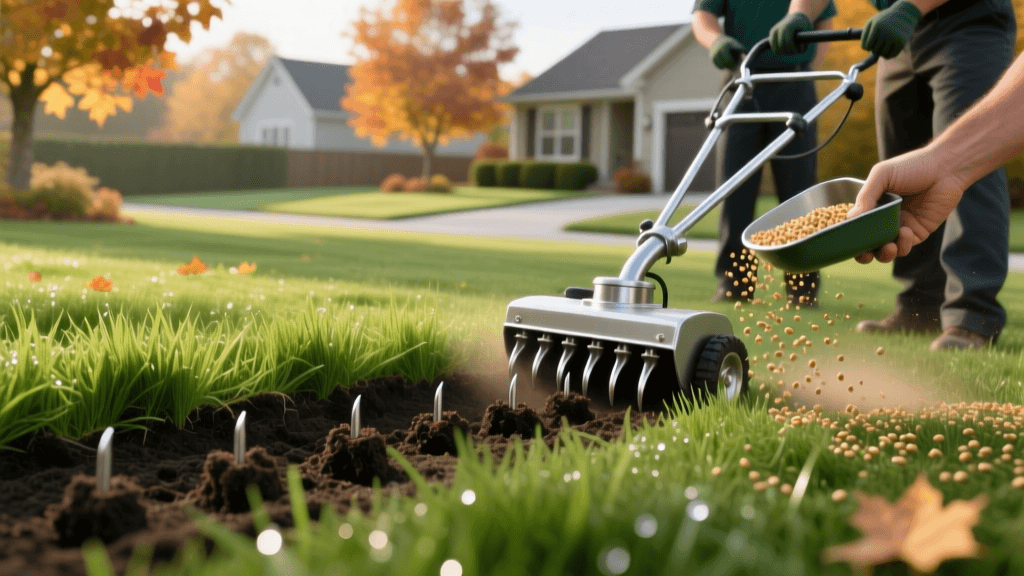
Core aeration is still the most reliable way to relieve physical compaction. It pulls out small soil plugs—usually 0.5–0.75 inches wide—leaving open channels for air, water, and roots. For cool-season grasses like Kentucky bluegrass, perennial ryegrass (Lolium perenne), and fine fescues, late August through mid-October works best in northern regions. Warm-season grasses such as zoysiagrass (Zoysia japonica) and bermudagrass (Cynodon dactylon) respond better when aerated during active growth: late May through early July in the Transition Zone and Southeast.
Equipment Selection and Pass Frequency
If you’re renting a machine, pick one with tines spaced no more than 3 inches apart. For lawns over 5,000 sq ft, making two passes at right angles helps pull more plugs—field data from Purdue University’s Turf Science Lab (2022) showed a 35% increase in removal. Skip spike aerators—they press soil down instead of loosening it.
Aim for 20–40 holes per square foot. Each plug should be 2–3 inches deep. Rental units usually reach about 2.5 inches if the soil is moderately moist—meaning it crumbles slightly when squeezed but doesn’t hold together in a ball.
Post-Aeration Management: Fertilizing, Seeding, and Watering
Right after aeration, apply a starter fertilizer with an N-P-K ratio like 10-20-10 at 0.5 lb nitrogen per 1,000 sq ft. Use a broadcast spreader set for even coverage—University of Minnesota Extension suggests Scotts Turf Builder Starter Food for New Grass, applied at 4.5 lbs per 1,000 sq ft.
If more than 30% of your lawn looks thin, overseed within 48 hours. For Kentucky bluegrass lawns in Ohio, OSU Extension recommends cultivars like ‘Moonlight’ or ‘Prosperity’, sown at 3–4 lbs per 1,000 sq ft. Keep the seedbed damp—water twice a day for 10–14 days, applying about 0.1 inch each time (use tuna cans scattered across the lawn to measure).
Watering Depth and Frequency Guidelines
Once the seed starts to sprout, shift to deeper, less frequent watering to help roots grow down:
- Weeks 1–2: 0.1 inch twice daily
- Weeks 3–4: 0.25 inch once daily
- Weeks 5–8: 0.5 inch every other day, measured with a rain gauge
Keep the top 4 inches of soil moist—check with a trowel or soil probe—to help new roots settle in without encouraging shallow growth.
Long-Term Soil Health: Organic Amendments and Preventive Practices
Aeration helps right away, but building lasting soil structure takes more. Spread compost at a depth of ¼ inch (about 1.5 cubic yards per 1,000 sq ft) right after aeration. University of California Cooperative Extension trials in Davis found this raised soil organic matter from 1.8% to 3.2% in a year and increased saturated hydraulic conductivity by 220% in clay-loam soils.
Some habits make compaction worse: mow only when the grass is dry, keep mower tire pressure above 12 psi, and avoid walking on wet soil. In high-use areas—like play zones near patios in suburban Atlanta—stepping stones or mulched paths can keep foot traffic off the grass.
Check soil penetration resistance each spring with a penetrometer. If readings go above 250 psi at 3 inches deep, consider aerating again—even if the lawn looks okay.
“Core aeration is not a one-time fix—it’s part of an annual soil health cycle. Skipping aeration for two consecutive years in high-traffic lawns can reduce topdressing efficacy by over 60% and delay recovery from drought stress by 11–14 days.” — Dr. Becky Griffin, Ohio State University Extension, 2023
Recommended Product and Application Summary
The following table summarizes key products, application rates, and seasonal windows based on peer-reviewed extension recommendations:
| Product | Target Grass Type | Application Rate | Optimal Season | Source |
|---|---|---|---|---|
| Scotts Turf Builder Starter Food | Kentucky bluegrass, perennial ryegrass | 4.5 lbs / 1,000 sq ft | Early fall (Aug 20–Oct 15) | OSU Extension Bulletin HYG-5123 |
| Sta-Green Lawn Restore Compost | All cool-season species | 0.25 inch depth (~1.5 yd³ / 1,000 sq ft) | Immediately post-aeration | UCCE Davis Turf Report No. 2022-04 |
For warm-season lawns in Texas, Texas A&M AgriLife Extension recommends Milorganite (5-2-0) at 3.5 lbs per 1,000 sq ft in early June to support zoysiagrass recovery without pushing too much leaf growth.
Mowing height matters, too: keep Kentucky bluegrass at 2.5–3.5 inches and tall fescue at 3–4 inches. Cutting shorter raises the risk of compaction-related stress and cuts photosynthetic capacity by up to 27%, based on field measurements from the University of Wisconsin–Madison.
Test your soil every 2–3 years—not just for pH and nutrients, but for bulk density and aggregate stability. The USDA Natural Resources Conservation Service offers free soil health assessments through county extension offices in over 42 states.
Track changes over time: measure root depth every three months, record infiltration rates twice a year, and take photos of the same 1-ft² patch every 30 days. Watching what happens helps you adjust before problems pile up.
Compacted soil isn’t a dead end—it’s a condition you can measure and manage. With timing that matches your grass type, consistent inputs, and attention to local conditions, your lawn can recover both function and strength.