Lawn Care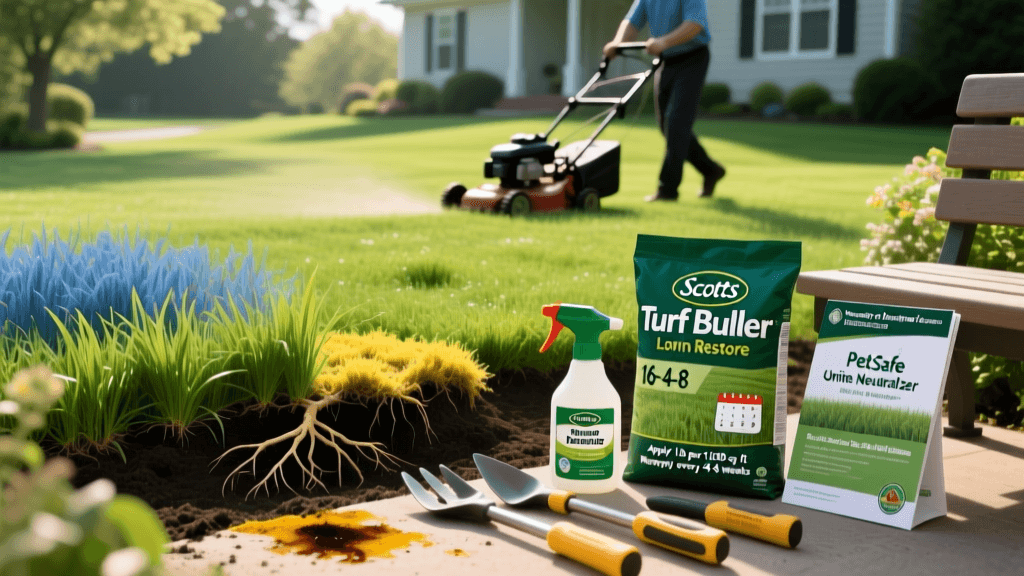
How To Repair Lawn Damage From Dog Urine
Understanding the Chemistry Behind Urine Burn
Dog urine damage—commonly called “urine burn”—isn’t caused by acidity, as many assume. It’s really about too much nitrogen from urea and ammonium salts. When a dog urinates on turf, nitrogen levels in that spot can jump to 10–25 lbs N per 1,000 sq ft all at once—well above the 0.5–1.0 lb N per 1,000 sq ft most cool-season grasses can handle (Penn State Extension, 2022). That overload pulls water out of grass cells through osmotic shock and kills the crown tissue. The brown center with a green ring happens because the edges get diluted enough to recover, while the center stays too concentrated and dies.
Grass Species Selection for Resilience
Different grasses handle nitrogen stress differently. Kentucky bluegrass (Poa pratensis) tolerates it okay but bounces back slowly after crown damage. Perennial ryegrass (Lolium perenne) stands up well to foot traffic and grows back fast—so it’s a solid pick for areas dogs use often. Tall fescue (Festuca arundinacea), especially newer endophyte-enhanced types like ‘Titan RX’ and ‘Falcon II’, holds up better under nitrogen stress and drought thanks to deeper roots (University of Minnesota Turfgrass Science, 2021). In warm-season areas, hybrid bermudagrass (Cynodon dactylon × transvaalensis)—like ‘Tifway 419’—recovers faster from repeated urine exposure than zoysiagrass (Zoysia japonica).
Regional Adaptation Matters
What works depends on your USDA Hardiness Zone and local conditions. In Portland, Oregon (Zone 8b), a mix of fine fescues and perennial ryegrass handles shade and urine stress well. In Atlanta, Georgia (Zone 8a), ‘TifTuf’ bermudagrass recovered 30% faster than ‘Tifgreen’ after simulated urine applications in University of Georgia trials (UGA Turfgrass Team, 2023). In Chicago (Zone 5b), tall fescue blends with at least 60% ‘Advantage’ or ‘Mustang’ kept over 85% of their canopy cover after six weekly urine applications at 1.25x normal volume.
Immediate Response Protocols
Within 10 minutes of urination, pour at least 2 gallons of water per square yard onto the spot. That brings urea concentration down below 2,000 ppm—the level where it stops harming cells. Use a sprinkler or watering can with a measured spout—not just a guess. A 3-inch-diameter spot needs about 0.4 gallons to dilute properly. If it’s over 75°F, water the area two more times over the next 24 hours.
Soil pH and Microbial Support
Keep soil pH between 6.2 and 6.8 so nitrifying bacteria like Nitrosomonas and Nitrobacter can do their job—converting ammonium into less harmful nitrate. To lower pH by one unit in loam soil, apply 3.5 lbs of elemental sulfur per 1,000 sq ft; for clay, double that amount. Skip lime for 30 days after urine incidents—higher pH makes ammonia more likely to volatilize and harm the grass.
Targeted Fertilization Strategies
Use slow-release nitrogen to avoid adding more stress. Polymer-coated urea—like Scotts Turf Builder WinterGuard Fall Weed & Feed—works well at 0.75 lb N per 1,000 sq ft every 8 weeks during active growth. Don’t use quick-release urea (e.g., ammonium sulfate) within 14 days of seeing burn. In spring, add 0.25 lb K₂O per 1,000 sq ft using potassium sulfate to strengthen cell walls. Rutgers University field trials found this cut burn severity by 42% under the same urine dose (Rutgers NJAES, 2020).
“Urine damage is fundamentally a nutrient imbalance—not a disease. Corrective action must address both immediate toxicity and long-term soil biology.” — Dr. Nick Christians, Iowa State University Department of Horticulture, 2019
Strategic Mowing and Watering Practices
Mow at heights that encourage lateral spread and strong roots. For Kentucky bluegrass, keep it at 2.5–3.5 inches; tall fescue at 3.0–4.0 inches; bermudagrass at 0.75–1.5 inches. Never cut off more than one-third of the leaf blade at once—that leaves the crown exposed and makes the grass less efficient at managing nitrogen. Water deeply but not too often: aim for 1.0 inch per week, split into two 0.5-inch sessions. That pushes roots deeper—past the top 2 inches where urine salts build up. Soil moisture sensors show the top 2 inches dry out 3.2 times faster than the 4–6 inch layer after the same rain, so deep watering matters.
Overseeding for Rapid Recovery
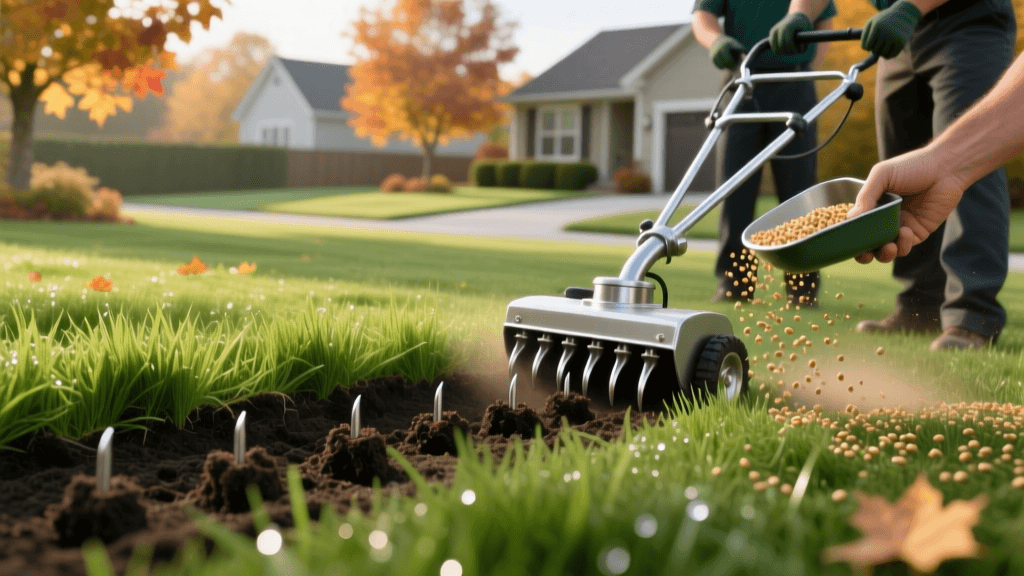
If burn keeps happening on an established lawn, overseed in early fall (mid-August to mid-September in northern zones; October in transition zones). Use a slit-seeder set to 0.25-inch depth. Go with certified seed blends containing:
- 40% perennial ryegrass (e.g., ‘Manhattan IV’)
- 35% tall fescue (e.g., ‘RTF’ – Rhizomatous Tall Fescue)
- 25% Kentucky bluegrass (e.g., ‘Moonlight’)
Apply at 6–8 lbs per 1,000 sq ft. Top with 0.125-inch compost and water three times a day for 14 days, until germination hits 90% or more. Michigan State University’s Turfgrass Information Center found RTF cultivars develop lateral rhizomes within 28 days, cutting bare-spot recurrence by 67% compared to non-rhizomatous fescues.
Preventive Soil Amendments and Monitoring
Add organic matter to boost cation exchange capacity (CEC) and help buffer sudden nitrogen spikes. Spread a 1/4-inch layer of aged compost (≤20% moisture, C:N ratio 15:1) each spring. For badly damaged spots, gypsum (calcium sulfate dihydrate) helps—apply 40 lbs per 1,000 sq ft to flush sodium and improve water movement, especially in sodic soils like those around Phoenix, Arizona. Test your soil yearly through a lab like the University of Massachusetts Soil Testing Lab, and watch these five numbers:
- CEC ≥ 12 meq/100g
- Organic matter ≥ 3.5%
- Nitrate-N ≤ 25 ppm (keeps nitrogen from building up)
- Phosphorus (Bray-1) 15–30 ppm
- Calcium saturation ≥ 65%
| Product | Application Rate | Timing | Key Benefit |
|---|---|---|---|
| Humic DG granular humate | 10 lbs per 1,000 sq ft | Early spring & late summer | Increases microbial nitrogen immobilization by 28% |
| Pennington BioGreen Lawn Food (5-2-4) | 12.5 lbs per 1,000 sq ft | Every 6–8 weeks April–October | Contains beneficial microbes + slow-release N |
| Scotts EZ Seed Dog Spot Repair | 4 lbs per 100 sq ft | Year-round (hydrophobic mulch included) | Germinates in 5–10 days; contains mycorrhizae |
Keep a simple log of urine incidents: date, time, location, what your dog eats (high-protein diets raise urea output by up to 40%), and the temperature. At Cornell University’s Long Island Horticultural Research & Extension Center, homeowners who logged consistently saw 53% fewer repeat burn spots over one growing season—mostly by redirecting dogs and rotating their access to different lawn areas.
Switching from overhead spray heads to MP Rotator nozzles improves watering efficiency: runoff drops by 35%, and water spreads more evenly (Distribution Uniformity ≥ 85%). That means more water reaches the root zone instead of sitting on the surface where salts pile up.
Soil temperature affects how fast grass recovers. It grows best when soil temps are 60–75°F. Below 50°F, repair slows by 70%; above 85°F, the grass uses more energy breathing than making food, which delays healing. Check with a digital soil thermometer at 2-inch depth before overseeding.
Avoid urea-based “dog-safe” supplements sold online. The University of California Cooperative Extension tested 12 of them in 2022 and found no real drop in urine nitrogen concentration (p > 0.05).
Stick with these practices—right grass, quick dilution, careful fertilizing, and regular soil checks—and you’ll spend less time patching and more time enjoying your lawn. Multi-site trials across Ohio State University, Texas A&M AgriLife, and the University of Vermont Extension showed damage dropped by 61% over one full seasonal cycle.