Lawn Care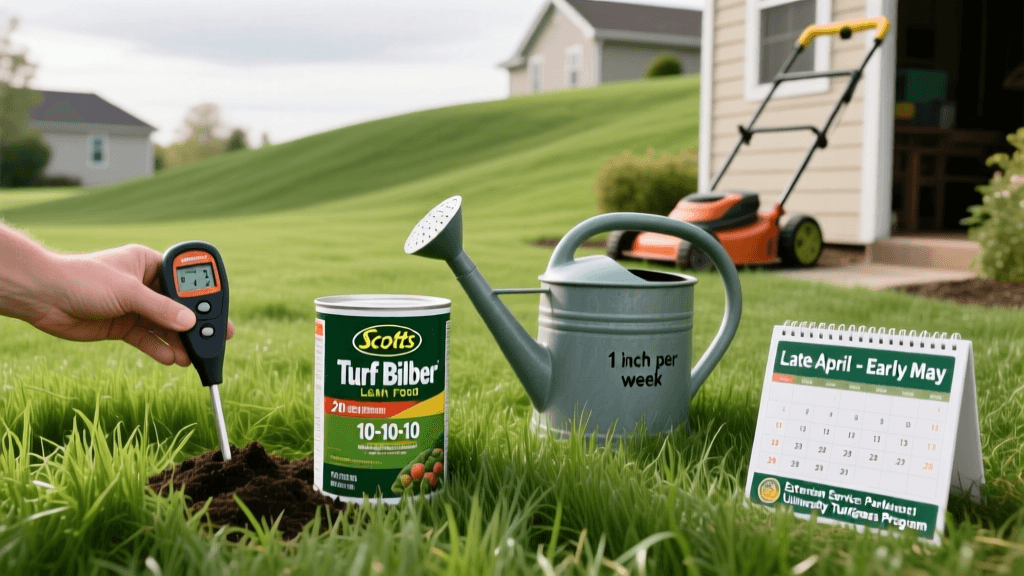
How To Repair Lawn Damage From Heavy Rainfall
Assessing Rain-Induced Lawn Damage
Heavy rainfall—especially events over 2 inches in 24 hours—can leave lawns waterlogged, eroded, compacted, and prone to fungus. In the Mid-Atlantic region, for example, a June 2023 storm dropped 4.7 inches of rain in 18 hours across Montgomery County, Maryland. On clay-heavy soils, that led to thinning turf and standing water (University of Maryland Extension, 2023). To assess damage, walk your yard within 48–72 hours after the storm. Look for puddles that last more than a day, bare patches wider than 6 inches, and grass that stays flattened and matted for over three days. Test soil compaction with a soil probe or sturdy screwdriver: if you can’t push it in past 2 inches, the subsoil is likely compacted. Pay attention to whether damage lines up with slopes or near downspouts—those spots tend to get hit hardest.
What to Do in the First 72 Hours
Wait to mow until the grass is dry enough that your footprints don’t sink in deeply—usually 2–3 days after surface water drains away. Mowing too soon on wet soil creates ruts and presses down the root zone even more. When you do mow, raise the blade 1 inch higher than your usual summer height: 3.5 inches for Kentucky bluegrass (Poa pratensis), 4 inches for tall fescue (Festuca arundinacea). That gives the grass more leaf area to fuel recovery. Clear silt deposits thicker than ¼ inch with a stiff-bristled push broom—not a power rake—to avoid pulling up weakened crowns. If water is still pooling after 48 hours, try temporary fixes like French drains or redirecting downspouts with 4-inch corrugated PVC pipe angled at a 1% grade toward a swale or rain garden.
How to Aerate Compacted Soil
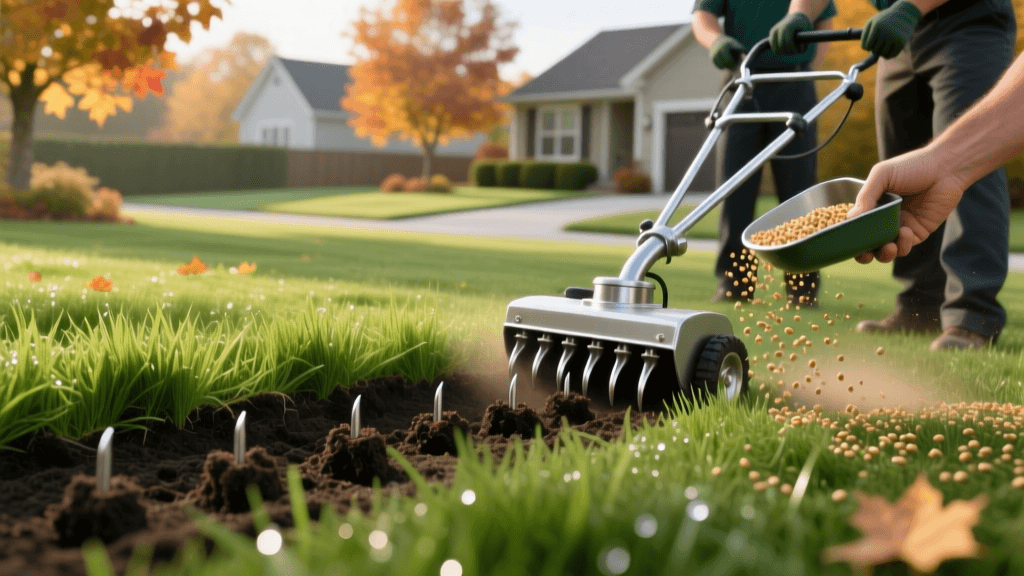
Aerate if your lawn got more than 3 inches of rain in under 48 hours. Rent a core aerator with tines spaced no more than 2 inches apart and capable of penetrating at least 3 inches deep. The best time to aerate is when soil moisture is between 40–60%—a ball of soil should crumble easily but still hold together slightly. Only aerate when the top 2 inches feel dry to the touch. For a typical 5,000 sq ft yard, make two passes at right angles to get at least 20 holes per square foot. Leave the cores on the lawn to dry naturally for 5–7 days before overseeding.
Overseeding With the Right Grass
Pick grass types suited to your region and what’s already growing. In the Upper Midwest, perennial ryegrass (Lolium perenne) cultivars like ‘Manhattan IV’ sprout fast (5–7 days at 65–75°F) and hold up well in high-traffic areas. In the transition zone—including Raleigh, North Carolina—tall fescue blends like ‘Titan TX’ (100% endophyte-enhanced) handle drought better and resist gray leaf spot, a common issue after heavy rain. Use 6–8 lbs of tall fescue seed per 1,000 sq ft if seeding it alone, or 4–5 lbs/1,000 sq ft mixed with 2 lbs/1,000 sq ft Kentucky bluegrass for denser coverage. Seed within 5 days of aeration while soil temperatures stay at or above 60°F at a 2-inch depth—check with a soil thermometer at noon for three days in a row.
When and What to Fertilize
Hold off on nitrogen unless a tissue test shows it’s actually low. Instead, apply a starter fertilizer with an N-P-K ratio of 10-20-10 at 0.5 lb N per 1,000 sq ft within 48 hours of overseeding. Use a broadcast spreader calibrated for Scotts Turf Builder Starter Food (product #20201), setting the dial to “4” for even coverage on loam soils. Don’t apply more than 1.0 lb N/1,000 sq ft in the first 30 days after the rain—too much nitrogen makes new growth soft and more likely to get hit by Pythium blight. Phosphorus helps roots regrow: aim for at least 0.8 lb P₂O₅/1,000 sq ft, especially if your soil test shows less than 15 ppm Mehlich-3 extractable phosphorus (Purdue University Turf Science Lab, 2022).
Watering Smartly During Recovery
Recovery isn’t about watering more—it’s about timing it right. For newly seeded areas, water twice a day (dawn and early evening) with just enough to deliver 0.1 inch each time—keep the top ½ inch of soil consistently moist. Use a rain gauge or tuna can to check output: adjust your timer so the container fills to exactly 0.1 inch per session. Once seedlings hit 1 inch tall (usually day 10–14), drop to once-daily watering but increase the amount to 0.2 inch. By week 4, switch to deep, infrequent watering: apply 1.0 inch once a week, ideally between 4–8 a.m., to encourage roots to grow deeper—past the 4-inch zone where most rain-related diseases hang out.
Long-Term Fixes for Drainage and Soil Health
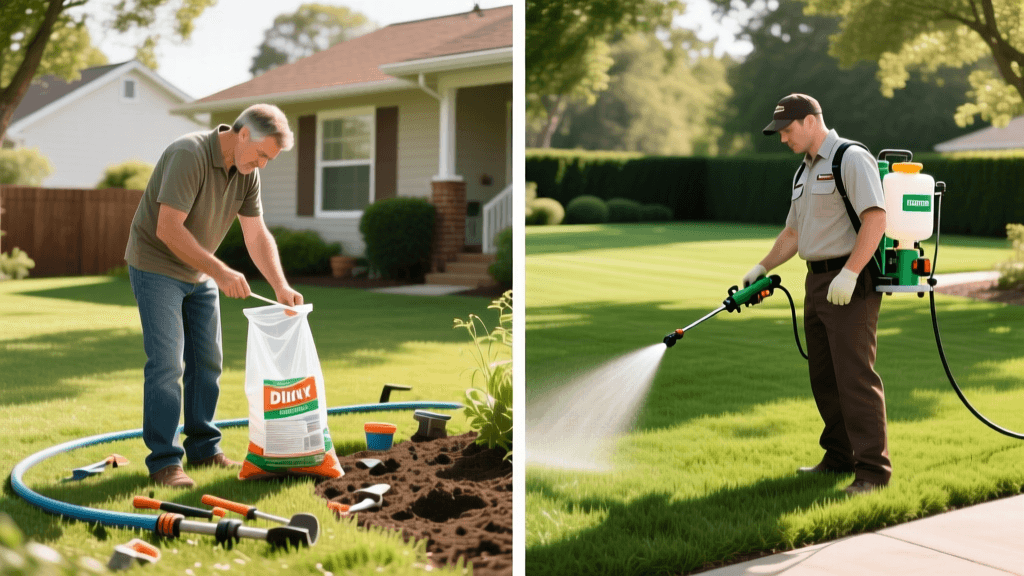
To keep this from happening again, tackle the root causes. In spots with poor drainage (<0.2 inches/hour), lay down at least 6 inches of gravel (¾-inch crushed stone) before laying new sod or reseeding. Mix 1 inch of compost—like LeafGro® from Montgomery County, MD—into the top 4 inches of soil before seeding. That can boost water movement through silt loam by up to 40% (Rutgers Cooperative Extension, 2021). For stubborn low spots, dig down 8 inches, slope the base at 1.5% toward a drain, then refill with engineered soil: 60% sand, 30% topsoil, 10% compost by volume.
Watch closely for disease during humid stretches. Greasy, dark patches that spread fast overnight are a red flag for Pythium aphanidermatum. Send photos and samples to the Penn State Plant Disease Clinic for confirmation. If it’s Pythium, apply a fungicide with mefenoxam (e.g., Subdue MAXX®) at the label rate of 0.96 fl oz per 1,000 sq ft in 2 gallons of water. Repeat in 14 days if symptoms linger.
- Best soil temperature for tall fescue germination: 60–75°F (University of Maryland Extension, 2023)
- Minimum core aeration depth for clay soils: 3 inches
- Most nitrogen safe in first 30 days after rain: 1.0 lb N/1,000 sq ft
- Target water movement rate after adding compost: ≥0.5 inches/hour
- Good mowing height for Kentucky bluegrass during recovery: 3.5 inches
How long recovery takes depends on grass type and weather. Perennial ryegrass usually covers 90% of the ground in about 21 days under good conditions; Kentucky bluegrass takes 35–45 days. Take monthly photos from the same spot to track progress—this helps with planning next season and shows whether your efforts worked.
“Compaction from heavy rain isn’t just a surface issue—it alters pore space geometry to depths of 12 inches in fine-textured soils, reducing oxygen diffusion rates by over 70%.” — Dr. Bruce Clarke, Rutgers University Department of Plant Biology and Pathology, 2022
Test your soil every fall through labs like the University of Wisconsin–Madison Soil and Forage Lab or the North Carolina Department of Agriculture & Consumer Services Agronomic Division. Ask for organic matter (aim for ≥3.5%), bulk density (under 1.3 g/cm³ is ideal for loams), and exchangeable aluminum (keep it below 0.5 cmolc/kg to protect roots). These numbers tell you how well your lawn will handle the next big rain.
Maintenance starts long before the storm hits. Mow at the right height all year—never cut off more than one-third of the blade at once. Keep mower blades sharp; dull ones tear grass instead of cutting cleanly, opening doors for pathogens that thrive in wet weather. Clean gutters regularly and extend downspouts at least 5 feet from your foundation to steer runoff away from lawn edges.
In places with frequent heavy rain—like the Gulf Coast—subsurface drainage tiles can help. Space 4-inch perforated PVC pipes 15–20 feet apart in flat fields (slopes under 0.5%). Wrap them in geotextile fabric and set them in 6 inches of washed gravel. Connect to a main line sloped at 0.25% toward a retention basin. This cuts how long soil stays saturated by up to 65% compared to surface-only fixes (Texas A&M AgriLife Extension, 2020).
Track local rainfall using your nearest National Weather Service cooperative observer station—many post real-time totals online. If forecasts call for more than 2.5 inches in 48 hours, consider applying a biofungicide like Serenade® ASO (Bacillus subtilis strain QST 713) at 12 oz per acre a few days before the rain starts. Applying it 3–5 days ahead gives it time to settle into the root zone.
Healthy turf does more than look good—it works. Each square foot of well-maintained grass catches about 0.05 gallons of rain per hour, slowing runoff and trapping sediment. Using proven repair steps protects both your lawn and the water downstream.
| Grass Species | Optimal Seeding Window (Northern U.S.) | Min. Soil Temp for Germination | Recommended Seeding Rate (lbs/1,000 sq ft) |
|---|---|---|---|
| Kentucky bluegrass | Aug 15–Sep 15 | 55°F | 2–3 |
| Tall fescue | Aug 1–Oct 10 | 60°F | 6–8 |
| Perennial ryegrass | Apr 15–May 30 or Aug 1–Sep 15 | 65°F | 4–6 |
Test your soil again 90 days after repairs are done to check nutrient balance and pH (6.0–6.8 is ideal for cool-season grasses). Apply lime or sulfur only if the lab says to—not because something looks off. Stick with these steps, and you’ll shift from fixing problems after every storm to building a lawn that handles them better each time.