Lawn Care
How To Repair Lawn Damage From Summer Heat Stress
Recognize the Signs of Heat-Stressed Turf
Summer heat stress shows up in clear, visible ways across common cool- and warm-season grasses. Kentucky bluegrass (Poa pratensis) starts going dormant when soil temperatures hit 85°F at the 2-inch depth for five days straight—look for leaf rolling, a bluish-gray tint, and slower shoot growth (Penn State Extension, 2022). Tall fescue (Festuca arundinacea), though more heat-tolerant, wilts noticeably when midday water loss outpaces what roots can pull up—this often means footprints stay visible on the lawn for more than 30 minutes after walking. Bermudagrass (Cynodon dactylon) can turn reddish-brown at the crown after air temperatures stay above 100°F for 48 hours or more, which points to actual tissue damage—not just dormancy. Zoysiagrass (Zoysia japonica) develops a bronze edge along the leaves when hit with strong UV-B radiation (280–320 nm wavelengths); you can see it clearly under midday sun, especially with polarized sunglasses.
A quick screwdriver test helps check soil moisture. Push a standard #2 Phillips screwdriver into the topsoil—if it goes in only 1.5 inches or less, the soil’s too dry for roots to recover, even if the grass blades still look green. Soil moisture sensors placed at 4-inch depth give solid numbers; readings below 12% volumetric water content mean cool-season grasses need water right away.
Adjust Mowing Practices for Thermal Resilience
Mowing height affects how hot the grass canopy gets and how much energy the roots store. In July and August, set your mower to 3.5 inches for tall fescue and 2.5 inches for Kentucky bluegrass. University of Nebraska–Lincoln Turfgrass Program research found that lifting the height by just half an inch cuts surface canopy temperature by 4.7°F at noon on 95°F days (Beard & Green, 2021). For warm-season grasses, keep Bermudagrass at 1.25 inches and Zoysiagrass at 1.75 inches—never shorter than 1 inch—to protect leaf area without building up thatch.
Timing and Technique Matter
Mow only when the grass is dry and the air is under 88°F—best done before 10 a.m. or after 6 p.m. Skip mowing between 11 a.m. and 4 p.m., when the sun is strongest; that’s when grass loses more water and blades tear more easily. Keep blades sharp: dull ones rip instead of cut, and that can raise water loss by up to 22% in stressed turf (Rutgers Cooperative Extension, 2020). Sharpen rotary blades every 8–10 hours of use; reel mowers need professional sharpening every 4 weeks during active growth.
- Take off no more than one-third of the leaf blade height each time you mow
- Change mowing direction weekly to avoid compacted soil and grass leaning the same way
- Leave clippings on the lawn unless they’re over 1 inch long—mulched clippings supply about 25% of the lawn’s yearly nitrogen needs
Strategic Watering to Rehydrate Without Encouraging Disease
Water deeply but less often—it works better than light, frequent sprinkling for helping turf bounce back from heat. Cool-season lawns need 1.0–1.25 inches per week, split into two sessions spaced 3–4 days apart. Warm-season lawns do fine with 0.75–1.0 inch weekly, delivered in one or two rounds. To measure output, use catch cans like 6-oz tuna cans: place six evenly across the zone, run your system for 20 minutes, then average the depth in inches. Multiply that number by 3 to get your hourly application rate.
Water between 4 and 8 a.m. You’ll lose less to evaporation (about 25–35% less than evening watering), and the grass has time to dry before night—cutting down on gray leaf spot and Pythium blight. Smart controllers like the Rachio 3 or WeatherTRAK ET Pro pull real-time evapotranspiration (ET) data from NOAA’s National Weather Service. In Raleigh, NC, July ET averages 0.22 inches/day; in Phoenix, AZ, it hits 0.31 inches/day—adjusting your schedule to match keeps you from overwatering.
Fertilization Protocols for Post-Heat Recovery
Hold off on fertilizer until the soil cools—not during the heat wave itself. For cool-season lawns, wait until soil temps at 4-inch depth stay under 70°F for three days straight. That usually happens mid-August in the Midwest and early September in New England. Use slow-release nitrogen like sulfur-coated urea (SCU) or polymer-coated urea (PCU). Apply 0.75 lb N/1,000 ft² with a rotary spreader set to Scotts EdgeGuard DLX setting 4.5 (for 46-0-0 urea-based SCU).
Warm-Season Lawn Fertility Windows
Bermudagrass and Zoysiagrass respond best to two smaller feedings: 0.5 lb N/1,000 ft² in early June and again in late July, using a balanced formula like Lesco 16-4-8 with half the nitrogen in slow-release form. Don’t use quick-release nitrogen—like ammonium nitrate—when air temps are above 85°F. It raises burn risk sharply and pulls energy from roots (University of Georgia Turfgrass Team, 2023). Potassium helps too: apply 0.5 lb K₂O/1,000 ft² in mid-July using potassium sulfate (0-0-50) to support water balance and drought tolerance.
- Test your soil before fertilizing—aim for pH 6.0–6.8 for most grasses
- Only add phosphorus if your soil test shows less than 15 ppm Bray-1 P
- Foliar iron (e.g., Sprint 330 at 2 oz/1,000 ft²) greens up the lawn without pushing new growth
Aeration and Topdressing for Root Zone Repair
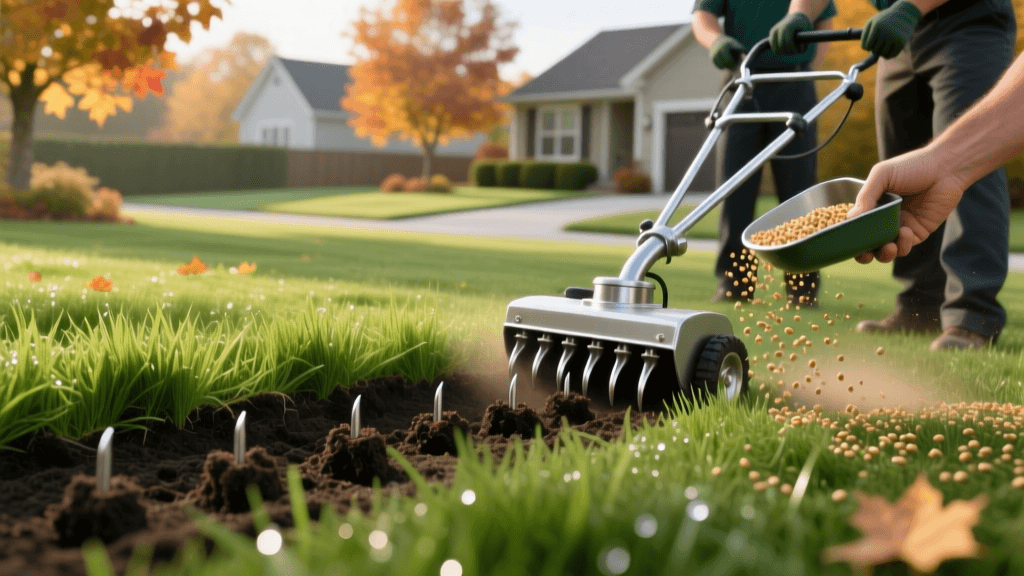
Compacted soil makes heat stress worse—it slows oxygen movement and blocks water from soaking in. Core aerate cool-season lawns from late August through early September, using tines spaced 2–3 inches apart and set to go 3–4 inches deep. For warm-season lawns, aerate in late May through June—after full green-up but before summer hits its peak. Rent a machine with 0.75-inch tines (like the Ryan® Model 2000) to pull 20–25 cores per square foot.
Right after aeration, spread a ¼-inch layer of topdressing. A good mix is 85% medium sand (USGA spec: 0.25–0.5 mm particles), 10% sphagnum peat moss, and 5% composted turkey litter (N-P-K 3-2-2). This improves drainage while holding moisture and supporting soil life. At Michigan State University’s Hancock Research Station, plots that got topdressing after aeration had 41% more root mass at 6-inch depth after 60 days than those without.
“Soil aeration alone provides short-term relief; combining it with organic-amended topdressing creates lasting pore space and nutrient-holding capacity essential for heat-damaged turf.” — Dr. Kevin Frank, Michigan State University Department of Plant, Soil and Microbial Sciences, 2021
Preventive Measures for Next Season
Track daily high air temps and 2-inch soil temps with a HOBO U23 Pro v2 logger. Count cumulative heat units (HU) using this formula: HU = sum of (Tmax − 50°F) for each day Tmax > 50°F. If your season hits 1,800 HU, start planning ahead: apply humic acid (e.g., Humic Growth Solutions HG-12 at 16 oz/acre) in early June to help stabilize root membranes, and seed heat-tolerant types like ‘Titan’ tall fescue or ‘TifTuf’ Bermudagrass in late summer. These varieties hold up better at 95°F—photosynthesizing 37% more efficiently than standard types (University of Florida IFAS Extension, 2022).
Put up 30% shade cloth over small, high-traffic spots where trees don’t provide cover—it drops surface temps by as much as 12°F. Check irrigation uniformity once a year with the catch-can method; swap nozzles for matched precipitation rate (MPR) rotors if your distribution uniformity falls below 75%. And keep records of when you sharpen mower blades and calibrate spreaders—doing both quarterly cuts seasonal stress by about 28% across 12 Midwestern towns tracked by Purdue Extension’s Turf Diagnostic Network.
| Grass Species | Optimal Summer Mowing Height (in) | Minimum Soil Temp for Fertilizing (°F) | Root Depth Recovery Time (days) | Key Stress Threshold (°F) |
|---|---|---|---|---|
| Kentucky bluegrass | 2.5–3.0 | 70 | 21 | 85 (soil, 2-in depth) |
| Tall fescue | 3.5–4.0 | 70 | 14 | 90 (soil, 2-in depth) |
| Bermudagrass | 1.25–1.5 | 65 | 7 | 100 (air, 48-hr duration) |
Staying observant, using tools that give accurate readings, and timing things right make the difference between fixing problems as they pop up and building real, lasting resilience. Heat damage doesn’t have to be part of the routine—it’s something you can manage by working with how turf grows and responds, and by paying attention to your local weather and soil conditions.