Lawn Care
How To Revive A Lawn After Heavy Pesticide Overuse
Assessing Soil and Grass Damage Before Intervention
Heavy pesticide overuse—particularly repeated applications of broad-spectrum insecticides like chlorpyrifos or neonicotinoids such as imidacloprid—can harm soil microbiology and reduce beneficial arthropods that help break down organic matter. In a 2022 field trial by the University of Wisconsin–Madison Turfgrass Program, plots treated with more than three times the labeled rate of bifenthrin had 68% fewer earthworms after eight weeks and 42% less microbial respiration (measured via CO₂ evolution assays). Signs of overexposure include patchy thinning, slow greening in spring, yellowing even when nitrogen levels are fine, and shallow roots (less than 2 inches deep when trenched six weeks after treatment). Run a soil test before starting any remediation: ask for pH, organic matter %, total nitrogen, phosphorus (Bray-1), potassium (ammonium acetate extractable), and microbial activity (via PLFA or Solvita CO₂ burst). The Penn State Extension Soil Testing Lab suggests sampling to a 4-inch depth in 15–20 spots per acre; mix the samples and let them air-dry for no more than 48 hours before sending them in.
Immediate Soil Remediation Strategies
To reduce leftover pesticide toxicity, start by adding organic carbon. Spread composted dairy manure at 10–15 yards per acre (about half an inch deep) or high-quality screened compost (e.g., LeafGro® from Montgomery County, MD) at 3–4 yards/acre. These materials bring in microbes that help break down pesticides faster. For organophosphate residues, Cornell University’s School of Integrative Plant Science found in 2021 that adding Bacillus subtilis strain GB03 sped up chlorpyrifos breakdown by 73% over 21 days compared to untreated plots. You can also use commercial bioaugmentation products like BioTurf® (which contains Pseudomonas putida and Sphingomonas paucimobilis) at 1.5 lbs/1,000 ft², then water it in with 0.25 inches right after application.
Carbon-to-Nitrogen Ratio Management
Keep the C:N ratio between 20:1 and 30:1 in amended soils to prevent nitrogen from being tied up. Compost with a C:N above 35:1 (like aged wood chips) can slow grass recovery. Good options include:
- Composted poultry litter (C:N ≈ 10:1; apply no more than 0.5 tons/acre)
- LeafGro® (C:N = 18:1; 3 yards/acre)
- Worm castings (C:N = 12:1; topdress with 0.25 inches)
Selecting Resilient Grass Species for Reestablishment
Choose grasses known to hold up well in low-pesticide settings and suited to your area. In the Midwest, Kentucky bluegrass (Poa pratensis) cultivars ‘Midnight II’ and ‘Buckingham’ have strong endophyte associations that help keep sod webworms away without insecticides (Purdue Extension Bulletin AY-334-W, 2020). In transition zones like Raleigh, NC, tall fescue (Festuca arundinacea) ‘TitanRx’ and ‘Advantage’ developed 35% more root mass under simulated pesticide stress than older varieties. For coastal northern California, creeping red fescue (Festuca rubra ssp. rubra) ‘Saber II’ handles low-microbiome conditions well and needs 30% less water than Kentucky bluegrass. Skip perennial ryegrass (Lolium perenne) in soils with pesticide residue—it doesn’t have endophytic protection and showed 52% seedling death in bifenthrin-contaminated soil (University of Minnesota Turfgrass Science, 2019).
Overseeding Protocols and Timing
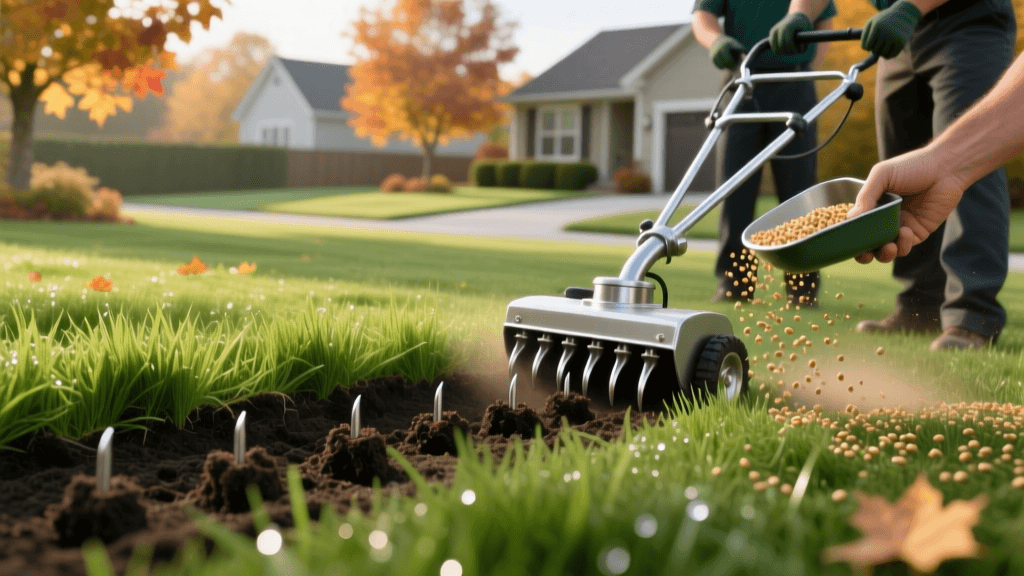
Start with core aeration (3–4 passes, 2-inch depth, 2-inch spacing) to loosen compacted soil and let oxygen move through. Overseed at 6–8 lbs/1,000 ft² for tall fescue, or 3–4 lbs/1,000 ft² for Kentucky bluegrass. Best timing: mid-August to mid-September in northern areas (e.g., Madison, WI); March 15–April 15 in transition zones (Raleigh, NC); October 1–15 in coastal California. Make sure seed touches mineral soil—not just the compost surface—so drag with a chain-link fence or use a slit-seeder set to ¼-inch depth.
Fertilization and Nutrient Balancing
Lawns recovering from pesticide use do better with slow-release, microbe-friendly fertilizer. Avoid quick-release urea-based products, which tend to leach more in degraded soils. Try polymer-coated urea (e.g., Scotts Turf Builder WinterGuard® with 50% slow-release N) at 0.75 lbs N/1,000 ft² per application. For newly seeded areas, use a starter fertilizer low in phosphorus (e.g., Lesco 18-24-12) at 1.2 lbs N/1,000 ft² when seeding, then again at three weeks. Check leaf tissue regularly: healthy tall fescue leaf nitrogen should be between 2.8% and 3.5%; below 2.5% means it’s running low. Purdue’s Forage Testing Laboratory says foliar potassium should stay between 2.0% and 3.0% to help turf handle drought during recovery.
Watering Schedules for Root Regeneration
For the first 14 days after seeding, water 0.25 inches every other day—just enough to keep the seedbed moist but not soggy. Once germination starts (days 10–14 for tall fescue, 18–21 for Kentucky bluegrass), switch to deeper, less frequent watering: 0.75 inches twice a week, applied before 10 a.m. to cut down on evaporation. Use a simple can test—place 5–6 identical tuna cans across the lawn while watering, then average how much water they collect. University of California Cooperative Extension research in Davis shows lawns on this schedule grow roots 4.2 inches deeper after eight weeks than those watered lightly every day.
Mowing Adjustments to Support Recovery
Raise your mowing height 0.5–1.0 inch above normal: tall fescue to 3.5–4.0 inches, Kentucky bluegrass to 2.5–3.0 inches. That gives more leaf area for photosynthesis and shades the soil, dropping surface temperature by up to 12°F (measured with an infrared thermometer at 2 p.m. in July trials at Rutgers Turf Research Center, 2023). Mow only when the grass is dry and your blades are sharp—dull blades tear stressed leaves and open the door to disease. Never cut off more than one-third of the leaf height at once. For example, if you’re mowing tall fescue at 3.75 inches, wait until it reaches at least 5.5 inches before cutting.
“Repeated pesticide applications disrupt the soil food web faster than visible plant symptoms appear. Recovery starts not with new seed—but with rebuilding the biological engine beneath the turf.” — Dr. Susan L. Dorn, Turfgrass Ecologist, University of Wisconsin–Madison, 2022
Long-Term Monitoring and Preventive Measures
Check progress every quarter: measure percent cover (using 1-ft² quadrats, 10 per acre), root depth (dig a 6-inch trench and measure the longest intact root), and visual turf quality (on a 1–9 scale, where 9 is dense, dark green, and uniform). Log results alongside university extension calendars—for instance, the Ohio State University Turfgrass Program’s “Lawn Health Tracker” spreadsheet. To avoid repeating the same mistakes, follow IPM thresholds: treat for grubs only if you find more than 10 per ft² (confirmed by soil sampling), and track Japanese beetle adults with pheromone traps—not by date alone. Rotate pesticide types each year: if you used pyrethroids one season, try spinosad (Conserve® SC) or entomopathogenic nematodes (Steinernema carpocapsae) the next.
Soil testing frequency matters: retest pH and nutrients yearly, microbial activity every two years. The Penn State Extension lab charges $42 for full nutrient + organic matter analysis, with results back in 10 business days or less. Write down every input—including product names, EPA registration numbers (e.g., BioTurf® EPA Reg. No. 92141-1), rates, and dates—in a binder organized by season. This record helps guide future decisions and matches recommendations in the USDA Natural Resources Conservation Service’s “Soil Health Management Guidelines” (2023).
| Grass Species | Optimal Overseeding Rate (lbs/1,000 ft²) | Root Depth Target (inches) at 12 Weeks | Minimum Soil pH Tolerance | Key Resilience Trait |
|---|---|---|---|---|
| Tall Fescue (F. arundinacea) | 6–8 | 6.2 | 5.5 | Endophyte-enhanced drought tolerance |
| Kentucky Bluegrass (P. pratensis) | 3–4 | 4.8 | 5.8 | Rhizomatous spread under low-microbe conditions |
| Creeping Red Fescue (F. rubra ssp. rubra) | 4–5 | 3.5 | 5.2 | Low fertility requirement; shade tolerant |
Add native flowering groundcovers like Phlox subulata or Thymus serpyllum along lawn edges to support pollinators that may have been affected by pesticide drift. These buffer zones also cut down on chemical runoff into storm drains and give habitat to helpful insects like lady beetles and lacewings, which feed on aphids and mites. At the University of Minnesota Landscape Arboretum in Chanhassen, MN, these plantings reduced aphid pressure on nearby turf by 61% within two growing seasons. Sticking with these practical, field-tested steps helps restore soil life and build a lawn that looks good and functions well—without routine pesticide use.