Tree Care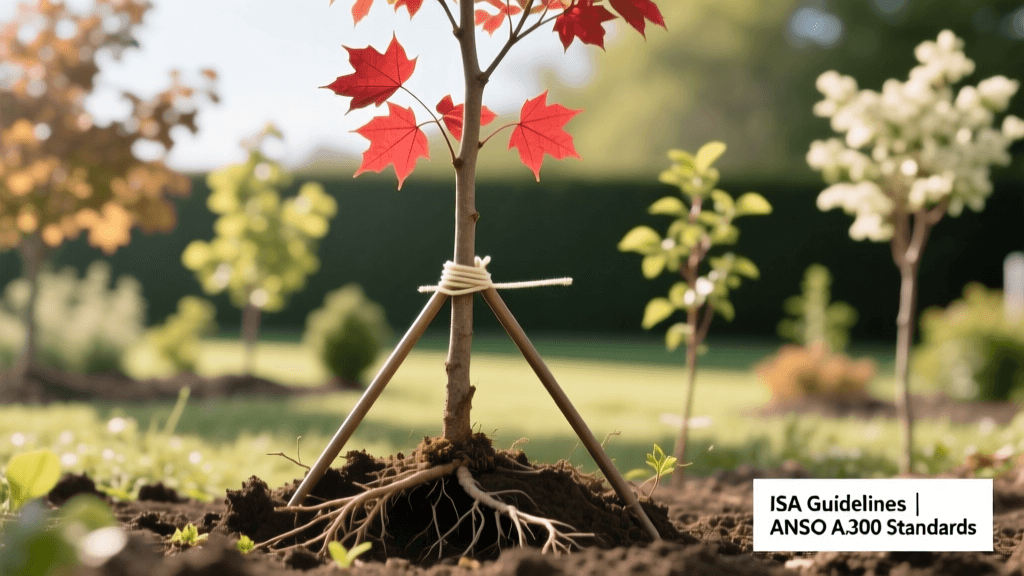
How To Stake A Young Tree Properly
When Staking Is Actually Necessary
Not every young tree needs a stake. This is a common mistake in home landscaping — and staking when it’s not needed can actually weaken the tree instead of helping it. The International Society of Arboriculture (ISA, 2019) says to stake only if the tree can’t stand upright on its own, if the root ball wobbles in the hole, or if the site gets steady winds over 15 mph. Trees planted in good soil with a healthy, properly sized root ball usually do better without stakes.
Here’s why: when a young trunk moves in the wind, it builds stronger wood — denser and more flexible — that helps it handle stress over time. A tree held rigid from day one misses out on this. It ends up with a thinner trunk above the tie point, and roots that don’t spread or anchor as well. Researchers at the University of Nevada Cooperative Extension found that after two years, staked trees had less trunk taper and stood up to wind less effectively than unstaked ones of the same species and age.
Choosing the Right Staking Method
When you do need to stake, how you do it matters just as much as the decision itself. Arborists use three main approaches: single-stake, double-stake, and guying. Which one works best depends on the tree’s size, root condition, and where it’s planted.
Single-Stake Method
Use single staking for small, slender trees — like bare-root transplants — with a trunk diameter (measured 6 inches above ground) of 1 inch or less. Drive the stake into solid soil outside the root ball — never through it — about 6 to 8 inches from the trunk. Place it on the side the wind usually comes from, so the tree leans into it only when the wind blows. Tie the tree once, with a flexible material, no higher than two-thirds up the trunk. That leaves the top third free to move.
Double-Stake Method
For trees with a trunk diameter between 1 and 2.5 inches, two stakes on opposite sides give steadier support without locking the trunk in place. Drive each stake at least 18 inches deep into firm soil beyond the planting hole. Use a figure-eight tie or a commercial tree tie that keeps the stake from rubbing the bark. The tie should be loose enough to let the trunk sway 1 to 2 inches in any direction — this movement is necessary for healthy trunk development.
Guying for Larger Transplants
Balled-and-burlapped trees with trunk diameters over 2.5 inches, or any tree taller than 12 feet at planting, usually need a three-point guying system. Three wire guys go to ground stakes spaced evenly around the tree (about 120 degrees apart), each passing through rubber hose or a commercial tree tie where it touches the trunk. Don’t pull the wires tight — the trunk still needs to flex. The Morton Arboretum in Lisle, Illinois, suggests marking guy wires with bright tape, especially in public areas, so people don’t trip over them.
Materials: What to Use and What to Avoid
Tie material is where many plantings run into trouble. Wire, rope, and twine — even threaded through garden hose — can cut into the trunk within one growing season if left unchecked. As a tree grows, its trunk thickens by about 0.5 to 1 inch per year, depending on the species. Inelastic ties start restricting flow under the bark long before they look tight from the outside.
- Approved materials: Wide, flat polyester straps; commercial rubber tree ties; nylon webbing at least 1 inch wide; purpose-made arborist ties with built-in spacers
- Materials to avoid: Wire (even in hose), sisal twine, zip ties, baling wire, rope of any kind, and narrow plastic strapping
Stakes themselves should be smooth, round, and free of sharp edges or hardware. Lodge-pole pine stakes, 2-inch bamboo, and fiberglass composite stakes all work well. Metal T-posts are fine for guying systems but shouldn’t touch small trees directly — they’re too stiff and concentrate force at the tie point.
Species-Specific Considerations
Different trees establish at different rates, grow roots in different patterns, and handle wind differently — all of which affect whether and how long they need staking.
Fast-growing trees like silver maple (Acer saccharinum) and green ash (Fraxinus pennsylvanica) can shoot up 3 to 5 feet a year in good conditions. Their roots have to keep pace, so they often need support for just 6 to 9 months. Slower growers like bur oak (Quercus macrocarpa) and American beech (Fagus grandifolia) may add only 12 to 18 inches a year, but they develop deep, wide-spreading roots — bur oak roots have been seen stretching 3 to 4 times the width of the canopy within ten years. These trees sometimes need stakes for 12 to 18 months, but rarely longer.
Columnar or fastigiate trees — like Quercus robur 'Fastigiata' or Carpinus betulus 'Fastigiata' — are a special case. Their narrow shape cuts wind resistance, but their tight branching can make the root ball top-heavy. The Chicago Botanic Garden has seen these forms benefit from a second season of staking, especially in open, windy spots.
"Stakes and ties should be removed as soon as the tree can support itself. In most cases, this is within one growing season. Leaving stakes in place beyond that point is one of the most common causes of long-term trunk damage in landscape trees."
— ANSI A300 (Part 6) Standards for Tree, Shrub, and Other Woody Plant Management, American National Standards Institute, 2012
Stake Placement and Depth
Where you put the stake matters just as much as how you use it. A frequent error is driving stakes through the root ball — this slices new feeder roots and undermines the very thing the stake is supposed to protect. Always drive stakes into undisturbed native soil outside the edge of the planting hole.
How deep depends on soil type and stake thickness. As a rule, stakes should go at least 18 inches into firm soil — 24 inches in sandy or loose soils. If a stake rocks when you push it, it’s not deep enough and won’t hold up. In clay, a 2-inch wooden stake driven 18 inches deep can usually handle 80 to 120 pounds of sideways force — enough for trees up to 2 inches in trunk diameter in most wind conditions.
| Tree Caliper | Recommended Method | Stake Depth | Tie Height | Typical Duration |
|---|---|---|---|---|
| Under 1 inch | Single stake | 18 inches | Up to ⅔ tree height | 6–9 months |
| 1–2.5 inches | Double stake | 18–24 inches | Lowest effective point | 9–12 months |
| Above 2.5 inches | Three-point guying | 24 inches | Lower third of crown | 12–18 months |
Monitoring, Adjustment, and Removal
Staking isn’t something you set and forget. Check ties every 4 to 6 weeks during the growing season. Look for bulging bark, discoloration, or signs the tie has dug in. If it’s starting to cut in, take it off right away — even if the tree still feels wobbly. Replace it with a wider, looser tie placed slightly higher or lower.
To test whether it’s time to remove the stakes, hold the trunk just above the root flare and let go. If the tree straightens on its own and the root ball stays still in the soil, the stakes can come out. If the root ball shifts or the trunk leans and stays leaned, wait another 4 to 6 weeks and try again.
When pulling stakes, lift them straight up — don’t rock them back and forth, since roots may have grown near the base. Cut guy wires rather than unwinding them, to avoid twisting the trunk. After removal, check the tie points for embedded material or early girdling. Minor bark compression usually heals over one or two growing seasons if caught early.
- Inspect ties every 4–6 weeks during the growing season
- Test trunk stability before removing stakes — don’t rely on a fixed timeline
- Remove all hardware as soon as the tree stands on its own
- Record the planting date and when stakes were installed
- Take photos of tie points at installation and each inspection
These steps follow the ISA Best Management Practices for Tree Planting (ISA, 2019). They point out that what happens after planting — especially taking stakes out at the right time — affects long-term survival more than almost anything else done at planting. A tree staked correctly and freed at the right moment will usually get off to a stronger start than an unstaked one, and stay healthier over its whole life than one left staked too long.