Tree Care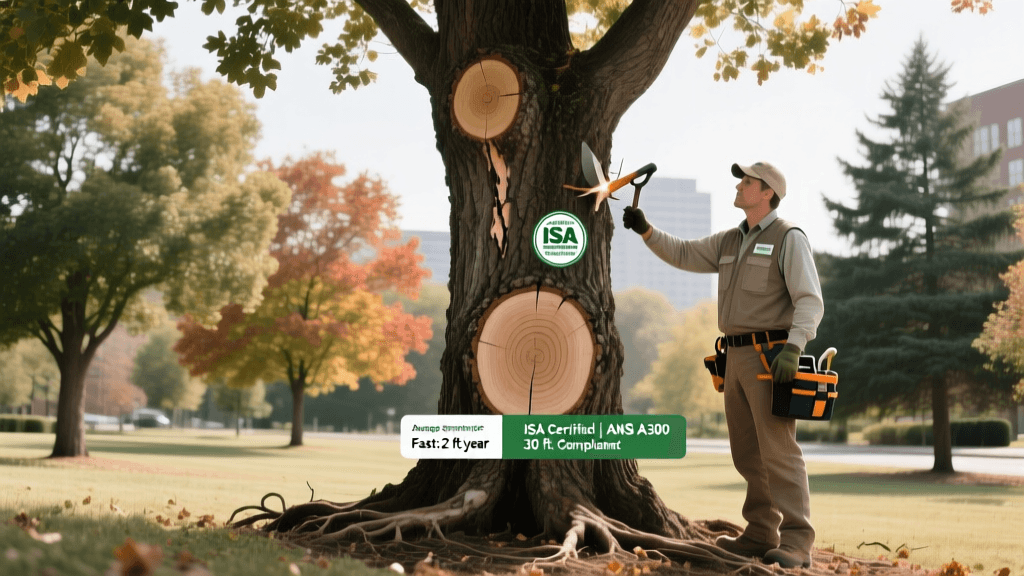
How To Treat Tree Diseases Common Problems
Recognizing the Signs of Tree Disease Before It's Too Late
Trees don’t usually show obvious signs when they start getting sick. More often, disease works its way through the vascular system, roots, or bark for months before anything shows up in the leaves or branches. By the time a homeowner notices yellowing leaves, oozing cankers, or branches dying back from the top, the pathogen may have already weakened the tree’s structure.
The International Society of Arboriculture (ISA) recommends checking all established trees once a year, and checking trees over 20 inches in diameter at breast height (DBH) twice a year. Trees in cities deal with extra stress — compacted soil, pollution, tight root spaces, and higher temperatures — which makes it harder for them to fight off infection. A tree growing in a forest with 36 inches of loose, healthy soil will hold up better than the same species planted in a 4-foot-wide tree pit on a city sidewalk.
Fungal Diseases: The Most Widespread Threat
Fungal pathogens cause most tree diseases diagnosed in North America. They spread through spores in the air, infected soil, dirty pruning tools, and insects. Temperature and moisture matter most — many fungal diseases take off when it’s between 60°F and 80°F and humidity stays above 70% for several days.
Dutch Elm Disease
Dutch elm disease (DED), caused by the fungus Ophiostoma novo-ulmi, has killed more than 100 million American elm (Ulmus americana) trees in North America since arriving in the 1930s. The fungus spreads mainly through two beetles: the native elm bark beetle (Hylurgopinus rufipes) and the European elm bark beetle (Scolytus multistriatus). Once inside the tree, the fungus triggers a reaction that blocks water movement in the xylem — which speeds up wilting instead of slowing it down.
Symptoms move fast: branches wilt suddenly, often one at a time. Peel back the bark and you’ll see brown streaks in the sapwood. In susceptible elms, the whole canopy can collapse in a single growing season. The Morton Arboretum in Lisle, Illinois has seen trees with 24-inch DBH go from first symptoms to dead in under 90 days during warm, wet summers.
Managing DED means combining systemic fungicide injections (propiconazole at 10.4% is the standard now), cutting out infected wood within 2–3 weeks of spotting symptoms, and breaking root grafts between nearby elms. Root grafts form naturally when elms are less than 50 feet apart, giving the fungus a direct path from one tree to another — no beetles needed.
Oak Wilt
Oak wilt, caused by Bretziella fagacearum, hits red oaks hard — species like Quercus rubra, Q. palustris, and Q. coccinea. These trees can die in 4–6 weeks. White oaks (Q. alba, Q. macrocarpa) tend to hold on longer, sometimes surviving years with limited damage. Knowing which oak you’re dealing with matters before deciding how to treat it.
Texas A&M Forest Service estimates oak wilt has killed millions of trees across 76 Texas counties, especially in the Hill Country. There, live oaks (Q. fusiformis) grow close together, and their roots fuse underground — creating a network the fungus moves through easily. To stop it, the USDA Forest Service recommends trenching 48 inches deep to cut those root connections, especially in dense stands. That advice appeared in their 2019 guidelines.
Anthracnose
Anthracnose isn’t one disease — it’s a group of leaf and twig problems caused by fungi like Discula and Apiognomonia. Sycamore (Platanus occidentalis), dogwood (Cornus florida), and white oak get hit often. Unlike Dutch elm disease or oak wilt, anthracnose rarely kills healthy trees outright. But if it strips the leaves every year for three to five years, the tree gets weaker and more open to other problems — like borers or secondary infections.
Bacterial Diseases and Canker Pathogens
Bacterial infections in trees usually show up as cankers — patches of dead bark and cambium that slowly grow larger. Fire blight (Erwinia amylovora) hits trees in the Rosaceae family hard, especially crabapple (Malus spp.) and ornamental pear (Pyrus calleryana). New shoots curl downward like a shepherd’s crook — that’s a telltale sign. Cut at least 12 inches below any visible damage, and clean your tools between cuts with a 10% bleach solution or 70% isopropyl alcohol to avoid spreading it.
Bacterial wetwood — also called slime flux — shows up in elms, poplars, and willows. Bacteria ferment inside the heartwood, building pressure until foul-smelling liquid leaks out through wounds or branch crotches. It looks bad and smells worse, but it doesn’t usually kill the tree. The University of Minnesota Extension says not to drill holes to drain it — that just adds more wounds without helping the tree.
Root Rot and Soil-Borne Pathogens
Root diseases are tough to spot because the warning signs above ground — thin canopy, slow growth, early fall color — look like drought, poor nutrition, or other non-disease issues. By the time you confirm Armillaria root rot (Armillaria mellea complex) in a lab, 60–80% of the root system may already be gone.
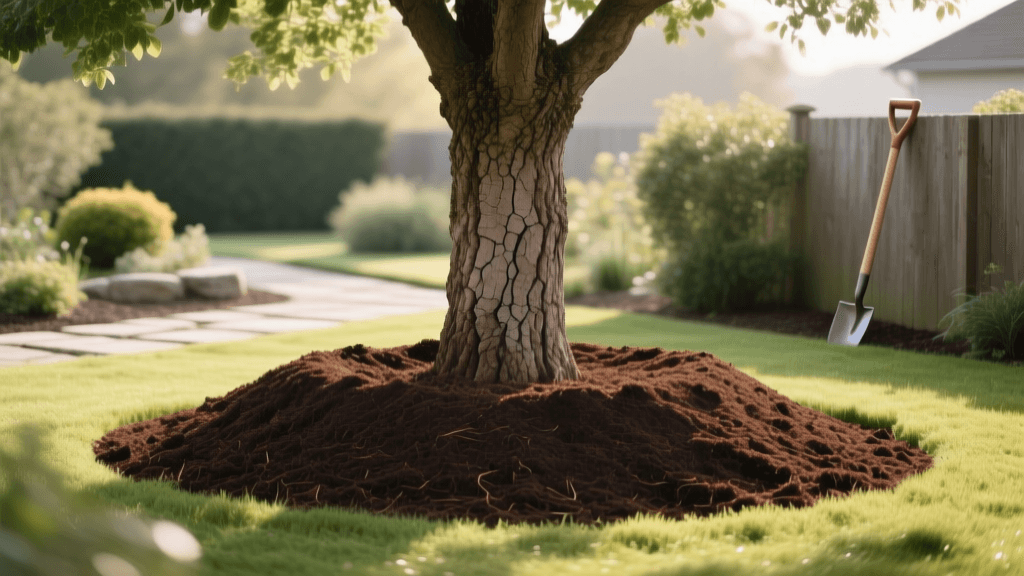
Armillaria spreads through dark, string-like fungal strands called rhizomorphs. They can travel up to 10 feet through soil from old stumps or root fragments. The fungus sticks around in dead wood for decades. Phytophthora root rot — caused by water molds in the genus Phytophthora — thrives where drainage is poor or trees get too much water. It’s the top reason newly planted trees decline, especially when root balls are buried too deep or mulch is piled against the trunk.
ANSI A300 Part 5 (Management of Trees and Shrubs During Site Planning, Site Development, and Construction) says the root protection zone (RPZ) for trees near construction should extend at least 1 foot outward for every inch of trunk diameter. For a 20-inch DBH oak, that’s a 20-foot radius of protected soil. On most job sites, that rule gets ignored — and the trees pay for it later.
Integrated Disease Management: A Practical Framework
Managing tree disease well means making a series of connected choices — based on what’s really going on, the tree’s species, the site conditions, and how much risk you’re willing to accept. This framework lines up with current best practices from the ISA and the American Phytopathological Society (APS, 2022).
Diagnosis Before Treatment
Misdiagnosing a tree disease is the most common mistake — and often the most expensive one. Spraying fungicide on a tree suffering from Phytophthora root rot won’t help if the real problem is soggy soil. Before treating anything, collect samples — pieces of bark, leaf tissue, or soil cores — and send them to a certified plant diagnostic lab. Most state land-grant universities offer this service. The Penn State Plant Disease Clinic and the University of Illinois Plant Clinic both turn samples around in 5–10 business days.
A certified arborist (with the ISA Certified Arborist credential) should also look at the tree in person. The ISA’s TRAQ (Tree Risk Assessment Qualification) process gives a clear way to judge whether disease has reached the point where the tree might fail and become unsafe.
Pruning Standards and Wound Management
Pruning can help manage disease — but it can also spread it. ANSI A300 Part 1 (Pruning) says cuts should land at the branch collar — the slightly swollen area where the branch meets the trunk — without leaving stubs or cutting flush. That kind of cut lets the tree wall off the wound using its natural compartmentalization process (CODIT — Compartmentalization of Decay in Trees).
Don’t use wound dressings or pruning paints unless you’re dealing with oak wilt in an area where it’s common. Research from the USDA Forest Service’s Northern Research Station found these products don’t stop decay, sometimes trap moisture, and can even slow the callus growth that helps seal wounds. The only exception is oak wilt: the Texas Forest Service recommends painting fresh pruning cuts on oaks right away during February–June to block spores.
"The best time to prune most trees is when they’re dormant and pathogens aren’t active — late fall through early spring in temperate climates. For oak wilt, avoid wounding oaks between February 1 and June 30 in counties where the disease is present. A single fresh cut during that window can draw nitidulid beetles carrying Bretziella fagacearum spores within hours." — Texas A&M Forest Service, Oak Wilt Management Guidelines, 2021
Fungicide and Systemic Treatment Protocols
Systemic fungicides work best before infection takes hold — or very early on. Trunk injection puts the chemical straight into the xylem, avoiding problems with soil uptake. Products like Arborjet’s TREE-äge and Mauget capsules are commonly used to protect high-value elms from DED. How often you need to re-treat depends on the product and tree size: a 30-inch DBH elm usually needs another round every 2–3 years, costing $150–$400 per treatment depending on local labor rates.
Soil drenches with phosphonate compounds (like potassium phosphite) have worked against Phytophthora in trials run by the University of California Cooperative Extension. Applying 10–20 mL of 53.3% phosphorous acid per inch of trunk circumference — diluted and poured into the root zone — can help keep Phytophthora in check, especially if you also fix the drainage.
Species-Specific Vulnerability and Resistance Data
| Species | Primary Disease Risk | Resistance Level | Annual Growth Rate | Root Spread (mature) |
|---|---|---|---|---|
| American Elm (Ulmus americana) | Dutch Elm Disease | Low (standard); High (Princeton, Valley Forge cultivars) | 3–6 ft/year | 1.5× crown radius |
| Red Oak (Quercus rubra) | Oak Wilt | Low | 1–2 ft/year | 2–3× crown radius |
| White Oak (Quercus alba) | Oak Wilt | Moderate | 0.5–1 ft/year | 2–3× crown radius |
| Sycamore (Platanus occidentalis) | Anthracnose | Low–Moderate | 2–3 ft/year | 1.5–2× crown radius |
| Dogwood (Cornus florida) | Anthracnose, Powdery Mildew | Low | 0.5–1 ft/year | 1× crown radius |
| Crabapple (Malus spp.) | Fire Blight, Apple Scab | Varies by cultivar | 1–2 ft/year | 1–1.5× crown radius |
Root spread data matters when planning soil treatments, trenching, or construction. The old idea that roots only go as far as the drip line — the edge of the canopy — is too narrow for most trees. A 2018 study in the ISA’s Arboriculture & Urban Forestry journal found structural roots in open-grown oaks extended 2–3 times the crown radius, and fine feeder roots went even further in good soil.
When Removal Is the Right Decision
Some diseased trees can’t be saved — or shouldn’t be. Deciding whether to remove a tree means weighing treatment costs, chances of recovery, how much life the tree has left, and, most importantly, whether it poses a danger to people or property if it falls. A 60-inch DBH cottonwood with 40% crown dieback from Cytospora canker and visible decay columns in the main stem is a different situation than a 6-inch DBH dogwood with anthracnose.
The ISA Best Management Practices for Tree Risk Assessment (Dunster et al., 2017) uses a simple matrix: likelihood the tree will fail, likelihood it will hit something, and how serious the consequences would be. Trees rated “high” or “extreme” risk should come down — no matter how much you like them or how nice they look. Cities like Chicago, Portland, and Seattle use this system for their street trees, helping them decide where to spend removal and replacement budgets across inventories of 300,000+ trees.
- Remove immediately: trees with structural cracks, included bark in major branch unions, heaved root plates, or fungal conks (like Ganoderma or Inonotus) at the base — signs of advanced internal decay
- Monitor closely: trees with less than 25% crown dieback, no structural flaws, and confirmed disease that responds to treatment
- Treat and reassess: trees with moderate symptoms, high value on-site, and diseases known to respond to fungicide or cultural fixes
- Document and replace: trees in terminal decline where removal is delayed — record species, DBH, and location so you know what to plant instead
When you do remove a tree, grind the stump at least 12 inches below grade if Armillaria is involved — that cuts down on leftover fungus that could infect new trees. For oak wilt, the USDA Forest Service says chip or burn infected wood on-site rather than hauling it somewhere else, to keep the disease from spreading.
- Hire only ISA Certified Arborists — or companies that employ them — for diagnosis and treatment decisions
- Ask for lab confirmation before starting expensive systemic treatments
- Keep records of every treatment: product names, amounts used, and dates — that info helps you judge what’s working over time
- Choose disease-resistant cultivars when replacing trees: Princeton and Valley Forge elms, Chinkapin oak (Q. muehlenbergii) as an oak wilt alternative, and crabapples like 'Prairifire' and 'Sugar Tyme'
- Avoid unnecessary wounds — every nick or scrape is a possible entry point. Repeated small injuries (from string trimmers, lawn mowers, or bad pruning) add up and make trees more vulnerable
Managing tree disease is a long game. What you do at planting — picking the right species, spacing them properly, preparing the soil, setting the right depth — sets the stage for disease risk decades later. A tree planted 3 inches too deep, with burlap left on the root ball and mulch piled against the trunk, starts off compromised. But a tree planted correctly in well-drained soil, with enough room for roots, pruned to ANSI A300 standards, and checked each year by a qualified arborist? That one can stay healthy and useful for a hundred years or more.