Pest Control
How To Use Neem Oil For Garden Pest Control
What Neem Oil Is and How It Works Against Pests
Neem oil is a naturally occurring pesticide pressed from the seeds of the neem tree (Azadirachta indica), native to the Indian subcontinent. Farmers have used it for pest control for centuries, and more gardeners and growers are turning to it now as an alternative to synthetic insecticides. The main active ingredient, azadirachtin, affects insect hormones instead of attacking their nervous systems — so it works differently than most conventional sprays.
Azadirachtin interferes with ecdysone, the hormone insects need to molt and grow. Insects exposed to it often fail to shed their old skin, stop eating, and die before they can reproduce. Other compounds in crude neem oil — nimbin, nimbidin, and salannin — add repellent and antifeedant effects. Since this mechanism targets pathways found only in insects, neem oil is relatively safe for mammals, birds, and many beneficial insects when used as directed.
Commercial neem oil products differ widely in how much azadirachtin they contain. Cold-pressed neem oil usually has 0.3–0.5% azadirachtin by weight. Clarified hydrophobic extracts — the kind used in some ready-to-use sprays — may contain less than 0.001% azadirachtin but still work against fungi and pests by smothering them or disrupting their outer layers. Which type you choose matters: it affects what pests you can target and when to apply it.
Target Pests and Their Lifecycles
Neem oil works best on soft-bodied insects and mites while they’re still young. Timing matters — it’s most effective during egg hatch and early larval stages, before their outer skin hardens and blocks the oil.
Aphids, Whiteflies, and Spider Mites
Aphids reproduce without mating during warm months. A single female can produce 40–60 offspring over 20–30 days under ideal conditions (University of California Statewide IPM Program, 2023). At 25°C, populations can double in just 1.5 days — so catching them early helps. A 2% spray (about 2 tablespoons per gallon of water, plus a drop of dish soap or horticultural surfactant) slows nymph development and cuts down how many eggs adults lay. During peak season, spraying every 7–14 days usually keeps numbers in check.
Whitefly nymphs don’t move much once they reach their second and third instars — that makes them easier to hit with a contact spray like neem oil. The greenhouse whitefly (Trialeurodes vaporariorum) finishes its lifecycle in about 25 days at 24°C. The crawler stage — the first instar, and the only one that moves — is the best time to spray. Yellow sticky traps help track when adults are flying and laying eggs, so you know when to start.
Two-spotted spider mites (Tetranychus urticae) can complete a generation in as little as 5–7 days at 30°C, especially when it’s hot and dry. Lab studies show salannin, one of neem’s natural compounds, deters mites. Because mites build resistance quickly to many miticides, Cornell University Cooperative Extension suggests rotating neem oil with options like insecticidal soap or sulfur to keep it working longer.
Caterpillars and Beetle Larvae
Azadirachtin works best on caterpillars in their first or second instar. By the third or fourth instar, their thicker skin and faster feeding often outpace the oil’s effects. For pests like cabbage loopers (Trichoplusia ni) and imported cabbageworms (Pieris rapae), start spraying right after eggs hatch. Many state extension services offer degree-day models to predict hatch timing. For example, the cabbage looper needs about 306 degree-days (base 10°C) to finish one full lifecycle.
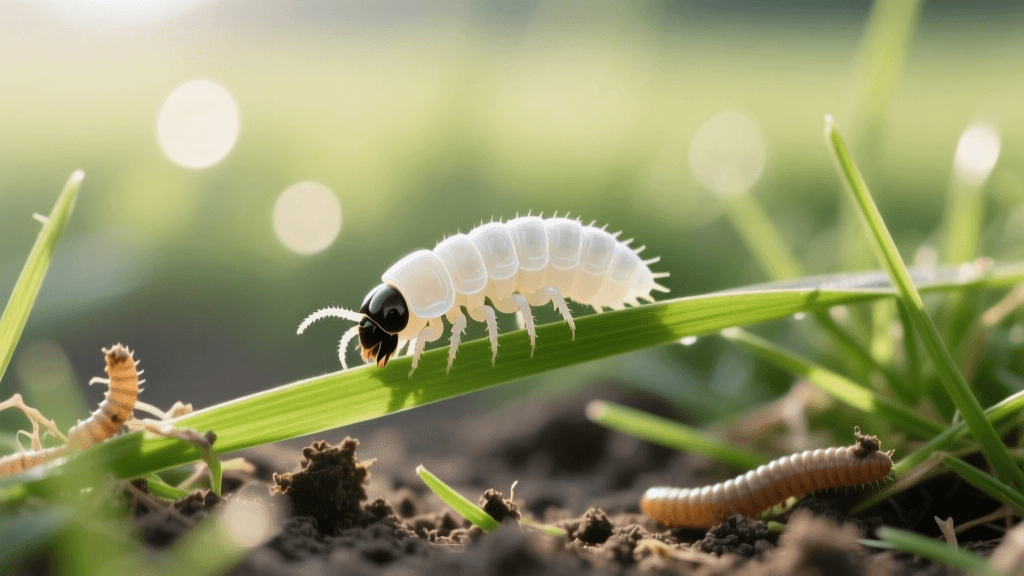
Japanese beetle grubs (Popillia japonica) in lawns and garden beds respond to neem oil applied as a soil drench, though it’s not as reliable as it is on leaves. Grubs are active from late summer through spring, but they’re easiest to reach in early fall — when they’re small and feeding near the surface. The University of Massachusetts Extension recommends applying neem-based drenches in August or September, when grubs are in their first or second instar.
Fungus Gnats and Soil Pests
Fungus gnat larvae (Bradysia spp.) feed on plant roots, especially in moist, organic-rich potting mixes and garden beds. At 24°C, the larval stage lasts 12–14 days. Drenching the soil with a 0.5–1% neem oil solution every 7 days disrupts their development and reduces how many adults emerge. Letting the top inch of soil dry between waterings also helps — larvae need constant moisture to survive.
Mixing, Application Rates, and Timing
Neem oil doesn’t dissolve in water on its own. You’ll need an emulsifier — a few drops of liquid dish soap or a horticultural surfactant — to get it to mix evenly. For most garden use, the standard foliar spray is 2 tablespoons (about 30 mL) of neem oil plus 1 teaspoon (5 mL) of emulsifier per gallon of water. Some IPM guidelines allow up to 4 tablespoons per gallon for heavy infestations, but higher rates raise the chance of leaf burn.
Temperature and timing affect both how well neem oil works and whether it harms plants. Don’t spray when it’s over 32°C (90°F), or when plants are drought-stressed — that’s when leaf damage is most likely. Early morning or evening applications give the oil time to dry before midday heat hits. Also avoid spraying within 24 hours of rain, since neem oil washes off easily and breaks down fast in sunlight — its half-life in direct sun is about 1–2.5 days.
"Neem-based pesticides are most effective when used as part of a comprehensive IPM program that includes monitoring, cultural controls, and biological controls. Relying on any single input — organic or synthetic — increases the risk of pest resistance and secondary pest outbreaks." — UC Cooperative Extension, Integrated Pest Management Guidelines, 2022
Good coverage matters. Neem oil kills mainly on contact or when pests eat treated leaves — it doesn’t linger in the air. That means you need to coat both sides of leaves, especially the undersides where aphids, whiteflies, and spider mites tend to gather. A pump sprayer with a fine mist nozzle usually gives better coverage than a hose-end sprayer for most home gardens.
Application Schedule by Pest Pressure
| Pest | Target Stage | Application Interval | Recommended Concentration | Notes |
|---|---|---|---|---|
| Aphids | Nymphs, adults | Every 7 days | 2% (2 tbsp/gal) | Begin at first colony detection |
| Whiteflies | Crawlers (1st instar) | Every 7–10 days | 2% | Time to egg hatch using sticky trap counts |
| Spider mites | Nymphs | Every 5–7 days | 2–3% | Rotate with insecticidal soap |
| Caterpillars | 1st–2nd instar larvae | Every 7–14 days | 2% | Apply at egg hatch; combine with Bt if pressure is high |
| Fungus gnats | Larvae in soil | Every 7 days (drench) | 0.5–1% | Allow soil surface to dry between waterings |
| Japanese beetle grubs | 1st–2nd instar | Single application in Aug–Sept | 2–3% soil drench | Water in thoroughly after application |
Integrating Neem Oil Into an IPM Program
Integrated pest management — as defined by the Food and Agriculture Organization and practiced by land-grant universities across the U.S. — focuses on keeping pest numbers low enough that they don’t cause economic or visible damage. It favors methods that disturb the garden ecosystem as little as possible. Neem oil fits well here: it’s a lower-risk option you can use after checking and confirming pest levels have crossed your action threshold.
The North Carolina State University Extension IPM program outlines a simple four-step process: identify the pest correctly, watch population levels over time, decide what number triggers action, then pick controls starting with the gentlest options. Neem oil usually falls into the second tier — after things like hand-picking, row covers, or adjusting watering, but before broad-spectrum synthetics. One common reason neem oil doesn’t work is misidentification. It won’t do much against large, mature chewing insects — or against slugs, earwigs, or adult beetles living in the soil.
Protecting beneficial insects matters too. Neem oil is generally safe for bees once it dries, but wet spray on open flowers during foraging hours can harm them. The Xerces Society for Invertebrate Conservation advises spraying in the evening, after bees have gone back to their hives, and skipping flowering plants entirely. Predators like lacewings, parasitic wasps, and lady beetles also handle neem oil better than they do pyrethroids — so it’s a good fit if you’re already encouraging natural pest control.
Resistance Management
Azadirachtin targets one specific hormonal pathway, so using it over and over without switching things up could eventually lead to resistance. Rotating with products that work differently — like insecticidal soap (which breaks down cell membranes), spinosad (which affects nerve receptors), or kaolin clay (a physical barrier) — helps prevent that. The Insecticide Resistance Action Committee (IRAC) lists azadirachtin as Group UN (unknown or uncertain mode of action), meaning it should be rotated with products from other IRAC groups rather than used alone all season.
Compatibility With Other Inputs
Don’t mix neem oil with sulfur-based fungicides — the combination can burn plants. Wait at least two weeks between sulfur and neem applications. Neem oil usually plays well with Bacillus thuringiensis (Bt), copper fungicides, and most biological controls — as long as you apply them separately. If you’re unsure about mixing it with something new, test it on a few leaves first.
Storage, Shelf Life, and Product Selection
Pure neem oil turns solid below about 18°C (65°F). If it’s congealed, just set the bottle in warm water for a few minutes — that brings it back to liquid without hurting the active ingredients. Once mixed with water, use the spray within 8 hours. The emulsion starts breaking down, and azadirachtin degrades quickly in solution.
Unopened, undiluted neem oil lasts 1–2 years if kept cool and dark, away from sunlight. Products with higher azadirachtin levels break down faster than clarified hydrophobic extracts. When buying, check the label’s guaranteed analysis for the azadirachtin percentage. EPA-registered products have been reviewed for safety and effectiveness, and their label directions are legally required — always follow them. Under FIFRA (Federal Insecticide, Fungicide, and Rodenticide Act), the label is the law.
- Look for products listing azadirachtin concentration as a percentage on the guaranteed analysis panel.
- Cold-pressed neem oil retains the full range of active compounds; solvent-extracted versions may have less of the secondary actives.
- EPA-registered products have undergone efficacy and safety review; unregistered "raw" neem oil may be used as a plant amendment but cannot legally be marketed with pest control claims.
- Organic certification: neem oil is listed by the Organic Materials Review Institute (OMRI) as approved for use in certified organic production when used according to label directions.
- Avoid products with undisclosed "inert" ingredients if pollinator safety is a concern — some surfactants in formulations are harder on bees than the neem oil itself.
Common Application Mistakes and How to Avoid Them
The most common reason neem oil doesn’t control pests is poor coverage. People often use too little spray, or skip the undersides of leaves where pests cluster. A proper application leaves visible droplets on all leaf surfaces — including the bottom side. On dense crops like kale or basil, gently part the leaves and spray inside the canopy.
Another frequent mistake is spraying too infrequently. One application rarely holds pests down all season. Azadirachtin breaks down in sunlight and rain, and even a few surviving pests can rebuild populations fast. Sticking to a 7–14 day schedule during active pest periods usually works better than stopping as soon as you see fewer bugs.
- Do not apply to water-stressed plants — drought stress increases phytotoxicity risk significantly.
- Do not apply in direct midday sun or when temperatures exceed 32°C.
- Do not use hard water without adjusting pH — neem oil emulsions are more stable at slightly acidic pH (6.0–7.0); hard water above pH 8 can cause the emulsion to break.
- Do not expect neem oil to kill large, mature caterpillars or adult beetles — it is most effective as a preventive and early-intervention tool.
- Do not apply to seedlings less than two weeks old without testing on a small area first, as young plants can be more sensitive to oil-based sprays.
If you see yellowing, brown leaf edges, or water-soaked spots within 24–48 hours, that’s likely phytotoxicity. Rinse the leaves with clean water and hold off on further sprays until the plant recovers. Dropping to a lower concentration or spraying in cooler weather usually fixes it.
Used well — timed to pest lifecycles, sprayed thoroughly, and combined with good monitoring and other practices — neem oil is one of the more flexible lower-risk tools available to home gardeners and small-scale growers. Its success depends less on the bottle you buy and more on how closely you watch your plants, how carefully you spray, and how well you pair it with other smart growing habits.