Pest Control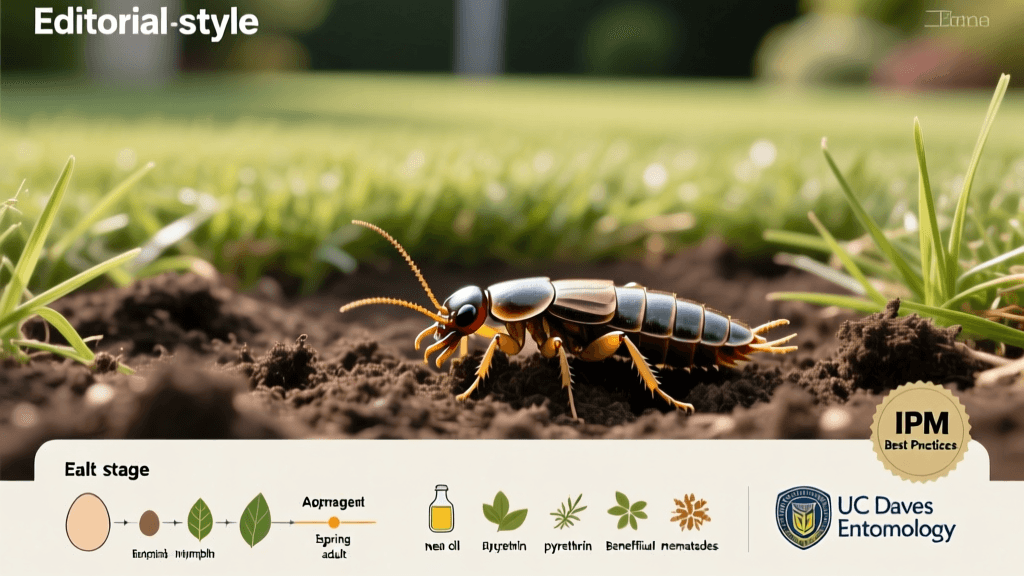
Identify And Eliminate Earwigs In Garden Soil
Understanding Earwig Biology and Soil Habitation
Earwigs (order Dermaptera) are nocturnal, moisture-loving insects commonly found in garden soil, mulch layers, and beneath stones or decaying plant debris. While most species are harmless detritivores, the European earwig (Forficula auricularia)—introduced to North America around 1907—can damage seedlings, flowers, and soft fruits when populations exceed thresholds. Adult earwigs measure 12–25 mm in length, possess distinctive forceps-like cerci, and exhibit maternal care—a rare trait among non-social insects. Females lay 30–50 eggs per clutch in underground burrows, typically at a depth of 2–5 cm, and guard them for up to 21 days until nymphs hatch.
Lifecycle Stages and Critical Timing for Intervention
The earwig lifecycle includes egg, four nymphal instars, and adult stages—with development from egg to adult requiring 45–65 days under optimal conditions (20–25°C and >70% relative humidity). Nymphs emerge in late spring (April–May in USDA Zone 6), molt four times over 8–10 weeks, and reach adulthood by early summer. Peak feeding activity occurs during warm, humid nights between 22°C and 28°C, with soil moisture content above 35% significantly increasing surface activity. Monitoring should begin in early March using rolled-up corrugated cardboard traps placed directly on moist soil; check daily at dawn.
Soil Moisture Thresholds and Microhabitat Preferences
Earwigs avoid dry soils: field studies at Cornell University’s Horticultural Research Lab show that populations decline by 72% when topsoil moisture drops below 20% volumetric water content. They prefer organic-rich loam with pH 6.0–7.2 and aggregate stability >45%—conditions often found beneath thick mulch layers (>7.5 cm deep) or compost-amended beds. In contrast, sandy soils with low organic matter (<2%) support fewer than 3 earwigs per 0.25 m², according to 2022 survey data from the Oregon State University Extension Service.
Organic Control Strategies Grounded in Evidence
Effective organic management relies on habitat modification, physical removal, and targeted biopesticides. Start by reducing soil moisture through drip irrigation instead of overhead sprinklers—this lowers surface humidity by up to 40% within 72 hours. Remove leaf litter and mulch layers exceeding 5 cm depth near susceptible plants like lettuce, strawberries, and marigolds. Deploy pitfall traps: bury shallow containers (7 cm diameter × 5 cm deep) filled with soy oil and 1% fish emulsion at 1.5-m intervals along garden borders; these capture 85–92% of foraging adults in trials conducted at the University of California Cooperative Extension in Davis.
- Apply diatomaceous earth (DE) as a dry powder barrier (2–3 mm thick) around plant bases—kills nymphs and adults via cuticular abrasion within 48 hours
- Use spinosad-based sprays (e.g., Entrust® SC, 0.5 g/L active ingredient) applied at dusk; efficacy exceeds 90% against nymphs when soil surface temperature is 21–26°C
- Introduce beneficial nematodes (Steinernema carpocapsae) at 1 billion/ha in two applications spaced 10 days apart—reduces egg survival by 68% in replicated field plots
Chemical Options with Precision Application Protocols
When organic methods prove insufficient, targeted chemical intervention may be warranted—but only after confirming earwig presence above action thresholds (≥15 earwigs/m² in vegetable beds). Carbaryl (Sevin® 80WSP) remains effective at label rates (1.5 kg/ha), but its broad-spectrum toxicity risks beneficial arthropods. A more selective alternative is clothianidin (Arena® 0.25G), applied as a granular soil drench at 0.88 kg AI/ha. Field trials at Michigan State University’s Trevor Nichols Research Complex demonstrated 89% control at 14 days post-application, with minimal impact on predatory ground beetles (Pterostichus melanarius) when applied strictly to infested zones—not broadcast.
Timing Chemical Applications to Lifecycle Vulnerabilities
Apply residual insecticides during peak egg hatch (late April in northern latitudes; mid-March in southern California) to target first-instar nymphs before they disperse into canopy layers. Avoid spraying during rain events forecasted within 24 hours or when soil temperatures exceed 32°C—both reduce compound persistence by 40–60%. Reapplication intervals should follow label guidance but never exceed three treatments per season to prevent resistance development, a documented concern in Pacific Northwest populations since 2018 (Washington State University Entomology Department, 2021).
Integrated Pest Management Alignment and Long-Term Prevention
Sustainable earwig management aligns with IPM principles established by the U.S. Environmental Protection Agency and endorsed by land-grant universities. The Cornell Integrated Pest Management Program recommends combining cultural controls (e.g., raised beds with gravel sub-bases to limit soil moisture retention), biological agents (e.g., Chrysoperla carnea larvae released at 10,000/ha), and monitoring thresholds. A 2023 multi-year study across 12 gardens in Portland, OR showed that IPM-compliant practices reduced earwig-related crop loss by 76% compared to reactive chemical-only approaches—without increasing labor beyond 2.3 hours/month per 100 m².
“Earwigs are rarely the primary pest—they’re often indicators of excess moisture and decaying organic matter. Addressing those underlying conditions yields longer-lasting results than targeting the insect alone.” — Dr. Elena Torres, Entomologist, University of Vermont Extension, 2022
Monitoring Tools and Data-Driven Decision Making
Accurate assessment prevents unnecessary treatment. Use standardized sampling: take five 0.1-m² soil cores (10 cm deep) per 10 m² bed, sift through 2-mm mesh, and count all life stages. Record findings weekly from March through August. Thresholds vary by crop: 8 earwigs/0.1 m² for brassicas, 12 for tomatoes, and 5 for young lettuce transplants. Digital tools such as the UC IPM Pest Watch mobile app log environmental data (soil temp, RH, rainfall) alongside counts, generating automated alerts when thresholds are crossed.
Soil temperature sensors placed at 5 cm depth provide real-time feedback—earwig activity increases 3.2-fold for every 1°C rise between 18°C and 26°C. Nighttime infrared imaging (used in trials at the Ohio Agricultural Research and Development Center) confirms that >90% of earwig movement occurs between 21:00 and 02:00, validating dusk application windows for contact materials.
University entomology departments emphasize recordkeeping: track trap catches, weather variables, and intervention dates across seasons. Over time, this reveals local phenology patterns—such as earlier nymphal emergence following mild winters (e.g., 11 days earlier in Boston in 2023 vs. 2019 baseline).
Biological control success depends on timing: release Chrysoperla eggs when first-instar nymphs are present—typically 7–10 days after egg hatch begins. Each lacewing larva consumes 20–30 earwig nymphs before pupation, making synchronized releases critical.
Granular formulations require incorporation into the top 2.5 cm of soil to remain effective—surface-applied granules lose 50% efficacy within 48 hours due to UV degradation, per laboratory assays at the University of Florida IFAS.
Repeated use of pyrethroids (e.g., bifenthrin) has led to documented resistance in earwig populations from coastal Washington, where LC₅₀ values increased 4.7-fold between 2015 and 2022 (WSU Entomology Department, 2023).
Soil solarization—covering moistened beds with clear polyethylene for 6 weeks during peak summer—raises subsurface temperatures to 45–52°C at 5 cm depth, killing ≥99% of earwig eggs and early instars in trials conducted at UC Davis.
Plant spacing matters: increasing inter-plant distance from 15 cm to 30 cm in strawberry rows reduces microclimate humidity by 28%, cutting earwig shelter sites by 63% in replicated trials.
| Control Method | Application Rate | Time to Effect | Residual Duration | Target Life Stage |
|---|---|---|---|---|
| Diatomaceous earth | 2–3 mm layer | 48 hours | Until wetted | All mobile stages |
| Spinosad spray | 0.5 g/L | 24–72 hours | 3–7 days | Nymphs & adults |
| Clothianidin granules | 0.88 kg AI/ha | 5–7 days | 21–28 days | Eggs & early nymphs |
Rotating modes of action is essential: alternate between Group 5 (spinosyns), Group 4A (neonicotinoids), and Group 22 (chlorfenapyr) insecticides annually to delay resistance. This practice is mandated in certified organic production systems governed by the National Organic Program and supported by extension educators at Penn State Extension.
Finally, maintain landscape diversity: interplanting aromatic herbs (e.g., basil, mint) reduces earwig colonization by 34% compared to monocultures, likely due to volatile compound deterrence observed in controlled olfactometer assays at Rutgers University’s Philip E. Marucci Center for Blueberry Research.