Lawn Care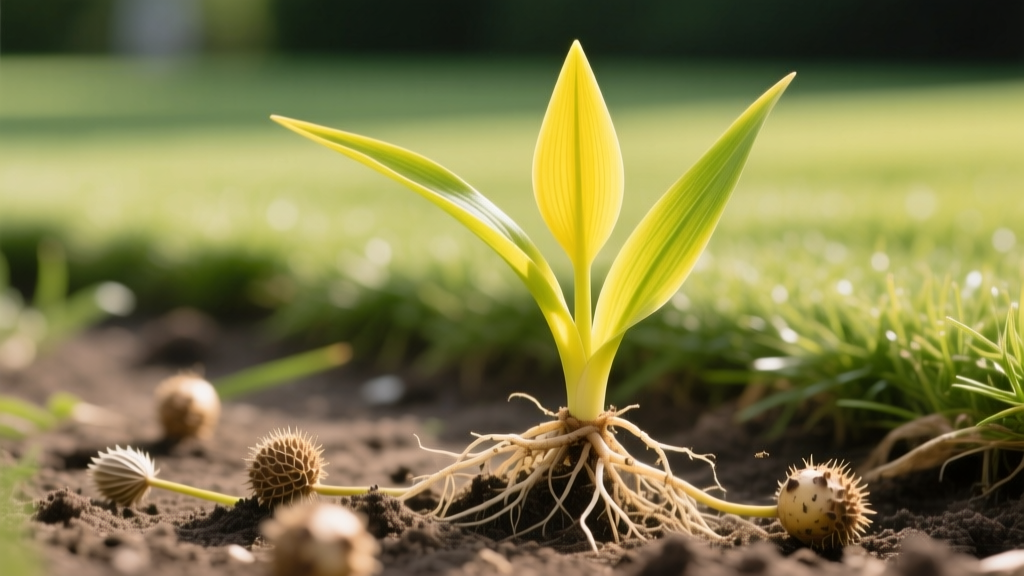
How to Identify and Eradicate Yellow Nutsedge in Lawns
Lisa ThompsonPublished
What is Yellow Nutsedge?
If you have ever noticed a patch of light green, fast-growing blades shooting up through your perfectly manicured lawn just days after mowing, you are likely dealing with yellow nutsedge (Cyperus esculentus). Often mistakenly called "nutgrass," yellow nutsedge is not a grass at all, nor is it a broadleaf weed. It is a sedge. This biological distinction is critical because standard grass and broadleaf weed killers will not touch it. Nutsedge is a perennial weed that reproduces primarily through underground tubers, known as "nutlets," making it one of the most stubborn and frustrating invaders a homeowner can face.
According to Penn State Extension, a single yellow nutsedge plant can produce hundreds of tubers in a single growing season. These tubers can remain dormant in the soil for years, sprouting when conditions become favorable. To win the war against nutsedge, you must move beyond generic weed-and-feed products and adopt a targeted identification and eradication strategy.
How to Identify Yellow Nutsedge
Proper identification is the first step in effective weed control. Because nutsedge mimics turfgrass in its early stages, many homeowners misidentify it until it has already established a massive underground network. Here are the key visual indicators to look for:
- Stem Shape: Unlike grass, which has round or flattened stems, sedge stems are distinctly triangular. Remember the old gardening rhyme: "Sedges have edges." If you roll the stem between your fingers, you will feel three distinct sides.
- Color and Growth Rate: Yellow nutsedge is typically a lighter, almost yellowish-green compared to your surrounding turf. It also grows significantly faster than most turfgrasses, often poking 2 to 3 inches above the canopy just two days after mowing.
- Leaf Structure: The leaves are thicker, stiffer, and have a prominent central midrib. They grow in sets of three at the base, whereas grass leaves grow in sets of two.
- Seedheads: If left unmowed, yellow nutsedge will produce a distinctive, umbrella-like seedhead (an inflorescence) with golden-brown spikelets.
Comparison Chart: Turfgrass vs. Yellow Nutsedge vs. Purple Nutsedge
| Feature | Standard Turfgrass | Yellow Nutsedge | Purple Nutsedge |
|---|---|---|---|
| Stem Shape | Round or Flat | Triangular (V-shaped) | Triangular (V-shaped) |
| Leaf Arrangement | Groups of 2 | Groups of 3 | Groups of 3 |
| Leaf Color | Dark to Medium Green | Light Yellowish-Green | Dark Green with Purple Base |
| Seedhead Color | Varies (often green/brown) | Golden / Straw-colored | Purple / Dark Reddish-Brown |
| Tuber Taste/Coat | N/A | Sweet, Almond-like (Thin coat) | Bitter (Thick, wiry coat) |
Why Nutsedge is Invading Your Lawn
Nutsedge is an indicator weed. Its presence tells you something specific about your soil environment. The University of California IPM program notes that nutsedge thrives in environments with excessive moisture, poor drainage, and compacted soil. If you have a low-lying area in your yard where water pools after a heavy rain, or if your irrigation system has a leaky sprinkler head, nutsedge will be the first weed to colonize that area. Furthermore, nutsedge loves thin turf. If your lawn is mowed too short or lacks proper fertilization, the turf canopy opens up, allowing sunlight to reach the soil surface and trigger dormant nutsedge tubers to sprout.
Cultural Controls: Preventing Nutsedge
Before reaching for chemicals, you must address the environmental conditions that invite nutsedge. Cultural controls will not kill existing tubers, but they will prevent new ones from germinating and help your turf outcompete the invaders.
1. Fix Drainage and Irrigation Issues
Audit your sprinkler system to ensure you are not overwatering specific zones. Replace broken heads and adjust nozzles to prevent runoff. If you have heavy clay soil that holds water, consider core aeration in the fall to relieve compaction and improve water infiltration. In severe cases, installing a French drain or regrading the lawn may be necessary to eliminate standing water.
2. Raise Your Mowing Height
Mowing your lawn too short stresses the turf and allows sunlight to hit the soil, triggering nutsedge growth. Raise your mower deck to the highest recommended setting for your specific grass type. For example, Tall Fescue should be mowed at 3 to 4 inches, while Bermudagrass should be kept at 1.5 to 2.5 inches. A thick, tall canopy shades the soil and suppresses nutsedge emergence.
3. Manual Removal: Why Pulling Fails
Many homeowners attempt to pull nutsedge by hand. While this removes the visible plant, it almost always leaves the "nutlets" and rhizomes behind in the soil. Worse, the physical trauma of pulling can actually stimulate dormant tubers on the same rhizome to sprout, resulting in three or four new plants replacing the one you pulled. If you must hand-pull, do it only when the plant is very young (before it has 5 to 6 leaves) and before tubers have formed, ensuring you dig deep enough to extract the entire root system.
Chemical Controls: The Best Herbicides for Nutsedge
Because nutsedge is a sedge, standard herbicides like 2,4-D (used for dandelions) or Glyphosate (non-selective) are largely ineffective or require multiple applications that damage surrounding turf. You need herbicides specifically formulated for sedges. The University of Minnesota Extension recommends targeting nutsedge with specific active ingredients that translocate down into the tubers.
Post-Emergent Herbicides (Killing Active Growth)
Post-emergent herbicides are applied when the nutsedge is actively growing. The ideal time to spray is when the plant is young, between the 3-leaf and 8-leaf stages, usually in late spring or early summer. At this stage, the plant is actively pulling nutrients (and herbicides) down into the developing tubers.
- Halosulfuron-methyl (e.g., SedgeHammer): This is the gold standard for residential nutsedge control. It is a systemic herbicide that is absorbed through the foliage and travels down to the tubers, sterilizing them. Cost: Approximately $25 for a box of 5 water-soluble packets. Mixing Rate: One 0.03 oz packet per 1 to 2 gallons of water, covering 1,000 square feet. Safety: Safe for most cool-season and warm-season grasses.
- Sulfentrazone (e.g., Dismiss): This is a contact and systemic herbicide that provides a much faster "burn down" of the visible foliage than Halosulfuron, often showing results in 24 to 48 hours. It also has some pre-emergent soil activity. Cost: Around $80 for a 4 oz bottle. Mixing Rate: 0.1 to 0.275 fluid ounces per 1,000 square feet. Safety: Excellent for cool-season grasses; use caution on certain warm-season grasses like St. Augustine.
- Sulfosulfuron (e.g., Certainty): Highly effective for warm-season lawns (Bermuda, Zoysia, St. Augustine). It is generally not recommended for cool-season turf like Kentucky Bluegrass or Fescue.
Crucial Application Tip: Sedge herbicides require a Non-Ionic Surfactant (NIS) to penetrate the waxy, thick cuticle of the nutsedge leaf. Without a surfactant (which costs about $15 for a bottle that lasts multiple seasons), the herbicide will bead up and roll off the leaf, rendering your application useless. Always add 1/4 ounce of surfactant per gallon of mixed solution unless the product label states otherwise.
Pre-Emergent Herbicides (Preventing Germination)
Pre-emergents create a chemical barrier in the soil that stops tubers from sprouting. However, standard pre-emergents like Prodiamine (Barricade) or Dithiopyr (Dimension) do not control nutsedge. You must use a pre-emergent specifically labeled for sedges:
- Dimethenamid-P (e.g., Tower): Highly effective against nutsedge. Often used in professional lawn care programs.
- S-metolachlor (e.g., Pennant Magnum): Another excellent pre-emergent specifically targeting yellow and purple nutsedge tubers before they emerge.
Apply these pre-emergents in early spring when soil temperatures consistently reach 60°F to 65°F, which is when nutsedge tubers begin to wake from dormancy.
Step-by-Step Nutsedge Eradication Calendar
To completely eradicate a severe nutsedge infestation, you must commit to a multi-year approach. Here is a seasonal roadmap to reclaiming your lawn:
Early Spring (Soil Temps 60°F)
- Apply a sedge-specific pre-emergent (S-metolachlor or Dimethenamid-P) to prevent the first flush of tubers from sprouting.
- Audit your irrigation system and fix any leaks or over-spraying issues.
Late Spring to Early Summer (Active Growth Phase)
- Monitor the lawn for the first signs of light green, triangular blades.
- Apply a post-emergent herbicide like SedgeHammer (Halosulfuron-methyl) mixed with a non-ionic surfactant when plants are in the 3-to-8 leaf stage.
- Avoid mowing for 2 days before and 2 days after your herbicide application to maximize leaf surface area for chemical absorption.
Mid-to-Late Summer (The Second Flush)
- Nutsedge often produces a second flush of growth in the heat of late summer. Inspect your lawn and apply a second round of post-emergent herbicide to any survivors or new sprouts. Do not let them reach the seedhead stage.
Fall (Cultural Recovery)
- Core aerate compacted areas of the lawn to improve drainage.
- Overseed thin patches of cool-season turf to build a dense canopy that will shade out nutsedge the following spring.
- Apply a winterizer fertilizer to strengthen turf roots.
Conclusion
Yellow nutsedge is a formidable opponent, but it is not invincible. By correctly identifying the weed, fixing the underlying drainage issues in your soil, and utilizing sedge-specific herbicides like Halosulfuron-methyl and Sulfentrazone with a proper surfactant, you can break the tuber lifecycle. Patience and consistency over two to three growing seasons will eventually starve the dormant nutlets in the soil, leaving you with a thick, healthy, and sedge-free lawn.