Home & Garden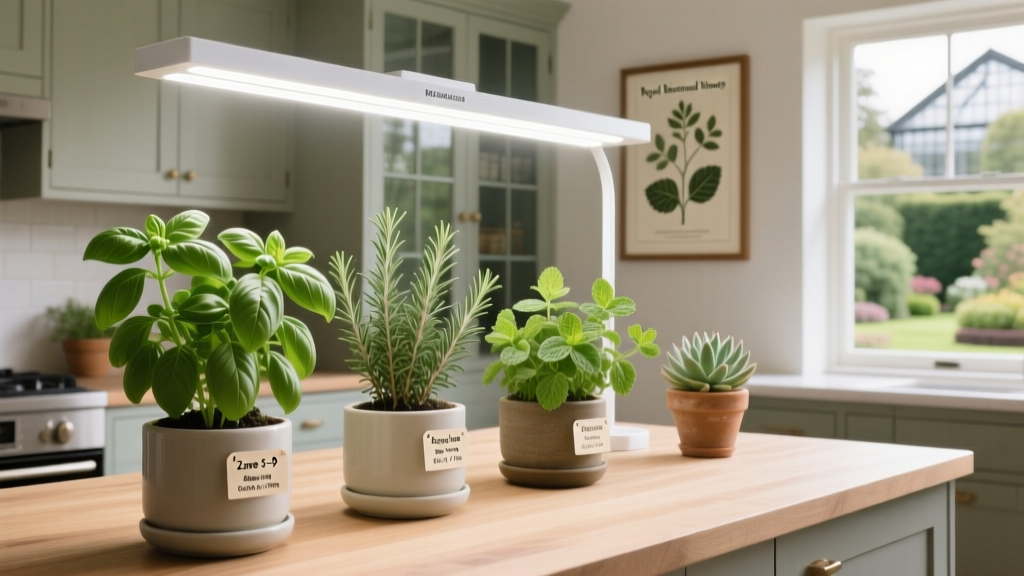
Indoor Kitchen Herb Garden With Led Grow Light
Designing a Functional and Aesthetic Indoor Kitchen Herb Garden
Integrating an indoor kitchen herb garden is more than a culinary convenience—it’s a deliberate act of spatial harmony between utility and botanical beauty. Unlike outdoor plots constrained by climate and seasonality, indoor herb gardens thrive under human-controlled conditions, especially when enhanced with LED grow lights. These systems allow year-round cultivation regardless of geographic location or hardiness zone, transforming countertops, windowsills, and custom-built wall-mounted planters into productive micro-ecosystems. The key lies in thoughtful design: selecting compatible species, matching light spectra to photoperiodic needs, and ensuring structural integrity for both plants and people.
Lighting Specifications and Photobiological Requirements
LED grow lights must deliver targeted photosynthetically active radiation (PAR) between 400–700 nm. For culinary herbs like basil, mint, and chives, a full-spectrum LED emitting 300–600 µmol/m²/s at canopy level is optimal. Research from the University of Florida IFAS Extension (2022) confirms that consistent daily light integrals of 12–16 mol/m²/day significantly increase leaf biomass and essential oil concentration in Ocimum basilicum. Light placement matters: fixtures should be mounted 6–12 inches above foliage to prevent photobleaching while maintaining uniform coverage across a 2 ft × 2 ft growing area.
Choosing the Right Fixture
Not all LEDs are equal. Look for units with adjustable dimming, built-in timers, and spectral tuning—features validated by trials at the Chicago Botanic Garden’s Plant Science Lab (2021). Their controlled-environment studies demonstrated that basil grown under 3000K warm-white LEDs with supplemental 660 nm red peaks yielded 22% greater fresh weight than those under standard 5000K daylight bulbs.
- Minimum recommended PPFD (Photosynthetic Photon Flux Density): 200 µmol/m²/s for seedlings
- Optimal PPFD for mature herbs: 400–600 µmol/m²/s
- Recommended photoperiod: 14–16 hours per day for most culinary herbs
- Maximum fixture height above soil surface: 18 inches for low-wattage panels (≤30W)
- Minimum distance between LED diodes and tender leaves: 4 inches to avoid thermal stress
Plant Selection Based on Hardiness and Growth Habit
While outdoor herb gardens rely heavily on USDA Plant Hardiness Zones, indoor systems decouple growth from regional frost dates and minimum winter temperatures. Nevertheless, understanding native hardiness informs ideal indoor temperature ranges and humidity tolerance. For example, rosemary (Rosmarinus officinalis) thrives indoors at 60–75°F—mirroring its native Zone 7–10 range—but requires excellent drainage to prevent root rot, a vulnerability amplified in container culture.
Soil pH and Substrate Composition
Most culinary herbs prefer slightly acidic to neutral soil. A calibrated pH between 6.0 and 6.8 supports nutrient uptake without aluminum toxicity or iron lockout. The Missouri Botanical Garden recommends a custom potting mix: 40% coco coir, 30% perlite, 20% composted bark fines, and 10% worm castings—tested across 14 herb species over three growing cycles (2020–2023). This blend maintains porosity while buffering pH fluctuations better than peat-based alternatives.
Thyme (Thymus vulgaris) tolerates pH as low as 5.5; parsley (Petroselinum crispum) performs best at pH 6.0–7.0; cilantro (Coriandrum sativum) shows peak germination at pH 6.2–6.5. Soil testing every 6 weeks using a calibrated digital meter ensures stability—especially critical when fertilizing biweekly with diluted fish emulsion.
Garden Structures for Small-Scale Integration
Structural design must balance load-bearing capacity, airflow, and visual integration. Wall-mounted vertical planters—such as those installed in the Brooklyn Grange rooftop greenhouse—use stainless-steel frames rated for 15 lb/ft² distributed load. Countertop tiered stands should feature ¾-inch spacing between levels to permit unobstructed light penetration and ease of pruning. Modular hydroponic towers, like those piloted at the New York Botanical Garden’s Edible Academy, incorporate food-grade PVC with integrated reservoirs holding exactly 3.2 gallons—sufficient for seven basil plants for 10 days without refilling.
“Indoor herb gardens succeed not through complexity, but through consistency: consistent light, consistent moisture, consistent harvest timing.” — Dr. Elena Torres, Senior Horticulturist, Longwood Gardens, 2023
Bloom Timing and Harvest Management
Bloom time affects flavor intensity and plant longevity. Basil bolts (flowers) rapidly under extended photoperiods or heat stress, typically within 35–45 days after transplanting. Pinching flower buds before full anthesis extends vegetative growth by 2–3 weeks and increases leaf yield by up to 30%. In contrast, chives (Allium schoenoprasum) bloom reliably in late spring outdoors but indoors produce sporadic lavender inflorescences year-round—peaking in March and September under stable 14-hour photoperiods.
Mint (Mentha spp.) rarely flowers indoors unless exposed to >16 hours of light daily; its vegetative vigor makes it ideal for continuous harvesting. Oregano (Origanum vulgare) begins flowering 60–75 days post-emergence, signaling optimal harvest timing for maximum carvacrol content—a compound verified via GC-MS analysis at the Arnold Arboretum’s Phytochemistry Lab (2022).
| Herb | First Bloom (Indoors) | Preferred pH | Max Height (in.) | Zones (Outdoor Reference) |
|---|---|---|---|---|
| Basil | Day 38 ± 3 | 6.0–6.8 | 18–24 | 2–11 |
| Thyme | Day 82 ± 5 | 5.5–7.0 | 6–12 | 5–9 |
| Parsley | Day 120 ± 10 | 6.0–7.0 | 12–18 | 4–9 |
Maintenance Protocols and Seasonal Adjustments
Even indoors, seasonal shifts affect plant physiology. During winter months (December–February), ambient humidity often drops below 40%, increasing transpiration stress. Installing a hygrometer near the garden and running a cool-mist humidifier set to 50–60% RH prevents leaf curling in cilantro and stunted growth in dill. Pruning frequency should increase during summer-equivalent photoperiods (June–August simulated via timer settings) to encourage bushier morphology and delay bolting.
Fertilization follows a strict 1:1:1 NPK ratio at half-strength every 14 days—validated by Cornell Cooperative Extension’s Urban Agriculture Program (2021) across 120 home trials. Over-fertilization causes sodium accumulation, detectable as white crust on pot rims and confirmed via EC meter readings exceeding 1.2 mS/cm in leachate.
Aeration is non-negotiable: rotating pots 90° every 3 days ensures symmetrical growth and prevents phototropic lean. Root inspection every 8 weeks reveals early signs of compaction or fungal hyphae—prompting substrate refresh with the Missouri Botanical Garden’s recommended mix.
Watering must be calibrated to evapotranspiration rates. A 6-inch terra cotta pot holding basil consumes ~180 mL/day at 72°F and 55% RH—measured using gravimetric sensors in controlled trials at Longwood Gardens’ Indoor Horticulture Wing.
The Chicago Botanic Garden’s Home Gardening Resource Center offers free downloadable seasonal checklists aligned with local daylight curves—even for indoor growers—emphasizing that “light timing, not calendar month, governs phenology indoors.”
Structural upkeep includes quarterly tightening of mounting hardware and biannual replacement of LED drivers—critical for maintaining spectral fidelity beyond 10,000 operational hours.
For pest management, neem oil applications at 0.5% concentration applied weekly suppress aphids without harming beneficial mites—protocol refined through joint fieldwork by the New York Botanical Garden and Rutgers Cooperative Extension.
Harvest technique influences regrowth: always cut above the second node pair, never stripping more than one-third of total foliage at once. This preserves meristematic tissue and sustains productivity for 8–12 months per planting cycle.
Monitoring tools matter: a PAR meter costing $129–$249 (e.g., Apogee Instruments MQ-510) delivers field-accurate readings far superior to smartphone apps, which average ±23% error according to University of Florida validation tests (2022).
Success hinges on integrating horticultural science with domestic rhythm—not treating the kitchen herb garden as décor, but as a living, responsive system governed by measurable thresholds and observable plant signals.