Tree Care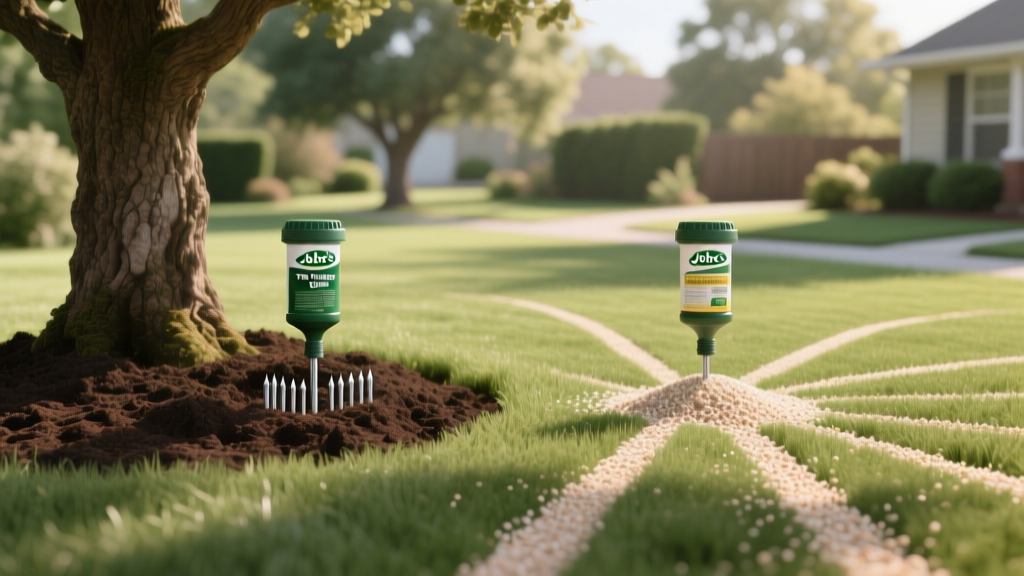
Jobe's Tree Spikes vs Granular Fertilizer: 2026 Guide
Mike RodriguezPublished
The Turf-Tree Interface: How Mowing Patterns Dictate Fertilizer Strategy in 2026
As we navigate the 2026 landscaping season, homeowners and lawn care professionals are increasingly recognizing that lawn care and tree care cannot be treated as isolated tasks. The health of your shade trees is intrinsically linked to the turfgrass growing beneath them, and more specifically, to the mowing techniques and patterns you employ. When deciding between targeted treatments like Jobe's Tree Fertilizer Spikes and broad-spectrum granular applications, the way you mow your lawn actually plays a hidden but critical role in determining which fertilizer method will be most effective.
Trees and turfgrass are natural competitors. They fight for the same water, sunlight, and soil nutrients. However, the physical act of mowing—specifically the patterns, turning radiuses, and edging techniques used around the tree base—alters the soil structure. Understanding this intersection is the key to choosing the right fertilizer delivery system for your landscape this year.
How Mowing Techniques Impact Soil Porosity and Nutrient Uptake
Before comparing Jobe's spikes to granular fertilizer, we must address the 'bullseye' mowing pattern. Many homeowners mow in tight, concentric circles around the trunk of a tree to ensure they get as close to the bark as possible. While this might look neat, arborists warn that this specific mowing pattern causes severe soil compaction in the critical root zone. The repeated weight of the mower, combined with the sharp turns, compresses the soil pores, destroying the macro-pores necessary for water and oxygen infiltration.
When soil is compacted by aggressive mowing patterns, surface-applied granular fertilizers struggle to penetrate the soil profile. The nutrients sit in the thatch layer or wash away during heavy spring rains, feeding the shallow turfgrass roots while the deeper tree roots starve. Conversely, if you employ a 'straight-line' mowing pattern that stops at the tree's drip line—leaving a wide, un-mowed mulch ring—the soil remains loose, porous, and highly receptive to granular applications.
According to the University of Minnesota Extension, the majority of a tree's feeder roots are located in the top 12 to 18 inches of soil, extending well past the drip line. If your mowing habits have compacted this zone, your fertilization strategy must adapt to bypass the physical barriers created by your lawn care routine.
Deep Dive: Jobe's Tree Fertilizer Spikes (2026 Formulations)
Jobe's Tree Fertilizer Spikes have long been a staple for homeowners seeking a low-effort, targeted feeding solution. In 2026, the standard Jobe's tree spike formulations (typically featuring an NPK ratio of 15-5-10 or 11-3-4, depending on the specific product line) continue to offer a concentrated dose of macronutrients directly into the soil.
The Mechanics of Spikes
Spikes are driven into the ground using a mallet and a specialized plastic cap. This physical insertion bypasses the thatch layer and the compacted soil surface caused by tight mowing patterns, delivering nutrients directly to the sub-surface root zone. Because they are placed in a ring around the drip line, they provide localized zones of high nutrient concentration.
Pros and Cons for Mowed Lawns
- Pro: Bypasses surface compaction caused by 'bullseye' mowing patterns.
- Pro: Eliminates the risk of burning the surrounding turfgrass, as the fertilizer is buried.
- Pro: Extremely fast application; a box of 15 spikes costs approximately $18 to $22 in 2026 and takes less than ten minutes to install.
- Con: Creates localized 'hot spots' of nutrients rather than uniform distribution.
- Con: If driven too close to the trunk, the high salt concentration of the spike can cause severe root burn.
Deep Dive: Granular Tree Fertilizer (2026 Blends)
Granular fertilizers, such as balanced 10-10-10 blends or specialized slow-release tree-and-shrub formulas, are broadcast over the soil surface. In 2026, many premium granular fertilizers now include bio-stimulants and mycorrhizal fungi to help roots break down nutrients more efficiently in competitive turf environments. A standard 40-pound bag of high-quality granular tree fertilizer ranges from $45 to $65 this season.
The Mechanics of Granular Application
Granular fertilizer relies on rainfall or irrigation to dissolve the prills and carry the nutrients down into the soil profile. It feeds the entire ecosystem within the application zone, meaning both the turfgrass and the tree roots will attempt to absorb the nutrients.
Pros and Cons for Mowed Lawns
- Pro: Provides uniform, widespread nutrient distribution across the entire root zone.
- Pro: Feeds the surrounding lawn simultaneously, promoting a thick turf that can naturally resist weeds.
- Con: Highly susceptible to interception by turfgrass roots; the grass often steals the nitrogen before it reaches the deeper tree roots.
- Con: Ineffective in areas where tight mowing patterns have created a hard, compacted soil crust; the granules will simply wash away or sit in the thatch.
Head-to-Head Comparison: Spikes vs. Granular
| Feature | Jobe's Tree Spikes | Granular Fertilizer |
|---|---|---|
| Application Method | Driven into soil with mallet | Broadcast via spreader or by hand |
| Nutrient Distribution | Localized, concentrated zones | Uniform, widespread coverage |
| Impact of Soil Compaction | Low (bypasses compacted surface) | High (requires porous soil to penetrate) |
| Turfgrass Competition | Minimal (buried below turf roots) | High (turf intercepts surface nutrients) |
| 2026 Avg. Cost (per mature tree) | $4.00 - $6.00 | $2.50 - $4.50 |
| Labor Intensity | Moderate (physical hammering) | Low (walking with spreader) |
Matching Your Fertilizer to Your Mowing Patterns
To maximize your tree's health in 2026, you must align your fertilizer choice with your actual lawn maintenance habits. The Morton Arboretum emphasizes that understanding the root environment is the first step in any successful fertilization program.
Scenario A: The 'Bullseye' Mower (Tight Circles & String Trimming)
If you or your lawn service mows right up to the trunk of the tree, using a string trimmer to cut the grass flush against the bark, your soil is likely highly compacted and the thatch layer is thick. Furthermore, the turfgrass density right up to the trunk means intense root competition.
The Verdict: Use Jobe's Tree Spikes. Because the soil surface is sealed tight by mower tires and string trimmers, granular fertilizer will not penetrate effectively. Driving spikes 2 inches below the surface along the drip line bypasses the compacted turf zone and delivers nutrients directly to the tree's feeder roots, avoiding the grass entirely.
Scenario B: The 'Drip-Line' Mower (Mulch Rings & Straight Lines)
If you practice ideal arboriculture by maintaining a 3-to-4-foot mulch ring around the trunk and mowing in straight lines that stop at the edge of the drip line, your soil structure is vastly superior. The absence of mower traffic over the critical root zone keeps the soil loose, aerated, and highly absorbent.
The Verdict: Use Granular Fertilizer. With loose soil and a reduced thatch barrier, a slow-release granular fertilizer applied in early spring or late fall will easily wash into the soil profile. The tree's roots, which extend far beyond the mulch ring into the mowed lawn, will easily intercept the broadcast nutrients. To combat turfgrass competition, apply the granular fertilizer just before a heavy rainstorm or water it in deeply with a sprinkler for 45 minutes to push the nutrients past the shallow grass roots.
Step-by-Step: Best Practices for 2026 Tree Fertilization
Regardless of the product you choose, proper timing and placement are non-negotiable. Follow this protocol to ensure your trees thrive alongside your mowed turf:
- Test Your Soil: Before buying spikes or granular bags, conduct a soil test. Many trees in established lawns suffer from phosphorus buildup due to years of generic lawn fertilizers. If phosphorus is high, seek a specialized nitrogen-only or potassium-heavy tree fertilizer.
- Locate the Drip Line: The drip line is the imaginary circle on the ground directly beneath the outermost edge of the tree's canopy. This is where the most active feeder roots reside.
- Apply at the Right Time: The optimal windows for fertilization in 2026 are early spring (just before bud break) or late fall (after the tree goes dormant but before the ground freezes). Never fertilize during the heat of summer, as this will stress the tree and burn the surrounding mowed turf.
- Placement for Spikes: Space Jobe's spikes evenly in a circle along the drip line. For a tree with a 2-inch trunk diameter, use roughly 2 to 3 spikes. Never place spikes within 2 feet of the trunk.
- Placement for Granular: Broadcast the granular fertilizer starting 1 foot away from the trunk and extending 5 feet past the drip line. Use a drop spreader for precise application to avoid burning ornamental beds.
The Future of Turf-Tree Coexistence
As lawn care technology and arboriculture continue to merge, the smartest homeowners in 2026 are rethinking their mowing patterns to favor tree health. By transitioning away from tight, compacting mowing circles and embracing wider mulch rings, you naturally improve soil porosity. This shift not only reduces the need for aggressive mechanical fertilization methods like spikes but also allows for the efficient, uniform use of modern, bio-enhanced granular fertilizers. Ultimately, the choice between Jobe's spikes and granular application is not just about the product itself; it is a direct reflection of how you manage the soil beneath your mower's wheels.