Tree Care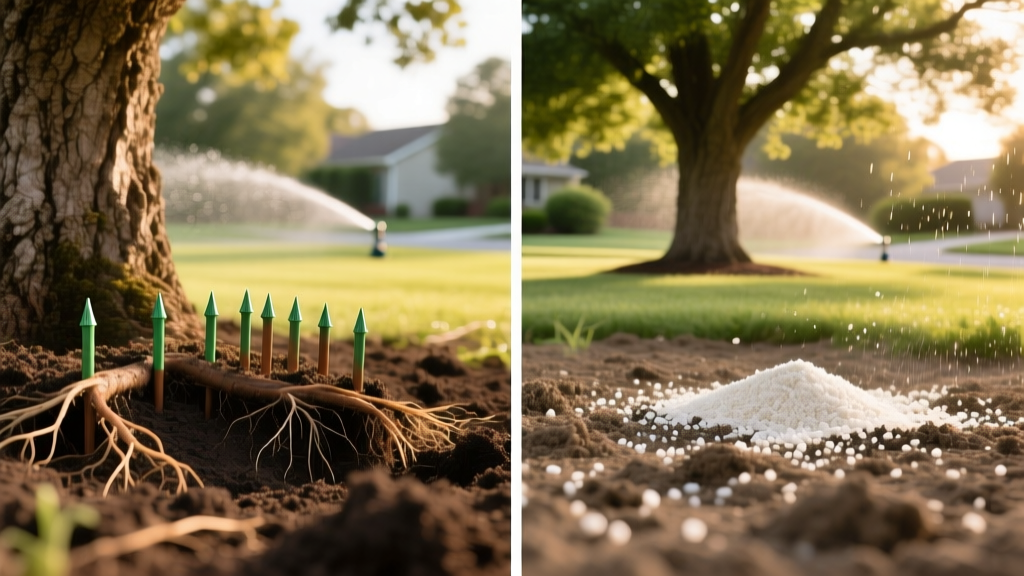
Jobe's Spikes vs Granular Tree Fertilizer 2026: Irrigation Guide
Sarah ChenPublished
The Intersection of Tree Nutrition and Irrigation in 2026
As we navigate the 2026 landscaping season, the integration of smart irrigation technology with targeted tree care has never been more critical. Homeowners and landscape professionals alike are upgrading to advanced sprinkler controllers like the Rachio 3e and Hunter Hydrawise systems, optimizing water usage to combat rising utility costs and regional drought restrictions. However, an often-overlooked variable in this equation is how your chosen irrigation method interacts with tree fertilizers. Specifically, the debate between using localized Jobe's tree fertilizer spikes versus broad-spectrum granular applications hinges entirely on how water moves through your soil profile.
Fertilizer does not feed a tree directly; it feeds the soil microbiome, which in turn makes nutrients available to the tree's root system. Without proper irrigation to activate and distribute these nutrients, even the most premium 2026 fertilizer formulations will remain inert. In this comprehensive guide, we will evaluate Jobe's tree spikes against traditional granular fertilizers through the lens of modern sprinkler and drip irrigation systems, helping you maximize nutrient uptake while minimizing water waste and environmental runoff.
Understanding the 'Wetting Front' and Soil Moisture
Before comparing specific products, it is essential to understand the concept of the 'wetting front.' When your sprinkler or drip system runs, water penetrates the soil to a specific depth before stopping or moving laterally. According to the University of Minnesota Extension, the majority of a tree's feeder roots—the roots responsible for absorbing water and nutrients—are located in the top 12 to 18 inches of soil, extending well past the drip line.
If your irrigation system only wets the top two inches of soil, any fertilizer placed below that zone will remain dry and inactive. Conversely, if your system applies water too quickly, the wetting front pushes past the root zone, carrying dissolved nutrients into the groundwater. Your choice between spikes and granular must align with your irrigation system's ability to control this wetting front.
Jobe's Tree Fertilizer Spikes: Localized, Slow-Release Nutrition
Jobe's tree fertilizer spikes (such as the popular 01611 and 01612 formulations) are solid, compressed cylinders of nutrients designed to be driven into the soil. In 2026, these spikes remain a favorite for their ease of use and lack of surface mess. They typically feature an NPK ratio tailored for woody plants, releasing nutrients slowly over several months as soil moisture breaks down the spike matrix.
How Irrigation Affects Spikes
Because spikes rely entirely on ambient soil moisture to dissolve, they are highly sensitive to your irrigation setup. If you use a standard overhead sprinkler system that runs for short, frequent cycles (e.g., 10 minutes every other day), the water may never reach the depth where the spikes are buried. The spikes will remain dry, hard, and ineffective.
- Best Irrigation Match: Deep, infrequent watering schedules or targeted drip irrigation.
- Placement Strategy: Spikes must be placed near the drip line, directly adjacent to drip emitters or soaker hoses, to ensure the localized wetting front consistently interacts with the spike.
- Drawback: In heavy clay soils, the dissolution rate can be uneven, creating localized 'hot spots' of nutrients that might burn nearby fine roots if not adequately diluted by deep irrigation.
Granular Tree Fertilizer: Broadcast and Water-In
Granular fertilizers, such as Espoma Tree-tone or Milorganite, are applied to the soil surface across the entire root zone. They offer a uniform distribution of nutrients but require a specific activation step: they must be watered in immediately after application to prevent nitrogen volatilization and to carry the nutrients down to the feeder roots.
How Irrigation Affects Granular Applications
Granular fertilizers are inherently designed to work in tandem with broadcast sprinkler systems. When you apply granular fertilizer, you typically need to run your rotor or spray-head sprinklers long enough to deliver roughly 0.25 to 0.5 inches of water. This specific volume is enough to dissolve the granules and push the nutrients into the top few inches of soil without causing excessive runoff.
- Best Irrigation Match: Overhead sprinkler systems with calibrated precipitation rates and smart controllers that can adjust run times based on soil type.
- Placement Strategy: Broadcast evenly from the trunk (avoiding direct contact with the bark) out to the drip line and slightly beyond.
- Drawback: If your sprinkler system has poor uniformity or if you water too heavily, granular fertilizers are highly susceptible to surface runoff, washing expensive nutrients into storm drains.
Head-to-Head Comparison: Spikes vs. Granular (2026 Data)
The following table breaks down how Jobe's spikes and granular fertilizers perform across key irrigation and maintenance metrics for the 2026 season.
| Feature | Jobe's Tree Fertilizer Spikes | Granular Tree Fertilizer |
|---|---|---|
| Primary Activation Method | Ambient soil moisture & deep drip irrigation | Broadcast sprinkler 'watering-in' (0.25 - 0.5 inches) |
| Runoff Risk | Very Low (subsurface placement) | Moderate to High (if overwatered or applied on slopes) |
| Nutrient Distribution | Localized, concentrated zones | Uniform, broad coverage across the root zone |
| Smart Controller Compatibility | Requires deep-soak scheduling to reach spike depth | Highly compatible with standard cycle-and-soak schedules |
| Estimated Cost (Mature Tree) | $12 - $18 (Requires 3-5 spikes per tree) | $8 - $15 (Based on 40lb bag coverage rates) |
| Weed Feeding Risk | Low (bypasses surface weeds) | High (surface application feeds turf and weeds) |
Matching Your Fertilizer to Your Irrigation System
To maximize your investment, you must align your fertilizer choice with the specific hardware installed in your landscape.
Scenario A: The Overhead Sprinkler System
If your trees are located in lawn zones watered by traditional spray heads or rotors, granular fertilizer is the superior choice. You can easily calibrate your sprinkler system using the 'tuna can test'—placing empty cans around the tree's drip line and running the system until they collect a quarter-inch of water. This ensures the granular fertilizer is activated perfectly. Using Jobe's spikes in overhead-sprinkler zones often results in the spikes remaining dry, as the frequent, shallow watering cycles typical of lawn care do not penetrate deeply enough to dissolve the compressed spike matrix.
Scenario B: Drip Irrigation and Soaker Hoses
If your trees are in dedicated landscape beds utilizing drip irrigation, Jobe's spikes can be highly effective, provided placement is strategic. Drip emitters only wet a localized column of soil. You must map out your drip lines and drive the spikes directly next to the emitters near the tree's drip line. If you use granular fertilizer over a drip-irrigated bed, much of the product will sit on dry soil between the emitters, failing to activate and potentially degrading in the sun.
Step-by-Step Application and Watering Guide
Follow these actionable steps to ensure proper nutrient delivery and water conservation.
For Granular Application with Sprinklers:
- Test the Soil: Before applying, conduct a 2026 soil test to confirm nitrogen and phosphorus deficiencies.
- Apply Evenly: Use a broadcast spreader on a low setting to distribute the granular fertilizer evenly under the canopy.
- Calibrate Irrigation: Set your smart controller to a 'Cycle and Soak' mode. Run the sprinklers for 10 minutes, wait 20 minutes for absorption, and repeat until 0.5 inches of water is applied. This prevents the nutrient runoff that the EPA actively warns against, protecting local waterways from nitrogen loading.
- Resume Normal Schedule: Wait 48 hours before resuming your standard irrigation schedule to allow the nutrients to bind to the soil particles.
For Jobe's Spikes with Drip/Deep Watering:
- Locate the Drip Line: Identify the outer edge of the tree's canopy where the feeder roots are most active.
- Pre-Soak the Soil: Run your drip system or deep-root waterer for one hour the day before installation. Driving spikes into dry, hard soil can shatter the spike or damage the root structure.
- Install the Spikes: Using a rubber mallet and the provided cap, drive the spikes into the moist soil, spacing them evenly in a circle around the drip line. Ensure they are fully submerged below the soil surface.
- Adjust Irrigation Timing: Modify your smart controller to favor longer, less frequent watering sessions (e.g., 2 hours once a week) rather than short daily bursts. This ensures the wetting front reaches the depth of the spikes, initiating the slow-release process.
Environmental Considerations and Runoff Prevention
In 2026, environmental stewardship is a core component of modern landscaping. The University of Minnesota Extension emphasizes that over-fertilization, combined with poor irrigation practices, is a leading cause of non-point source water pollution. Granular fertilizers applied to sloped terrain or compacted soils are at high risk of washing into storm sewers during heavy irrigation cycles or spring rains. By utilizing subsurface spike applications in vulnerable areas, or by strictly calibrating sprinkler run-times to match soil infiltration rates, homeowners can drastically reduce their environmental footprint while maintaining vibrant, healthy trees.
Conclusion
The choice between Jobe's tree fertilizer spikes and granular applications is not merely a matter of convenience; it is fundamentally an irrigation decision. If your landscape relies on broadcast sprinklers and you are willing to calibrate your run-times for precise watering-in, granular fertilizers offer superior, uniform root-zone coverage. However, if your trees are situated in drip-irrigated beds, or if you struggle with surface runoff on sloped properties, Jobe's spikes provide a targeted, low-runoff alternative—provided they are placed strategically within the active wetting front. By aligning your fertilizer strategy with your 2026 irrigation hardware, you ensure that every drop of water and every ounce of nutrient is utilized efficiently, promoting robust tree health for decades to come.
