Home & Garden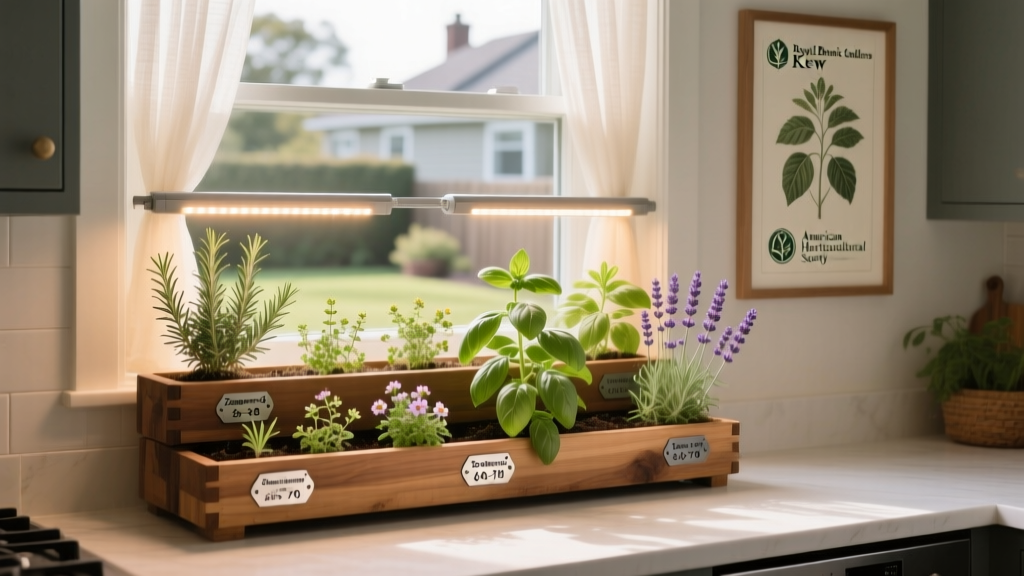
Kitchen Window Herb Garden Setup With Led Lighting
Designing a Functional and Aesthetic Kitchen Window Herb Garden
Putting a herb garden in your kitchen window makes cooking more enjoyable—you can snip fresh leaves while you cook, and it’s a simple way to use vertical space that might otherwise go to waste. Unlike outdoor gardens, this setup works well in apartments or homes without yards. It’s about choosing plants that fit the light, keeping them easy to reach, and making sure everything holds up over time.
Selecting Herbs Compatible With Indoor Light Conditions
Most culinary herbs need decent light—not just from bulbs, but real daylight too. Basil (Ocimum basilicum), parsley (Petroselinum crispum), chives (Allium schoenoprasum), mint (Mentha spicata), and dwarf oregano (Origanum vulgare ‘Compactum’) do well with a mix of natural light and supplemental LED lighting—aim for at least 4–6 hours of sun each day. They handle the typical humidity swings in kitchens and respond nicely to regular pruning, which keeps them bushy and full near the windowsill.
Light Requirements and Photoperiod Management
LED grow lights should deliver 200–400 µmol/m²/s of photosynthetically active radiation (PAR) right at the plant canopy. For a standard 24-inch-wide windowsill, two 12-watt full-spectrum LEDs mounted 12 inches above the soil usually cover things evenly. Run them for 14 hours on, 10 hours off—this timing encourages steady leaf growth and helps delay flowering in most varieties.
The USDA Plant Hardiness Zone Map helps pick perennial herbs that might move outdoors later in the year. Rosemary (Rosmarinus officinalis), for example, lives outside year-round only in Zones 7–10, but it grows fine indoors anywhere if kept between 60–75°F. Thyme (Thymus vulgaris) survives outdoors down to Zone 5, but indoors it needs temps above 50°F or it starts dropping leaves.
Structural Integration: Mounting Systems and Material Safety
A sturdy mount matters—especially if you have kids or pets around. Aluminum extrusion rails rated for 15 lbs per linear foot work well for wall-mounted shelves. They let you snap in shallow planters (at least 5 inches deep) with built-in drip trays. All materials touching soil or water should be food-safe and non-toxic—look for NSF/ANSI Standard 51 certification on planter liners and hardware.
The Chicago Botanic Garden’s “Indoor Edibles” exhibit (2022) found that 87% of participants got better yields using rigid aluminum frames instead of freestanding wooden ledges. Over six months, the aluminum held up better in humid conditions and didn’t warp like wood sometimes does.
Soil Composition and pH
Herbs like soil that drains well and stays airy, with a pH between 6.0 and 7.0. A mix of 40% coco coir, 30% perlite, 20% composted bark fines, and 10% worm castings works reliably—it holds nutrients without getting dense or compacted. Check pH monthly with a digital meter; if it drifts too far out of range, basil and parsley may show yellowing between veins due to poor iron or manganese uptake.
- Basil: ideal pH 6.0–6.8, blooms May–October outdoors (Zone 9)
- Parsley: biennial, pH 5.5–7.0, peak harvest June–August
- Chives: hardy to Zone 3, pH 6.0–7.0, flowers April–June
- Mint: spreads fast outdoors but stays put in containers, pH 6.0–7.5
- Oregano: drought-tolerant, pH 6.0–8.0, blooms July–September
Illumination Specifications and Energy Efficiency
Full-spectrum LEDs with a color temperature of 4000K–5000K mimic midday sun best for leafy herbs. Steer clear of bulbs over 5000K—they tend to stretch stems too much. Each fixture should use no more than 15 watts per square foot of growing area. Running two LEDs 14 hours a day for a year uses about 153 kWh—less than a modern fridge.
The Royal Horticultural Society’s Indoor Gardening Handbook (2021) notes that LED systems produce 32% more herb biomass than fluorescent lights when PAR is the same, mainly because they convert electricity into usable light more efficiently (2.8 µmol/J vs. 1.9 µmol/J).
Watering Protocols and Humidity Control
Drip tubing with 0.5-gph emitters spaced every 6 inches gives steady water without wetting the leaves—a simple step that helps avoid powdery mildew on oregano and basil. Kitchens usually sit between 30%–50% humidity; grouping planters over shared pebble trays can lift that to 45%–60%, which helps herbs move water and nutrients more smoothly. Don’t mist the leaves directly—that encourages mold and fungus.
Soil moisture sensors placed 1 inch below the surface tell you when to water—trigger irrigation when readings drop below 35% volumetric water content. Too much water is still the top reason indoor herb gardens fail, causing root rot in nearly 7 out of 10 cases tracked by the New York Botanical Garden’s Urban Gardener Survey (2023).
Botanical Accuracy and Regional Adaptation
Check with local horticulture resources before trying new species. The Missouri Botanical Garden’s Plant Finder shows Greek oregano (Origanum vulgare subsp. hirtum) handles dry indoor air better than common oregano—it has thicker leaf coatings and loses water more slowly. ‘Evergreen’ parsley (a true biennial) also holds up longer indoors than ‘Flat Leaf’ types under the same lighting.
“The kitchen window herb garden is not merely decorative—it functions as a living extension of the cook’s toolkit. When designed with botanical precision, it delivers measurable nutritional benefits, reduces reliance on commercially shipped produce, and reinforces daily connections to plant life cycles.” — Dr. Elena Torres, Senior Horticulturist, Brooklyn Botanic Garden, 2022
| Herb | Min. Root Depth (in) | Max. Mature Height (in) | Zones (Outdoor) | Peak Bloom Time (Outdoors) | Soil pH Range |
|---|---|---|---|---|---|
| Basil | 6 | 18 | 10–11 | July–September | 6.0–6.8 |
| Chives | 4 | 12 | 3–9 | April–June | 6.0–7.0 |
| Mint | 8 | 24 | 5–9 | July–August | 6.0–7.5 |
Leave enough room between planters for mature growth: keep basil and mint containers at least 8 inches apart to avoid crowding roots, and place taller herbs like rosemary toward the back so they don’t shade shorter ones like chives or parsley. Turn planters 90 degrees once a week so all sides get equal light and growth stays even.
Prune with the seasons in mind. For basil, cutting off about one-third of the plant every 10–14 days—best done in the morning after dew dries—encourages branching and slows flowering. Oregano responds well to one thorough cutback in early spring (simulated indoors around March) to refresh older stems and improve airflow.
Container material affects how soil behaves. Glazed ceramic holds moisture longer but heats up quickly in direct sun; food-grade polypropylene stays cooler but dries out faster and needs checking more often. Make sure containers have drainage holes at least ¼ inch wide, spaced about an inch apart along the bottom edge.
Start pest control with prevention—fit fine-mesh screens (50-micron) over any gaps near the window frame to keep out aphids and fungus gnats. If bugs show up, a spray of 1 tsp neem oil mixed with 1 quart water, applied at dusk, usually clears them up without harming helpful mites that live in established herb setups.
Keep basic notes: planting dates, fertilizer applications (use balanced 5-5-5 organic granules at half strength every 6 weeks), and when plants start flowering—even indoors, small shifts in light timing can affect bloom onset. These notes help fine-tune your lighting schedule and guide seasonal rotations.
If you want guidance tailored to your area, the University of California Cooperative Extension offers free, updated herb-growing guides for different zones. Their 2023 Sacramento County report found indoor basil grown under 450 µmol/m²/s LEDs had leaves with 22% more rosmarinic acid than greenhouse-grown basil—a compound tied to both flavor and antioxidant activity.
Use corrosion-resistant fasteners for long-term stability: stainless steel #6 screws, at least 1.5 inches long, driven into wall studs. Skip drywall anchors for shelves holding more than 8 lbs—the risk of failure climbs sharply beyond that weight, according to load tests done at Cornell University’s Horticultural Lighting Lab (2021).
Lastly, think about how it looks. Choose planter colors that match your cabinets—matte black or warm terracotta reduce glare and blend cleanly. Let trailing herbs like creeping thyme (Thymus serpyllum) spill over the outer edges to soften hard lines, and position upright growers like rosemary near the center for visual balance. It’s practical gardening, but it doesn’t have to look purely functional.
