Tree Care
Landscape Design: Strategic Tree Placement for Energy Savings
The Intersection of Landscape Design and Energy Conservation
When planning a residential landscape, homeowners often focus primarily on aesthetics, curb appeal, and property value. However, one of the most impactful elements of landscape design is often overlooked: strategic tree placement for energy conservation. By carefully selecting tree species and calculating their mature canopy spread, you can significantly reduce your home's heating and cooling costs while simultaneously creating a beautiful, thriving outdoor environment.
According to the U.S. Department of Energy, carefully positioned trees can save up to 25% of a household's energy consumption for heating and cooling. This guide will walk you through the design principles, spacing metrics, and long-term tree care strategies required to transform your yard into an energy-efficient microclimate.
The Science of Evapotranspiration and Shade
Trees cool their surroundings through two primary mechanisms: shading and evapotranspiration. Shading blocks direct solar radiation from hitting your home's exterior, windows, and hardscapes. Evapotranspiration is the process by which trees release water vapor through their leaves, which absorbs ambient heat and lowers the surrounding air temperature. In fact, the air temperature directly under a mature tree can be up to 9°F cooler than the temperature of an unshaded lawn or driveway.
Understanding these mechanisms is crucial for design planning. You are not just planting a tree; you are installing a biological HVAC system that requires proper soil volume, sunlight, and water to function efficiently.
Summer Shading Strategies for Maximum Cooling
To maximize summer cooling, your landscape design must account for the sun's trajectory. In the Northern Hemisphere, the sun rises in the east and sets in the west, reaching its peak intensity in the early to mid-afternoon. The west-facing side of a home typically absorbs the most intense heat of the day.
Optimal Placement and Spacing
- West and Southwest Exposure: Plant tall, broad-canopied deciduous trees on the west and southwest sides of your home. This blocks the intense late-afternoon sun.
- East Exposure: Medium-sized deciduous trees can be planted on the east side to block the morning sun, which is less intense but still contributes to heat gain.
- Distance from the Foundation: Plant trees at least 15 to 20 feet away from your home's foundation. This prevents root intrusion into underground plumbing and ensures the mature canopy shades the roof and upper-story windows without scraping the siding.
The Arbor Day Foundation emphasizes that deciduous trees are ideal for summer shading because their dense leaf canopy blocks sunlight in the summer, but they drop their leaves in the winter, allowing passive solar heating when you need it most.
Recommended Deciduous Trees for Summer Shading
| Tree Species | Mature Height | Canopy Spread | Est. Cost (15-Gallon) |
|---|---|---|---|
| Red Maple (Acer rubrum) | 40-60 ft | 30-40 ft | $90 - $130 |
| White Oak (Quercus alba) | 50-80 ft | 50-80 ft | $120 - $180 |
| Tulip Poplar (Liriodendron tulipifera) | 70-90 ft | 30-50 ft | $80 - $110 |
| London Planetree (Platanus x acerifolia) | 60-80 ft | 50-70 ft | $110 - $150 |
Winter Windbreaks for Heating Efficiency
While summer cooling is vital, winter heating costs can be equally burdensome. Cold winds strip heat from the exterior of your home through a process called wind chill and infiltration. A properly designed evergreen windbreak can reduce winter heating bills by 10% to 25%.
Designing the Windbreak
Windbreaks should be planted on the north and northwest sides of your property, perpendicular to the prevailing winter winds. According to Penn State Extension, the most effective windbreaks consist of dense evergreen trees combined with lower-growing shrubs to block wind at the ground level.
- The Distance Rule: The protected zone of a windbreak extends downwind for a distance equal to 2 to 5 times the mature height of the trees. If you plant Norway Spruces that will reach 50 feet in height, the maximum wind protection will occur between 100 and 250 feet away from the tree line.
- Tree Selection: Choose dense, cold-hardy evergreens such as Eastern Red Cedar, Norway Spruce, or Colorado Blue Spruce.
- Spacing: Plant evergreens 8 to 12 feet apart in a single row, or stagger them in two rows spaced 10 feet apart for maximum density.
Solar Panel and Roof Considerations
As solar energy becomes more prevalent, landscape designers must balance tree shade with solar panel efficiency. A south-facing roof is prime real estate for solar arrays, and shading from a mature southern tree can devastate energy production.
Design Tip: Keep the southern exposure of your home completely clear of tall-growing trees. Reserve the south side for low-growing ornamental shrubs, garden beds, or hardscaping that will not cast a shadow on a solar array or block passive winter sunlight from entering south-facing windows.
Hardscape Integration and Root Management
Strategic placement also means protecting your infrastructure. Tree roots naturally seek out moisture and can easily crack driveways, patios, and underground utility lines if planted too closely.
- Utility Lines: Always call 811 before digging to mark underground utilities. Never plant large-canopy trees directly under or within 15 feet of overhead power lines.
- Driveways and Sidewalks: Plant large trees at least 10 feet away from concrete hardscapes. If space is limited, install physical root barriers (typically 24 to 36 inches deep) between the tree and the hardscape to deflect roots downward.
- Soil Volume: A mature shade tree requires roughly 1,000 cubic feet of uncompacted soil to thrive. Plan your landscape beds accordingly to avoid stunted growth and structural instability.
Furthermore, consider using permeable pavers or structural soil systems in areas where tree roots and pedestrian traffic must coexist. Compacted soil suffocates roots and leads to premature tree decline, which ruins your energy-saving design. Structural soils allow for load-bearing surfaces above ground while providing adequate pore space for root respiration below.
Long-Term Care and Establishment Planning
A well-designed landscape will fail without a proper tree care and maintenance schedule. Young trees require specific interventions to ensure they reach their energy-saving potential.
Watering and Mulching
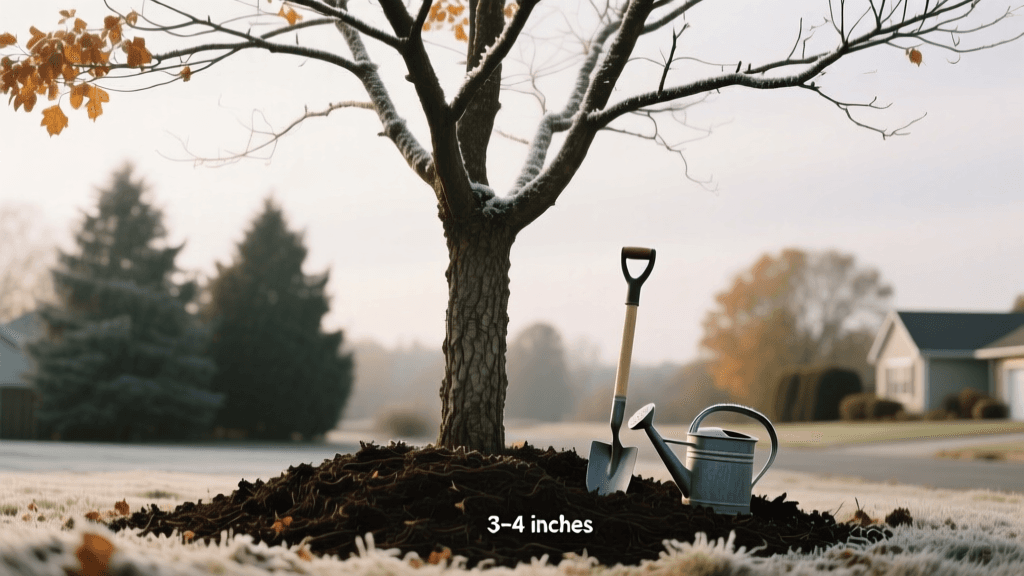
During the first two to three years, newly planted trees need deep, infrequent watering to establish a robust root system. Apply 10 to 15 gallons of water per week during the growing season. Use the 3-3-3 mulching rule: apply a 3-inch layer of organic wood chips, in a 3-foot radius around the trunk, keeping the mulch 3 inches away from the trunk flare to prevent rot and pest infestations.
Structural Pruning and Health Monitoring
To ensure your shade trees do not interfere with your home or walkways, plan for structural pruning every 3 to 5 years. Elevate the canopy by removing lower limbs so that the lowest branches are at least 8 feet above pedestrian walkways and 15 feet above driveways. This maintains the high-clearance shade required to cool your home while keeping the landscape accessible.
Additionally, incorporate an annual health assessment into your landscape maintenance routine. Monitor for signs of pest infestations, such as the Emerald Ash Borer or aphid damage, which can rapidly defoliate a tree and eliminate its shading capacity. A proactive approach to disease identification ensures your biological HVAC system remains operational for decades.
Conclusion: The ROI of Strategic Tree Placement
Integrating tree care and energy conservation into your landscape design is a long-term investment. While a 15-gallon tree may cost between $80 and $180 upfront, the reduction in annual HVAC costs, combined with increased property values and extended lifespan of your roof and exterior siding, yields a substantial return on investment. By respecting mature canopy spreads, utilizing deciduous and evergreen species appropriately, and committing to a rigorous establishment watering schedule, you can design a landscape that is as economically efficient as it is ecologically beautiful.