
Landscaping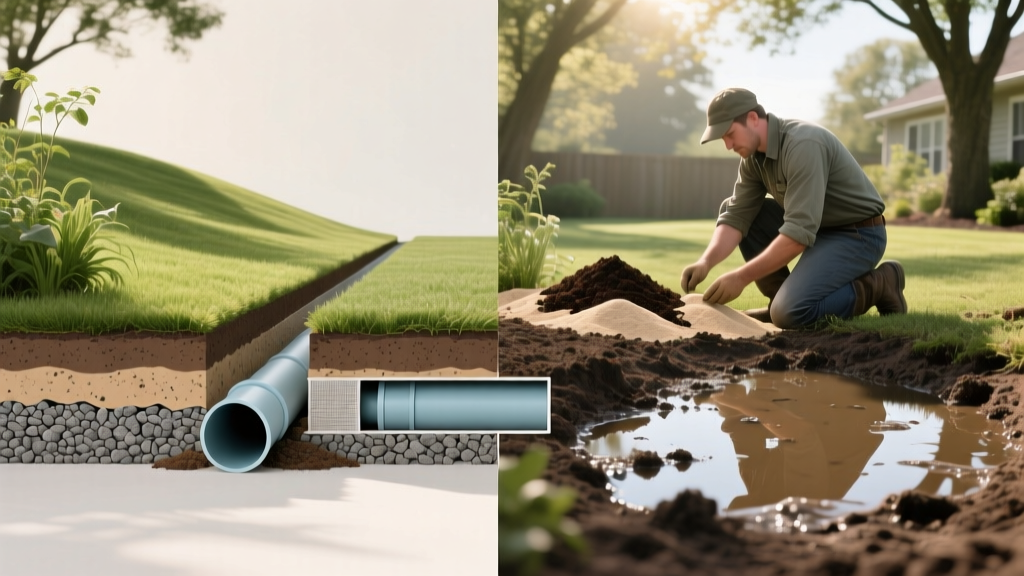
Landscape Drainage Myths: Fact vs Fiction for Yard Flooding
David ParkPublished
Introduction: The High Cost of Bad Landscaping Advice
When your yard turns into a swamp after a heavy rainstorm, the panic to fix the flooding can lead to costly landscaping mistakes. The internet and old-school gardening forums are rife with well-meaning but scientifically inaccurate advice regarding landscape drainage, soil amendment, and hardscaping. Believing these myths doesn't just waste your weekend; it can kill your expensive plantings, erode your home's foundation, and cost thousands of dollars in failed hardscaping projects.
As a core principle of sustainable landscape design, water must be managed, not merely hidden. In this guide, we are separating landscape drainage fact from fiction. We will debunk the four most pervasive myths about yard drainage and provide actionable, measurement-specific solutions to keep your outdoor living spaces dry, healthy, and structurally sound.
Myth 1: Adding Sand to Clay Soil Improves Drainage
The Fiction
Many homeowners believe that because sandy soil drains quickly and clay soil holds water, mixing sand into heavy clay will create a perfectly draining loam. It seems like basic logic: combine the fast-draining properties of sand with the nutrient-holding properties of clay.
The Fact
Mixing sand into clay soil actually creates a substance remarkably similar to concrete. Clay particles are incredibly small and flat, while sand particles are large and round. When you mix them, the tiny clay particles fill the voids between the sand particles, locking them together and completely destroying soil porosity. According to soil scientists at the University of Minnesota Extension, you would need to add roughly 80% sand by volume to clay soil to see any structural improvement—a feat that is physically and financially impossible for most residential landscapes.
Actionable Fix: Organic Matter and Expanded Shale
To fix poorly draining clay beds, you must alter the soil biology and structure using organic matter and inorganic porous materials.
- Top-Dressing: Apply 2 to 3 inches of high-quality compost over the garden bed and till it into the top 6 inches of soil. This binds clay particles into larger "aggregates," creating macro-pores for water to escape.
- Expanded Shale: For a permanent inorganic amendment, incorporate expanded shale (often sold under brand names like PermaTill or Haydite). Apply a 2-inch layer and till it into the top 8 inches. The porous shale holds both water and air, preventing soil compaction over time.
- Timing: Amend soil in the early fall or spring when the soil is slightly moist, but never when it is wet and muddy, which exacerbates compaction.
Myth 2: Gravel in Pots or Beds Prevents Root Rot
The Fiction
Placing a 2-inch layer of gravel, pebbles, or broken pottery shards at the bottom of a raised garden bed or container planter will improve drainage and keep plant roots out of standing water.
The Fact
This is perhaps the most stubborn myth in horticulture. Adding a coarse drainage layer at the bottom of a container actually raises the water table inside the pot. Water is subject to capillary action; it clings to the fine particles of potting soil and resists moving into the large, coarse air spaces of the gravel layer below. Instead of draining away, water saturates the bottom few inches of soil directly above the gravel, creating a "perched water table." This is exactly where your plant's deepest roots sit, leading directly to root rot. Dr. Linda Chalker-Scott of Washington State University extensively debunks this in her research on container planting drainage myths.
Actionable Fix: Uniform Soil Profiles
- Containers: Fill the entire pot with a high-quality, well-draining potting mix (look for ingredients like pine bark fines, perlite, and coir). Never use garden soil in pots.
- Raised Beds: If your raised bed sits on heavy native clay, do not use gravel. Instead, loosen the native soil beneath the bed with a broadfork, and fill the bed entirely with a 60% topsoil, 30% compost, and 10% pumice or perlite mix.
- Drainage Holes: Ensure pots have multiple drainage holes at the absolute lowest point. If using decorative pots without holes, keep the plant in a plastic nursery pot that can be lifted out to drain after watering.
Myth 3: A French Drain is the Ultimate Fix for All Soggy Yards
The Fiction
If your yard is wet, digging a trench and installing a perforated pipe (a French drain) will magically suck the water out of the landscape.
The Fact
A French drain is a subsurface drainage system designed to intercept and redirect groundwater. It is entirely useless for surface water pooling caused by negative grading or clay hardpans. Furthermore, a French drain requires a "daylight" point—a lower elevation where the water can safely exit the pipe. If you install a French drain in a flat yard with no lower discharge point, you are simply building an underground bathtub that will fill up and overflow.
Actionable Fix: Match the Solution to the Water Type
Before digging, identify if you have a surface water issue or a subsurface water issue. The Clemson University Cooperative Extension recommends managing surface water via grading and swales, while reserving French drains for high water tables and foundation protection.
- For Surface Ponding (Regrading): Ensure the soil slopes away from your home's foundation at a minimum grade of 1/4 inch per foot for the first 10 feet. Use a laser level or a string line level to verify the slope.
- For Subsurface Water (French Drain Specs): If you must install a French drain, dig a trench 12 inches deep and 6 inches wide. Line it with non-woven geotextile fabric (not woven weed fabric). Place a 4-inch corrugated slotted pipe (like NDS EZ-Drain) wrapped in a soil sock. Maintain a strict 1% slope (1 inch of drop per 8 feet of pipe). Fill with 3/4-inch washed gravel, fold the fabric over the top, and cover with 2 inches of topsoil and sod.
- For Flat Yards (Dry Wells): If you have no daylight point, route downspouts into an underground dry well (such as the NDS Flo-Well 50-gallon basin) filled with crushed stone, allowing water to percolate slowly into the subsoil over 24-48 hours.
Myth 4: Landscape Fabric Stops Weeds Without Ruining Drainage
The Fiction
Laying down black woven landscape fabric before adding mulch will permanently stop weeds while allowing rainwater to pass through into the soil.
The Fact
While landscape fabric may allow water to pass through on day one, it quickly becomes a drainage nightmare. Within a single season, soil particles, fungal networks, and decomposing organic matter clog the microscopic pores of the fabric. Once clogged, water sheets off the fabric, causing erosion and runoff. Furthermore, weeds eventually blow in and root *into* the fabric, making them nearly impossible to pull without tearing the material. It also starves the soil of organic matter, killing beneficial earthworms and microbes.
Actionable Fix: The Arborist Mulch Method
"The best weed barrier is a thick layer of organic mulch that builds soil health rather than suffocating it."
- Material: Use coarse arborist wood chips or shredded hardwood bark. Avoid fine mulches like cocoa bean or dyed rubber, which compact and repel water.
- Measurement: Apply a uniform 3-inch layer of mulch over bare soil. This thickness blocks sunlight from reaching weed seeds while still allowing oxygen and rainwater to penetrate the soil profile.
- Maintenance: Top-dress the mulch with 1 inch of fresh material annually in the spring to maintain the 3-inch depth as the bottom layers decompose and feed the soil.
Drainage Solutions: Cost and Application Comparison
Choosing the right drainage solution requires balancing your budget, your soil type, and the specific hydrology of your property. Use the table below to compare standard landscape drainage interventions.
| Solution | DIY Cost Estimate | Professional Cost | Best Application |
|---|---|---|---|
| Positive Regrading | $0.50 - $1.50 / sq ft (Topsoil) | $2 - $5 / sq ft | Surface pooling near foundations; negative slopes. |
| French Drain | $5 - $10 / linear ft | $20 - $40 / linear ft | Subsurface groundwater; wet basements; retaining walls. |
| Dry Well (50 Gal) | $150 - $300 per unit | $500 - $1,200 per unit | Downspout runoff in flat yards with no daylight exit. |
| Soil Amendment | $30 - $60 / cubic yard (Compost) | $75 - $150 / cubic yard (Installed) | Slow-draining clay beds; turfgrass that stays soggy. |
| Rain Garden / Swale | $3 - $8 / sq ft (Plants/Gravel) | $10 - $25 / sq ft | Capturing runoff; eco-friendly stormwater management. |
Conclusion: Test Before You Dig
The most critical step in landscape drainage is understanding your specific site conditions. Before purchasing pipes or ordering yards of compost, perform a simple percolation test. Dig a hole 12 inches deep and 12 inches wide, fill it with water, and let it drain. Refill it and measure how many inches the water drops per hour. If it drops less than 1 inch per hour, you have a severe clay or compaction issue that requires organic amendment or mechanical aeration. If it drops rapidly but your yard still floods, you likely have a surface grading issue. By abandoning outdated myths and relying on soil science and proper civil engineering principles, you can design a landscape that is as resilient as it is beautiful.

