Tree Care
Late Fall Tree Winterization: Protecting Roots and Trunks
The Hidden Dangers of Winter for Landscape Trees
As autumn leaves fall and temperatures drop, many homeowners assume their landscape trees can handle winter on their own. But the shift from late fall into deep winter brings real challenges—cold snaps, drying winds, frozen soil—that can hurt or even kill young and mature trees alike. Winter care isn’t just a nice-to-do chore. It’s part of keeping trees healthy year after year. Knowing what your trees struggle with—and acting before trouble shows up—can help them avoid frost cracks, winter drought damage, and broken branches.
Understanding Tree Dormancy and Winter Stress
Tree dormancy is how woody plants slow down to survive cold weather. In late fall, deciduous trees pull nutrients from their leaves back into the trunk and roots, then drop their leaves and stop growing above ground. But below the surface, roots stay active until soil temps fall below 40°F. That window—when the tree looks still but roots are still working—is when sudden temperature swings cause the most harm. A warm spell in late November followed by a hard freeze can make water inside the tree expand fast, splitting bark open. And without snow cover, dry wind pulls moisture from both soil and bark, leaving trees parched.
Step 1: Deep Root Watering Before the Ground Freezes
Winter drought kills more young trees than people realize—especially maples, spruces, and other shallow-rooted species. Once the ground freezes, roots can’t take up water. If a tree goes into winter already low on moisture, its leaves or needles may burn, and roots can die back.
Arborists recommend watering deeply through late fall, right up to freeze-up. A good rule: 10 gallons per inch of trunk width (measured at knee height), once a week during dry spells. For a 3-inch-wide trunk, that’s 30 gallons—applied slowly around the drip line. Use a soaker hose or root feeder to get water down 12–18 inches, where most absorbing roots live. Don’t soak the trunk—it encourages rot and fungus. Keep going until soil temps stay below 40°F. That way, the tree goes into winter fully hydrated.
Step 2: Strategic Mulching for Root Insulation
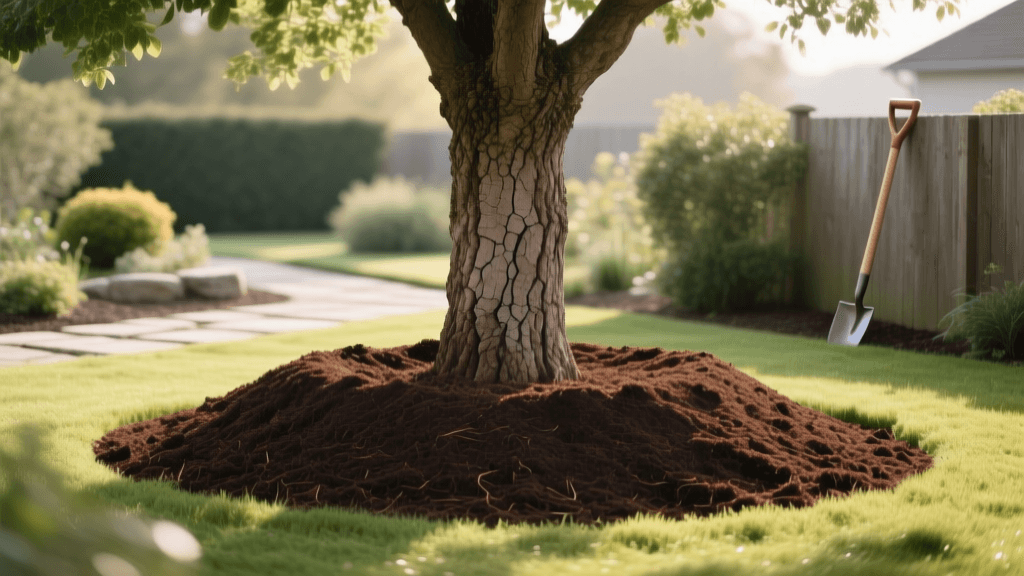
Mulch helps keep soil temperature steady and holds moisture—but only if it’s done right. Piling mulch high against the trunk—the “mulch volcano”—traps moisture, invites pests, and can choke the tree over time.
Instead, spread 2–4 inches of coarse organic mulch like aged wood chips or shredded bark. Start 3–4 inches away from the trunk, leaving the root flare visible. Extend the ring out to the drip line if you can. This “donut” shape buffers soil from rapid freeze-thaw cycles, which can heave the ground and tear fine roots. Trees with proper mulch tend to have steadier soil temps and stronger root growth come spring.
Step 3: Trunk Protection Against Sunscald and Frost Cracks
Young trees, newly planted ones, and species with thin bark—honey locust, maple, crabapple, linden—are especially prone to sunscald and frost cracks. On cold, sunny winter days, the southwest side of the trunk warms up, waking up cells beneath the bark. When the sun drops or clouds roll in, temps crash—and those active cells die, leaving sunken, discolored patches that can girdle the trunk.
To prevent this, wrap vulnerable trunks in late fall using paper tree wrap or white plastic guards. Start at the base and spiral upward, overlapping slightly, all the way to the first major branches. Take it off in early spring—leaving it on too long traps moisture and attracts insects.
| Protection Method | Best Used For | Estimated Cost | Lifespan |
|---|---|---|---|
| Crepe Paper Tree Wrap | Thin-barked deciduous trees, young saplings | $5 - $10 per roll | 1 Season (Must remove in spring) |
| White Plastic Spiral Guards | Protection against rodents and sunscald | $3 - $8 per guard | 3 - 5 Seasons |
| Hardware Cloth / Wire Mesh | Chewing rodents (voles, rabbits, mice) | $15 - $25 per roll | 10+ Seasons |
Step 4: Applying Anti-Desiccant Sprays to Evergreens
Evergreens keep their leaves or needles all winter—and keep losing moisture through them. But frozen ground means roots can’t replace it. The result? Winter burn: brown, brittle needles, usually on the side facing the wind.
Spraying broadleaf evergreens like rhododendrons and boxwoods—and some conifers—with an anti-desiccant like Wilt Pruf or Nu-Film helps. It forms a thin, flexible coating over the leaf pores, cutting down moisture loss. Apply on a dry day when temps are between 40°F and 50°F, and let it dry fully before freezing weather returns. A second spray in late January or early February—during a thaw—renews protection for the coldest stretch.
Step 5: Structural Pruning During Deep Dormancy
Pruning in late summer risks pushing out tender new growth that won’t survive frost. But late fall and winter are ideal for structural work. Without leaves, you can see the tree’s shape clearly—spotting crossing branches, weak branch angles, or dead wood is much easier.
Dormant-season pruning also lowers the chance of spreading disease or pests, since most fungi and borers aren’t active yet. Focus on removing dead, damaged, or diseased branches—the “three Ds”—plus any limbs that could break under snow or ice and hit a roof, car, or power line. Use clean, sharp bypass pruners or saws, and cut just outside the branch collar. Skip the wound sealants—research shows they trap moisture and slow healing.
Winterization Cost and Effort Breakdown
Winter tree care costs less than replacing a dead tree—or fixing damage from a storm-downed limb. Here’s what it typically takes for five medium-sized trees:
| Winterization Task | Materials Required | Average Cost (5 Trees) | Time Commitment |
|---|---|---|---|
| Deep Root Watering | Water, Soaker Hose | $10 - $20 (Water bill) | 2 - 3 Hours |
| Mulching Root Zones | 2 Cubic Yards Arborist Chips | $60 - $90 | 2 Hours |
| Trunk Wrapping | 5 Rolls Crepe Paper Wrap | $25 - $40 | 1 Hour |
| Anti-Desiccant Spray | 1 Gallon Concentrate | $30 - $50 | 1 Hour |
Expert Insights and Authoritative Guidelines
University extensions and arborists back these practices with real-world data. The University of Minnesota Extension notes sunscald and frost cracks are top reasons young urban trees decline early—and says trunk wrapping is standard practice for new plantings in colder zones. Colorado State University Extension stresses winter watering as the single biggest factor in tree survival where snow is scarce and winds are strong. Their guidance is simple: water when air temps are above 40°F and the ground is bare of snow.
Conclusion: Securing Your Landscape's Future
Taking time in late fall to water deeply, mulch well, wrap trunks, protect evergreens, and prune thoughtfully pays off. You won’t always see results right away—but come spring, healthier buds, stronger growth, and fewer surprises mean your trees are better set up for years ahead.