Lawn Care
Lawn Aeration When And How To Do It
What Lawn Aeration Actually Does for Your Soil
Compacted soil is one of the most common problems in residential lawns — and one you usually can’t see. When soil particles get pressed tightly together by foot traffic, heavy mowing equipment, or repeated rain, air, water, and nutrients have a harder time reaching the roots. Aeration is the mechanical process of poking holes in the soil to loosen it up. Done at the right time, it’s often the most useful thing you can do for your lawn all year.
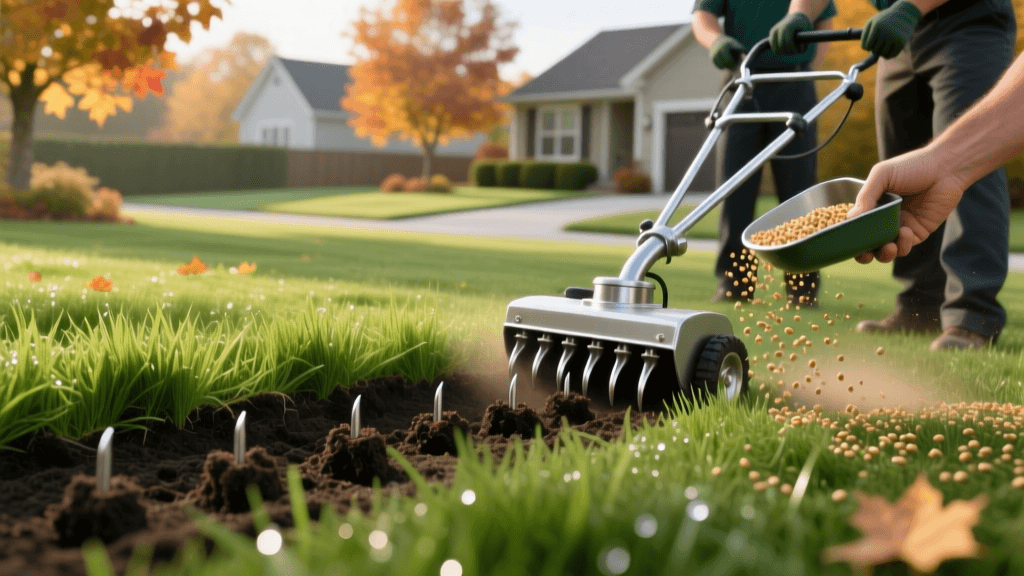
Core aeration, the most effective method, pulls small plugs of soil roughly 0.5 to 0.75 inches wide and 2 to 3 inches deep. These plugs land on the surface and break down over one to two weeks, adding organic matter back into the lawn. The holes left behind let oxygen get deeper, help water soak in better, and give roots more space to grow. According to the University of Minnesota Extension (2022), lawns aerated once a year tend to develop deeper roots and handle dry spells better than lawns that aren’t aerated.
Timing Aeration to Your Grass Type
The biggest factor in choosing when to aerate is whether your lawn is cool-season or warm-season grass. Aerating at the wrong time — especially during heat or drought — can hurt the turf instead of helping it.
Cool-Season Grasses
Kentucky bluegrass (Poa pratensis), tall fescue (Festuca arundinacea), and perennial ryegrass (Lolium perenne) are the main cool-season grasses across the northern U.S. and Canada. They grow best in spring and fall, when soil temperatures are between 50°F and 65°F. Fall is usually the best time — late August through October — because the grass recovers quickly, fewer weeds are active, and you can overseed at the same time.
You can aerate cool-season lawns in spring, but it’s riskier. Doing it in April or May opens up the soil just as crabgrass (Digitaria sanguinalis) and other annual weeds start to sprout, and it can weaken pre-emergent herbicide barriers. If spring is your only option, wait until the lawn has fully greened up and you’ve mowed it at least twice.
Warm-Season Grasses
Bermudagrass (Cynodon dactylon), zoysiagrass (Zoysia japonica), St. Augustinegrass (Stenotaphrum secundatum), and centipedegrass (Eremochloa ophiuroides) grow best in the southern U.S. and transition zone. These grasses should be aerated in late spring to early summer — May through June — when they’re actively growing and can fill in the holes within two to four weeks. Aerating them in fall leaves open holes that can let in winter weeds or cold damage.
The Transition Zone Challenge
In the transition zone — a strip running roughly from Kansas City to northern Virginia — lawns often mix species or are managed as either cool- or warm-season depending on the homeowner’s preference. Virginia Tech’s turfgrass program suggests basing your timing on the dominant grass type: fall aeration if tall fescue or bluegrass makes up most of the lawn, and late spring if bermudagrass or zoysia is dominant.
Reading Your Soil Before You Aerate
Not every lawn needs aeration every year. Before renting equipment or hiring someone, try the screwdriver test: push a standard screwdriver into moist soil. If it goes in 6 inches with light hand pressure, compaction isn’t serious. If it stops at 2 to 3 inches, aeration will likely help. A soil penetrometer gives a more precise reading in pounds per square inch (PSI). Purdue University Extension (2021) found that root growth slows noticeably in most lawn soils once compaction reaches 300 PSI or higher.
Thatch thickness is another clue. Pull up a small section of turf and measure the brown, spongy layer between the green blades and the soil. If it’s thicker than 0.5 inches, it’s slowing water movement and can hold fungal diseases. Core aeration helps break down thatch by bringing soil microbes into the layer — so it’s useful even if compaction isn’t your main issue.
"Core aeration is the most practical and cost-effective cultural practice for managing soil compaction and thatch accumulation in home lawns. A single fall aeration on a Kentucky bluegrass lawn can improve water infiltration rates by 25 to 40 percent within one growing season." — Penn State Extension, Turfgrass Management, 2023
Equipment Options and How to Use Them
There are three main types of aeration equipment available to homeowners and professionals. Knowing the differences helps you pick the right one.
- Core (plug) aerators: Pull actual soil plugs. Available as walk-behind units (usually 18 to 24 inches wide) or tow-behind models for riding mowers. This is the best choice for relieving compaction and managing thatch. Rental costs run $60 to $100 per day at most equipment rental centers.
- Spike aerators: Poke holes with solid tines instead of removing soil. They’re less effective and can make compaction worse around the holes over time. Spike aerator shoes and rolling spike tools fall into this category and aren’t generally recommended by turfgrass extension specialists.
- Liquid aerators: Products like Aerify PLUS or Simple Lawn Solutions Liquid Aerator contain surfactants and humic acids said to loosen soil. There’s little research backing them up. They might help water soak in a bit better on lightly compacted soil, but they won’t replace core aeration on heavily compacted ground.
When using a walk-behind core aerator, make two passes over the lawn in perpendicular directions. This doubles the number of holes and spreads them out more evenly. Aim for holes spaced 2 to 4 inches apart — most rental machines set to standard depth will hit that range at a normal walking pace. On slopes steeper than 15 degrees, use a lighter tow-behind unit or hire a pro to keep control of the equipment.
Soil moisture matters. Aerate when the soil is moist but not soggy — ideally 24 to 48 hours after a half-inch of rain or irrigation. Dry, hard soil makes it tough for the tines to go deep, leading to shallow holes. Saturated soil gets smeared instead of releasing clean plugs.
Combining Aeration with Overseeding and Fertilization
Aeration creates good conditions for overseeding because the holes put seed directly in contact with soil — which is key for germination. For cool-season lawns overseeded in fall, spread seed right after aeration while the holes are still open. Seeding rates vary by grass:
| Grass Species | Overseeding Rate (lbs/1,000 sq ft) | Optimal Soil Temp for Germination |
|---|---|---|
| Kentucky Bluegrass | 1–2 | 50–65°F |
| Tall Fescue | 4–8 | 50–65°F |
| Perennial Ryegrass | 3–6 | 50–65°F |
| Bermudagrass (hulled) | 1–2 | 65–70°F |
| Zoysiagrass | 1–3 | 65–70°F |
After overseeding, use a starter fertilizer instead of a regular maintenance blend. Starter fertilizers have more phosphorus — look for something like 18-24-12 or 12-24-12 — to help new seedlings build strong roots. Scotts Starter Food for New Grass and Jonathan Green Green-Up Seeding & Sodding Fertilizer are two common options. Apply at the rate listed on the bag, usually 3 to 4 pounds per 1,000 square feet, and water lightly twice a day until the seed sprouts.
For established lawns not being overseeded, aeration is still a good time to apply fall fertilizer. The holes let granular fertilizer move straight into the root zone instead of sitting on top. A slow-release nitrogen source like Milorganite (6-4-0) applied at 32 pounds per 1,000 square feet, or a synthetic slow-release like Lesco 32-0-10, feeds the lawn through fall without pushing too much top growth.
Post-Aeration Care and Common Mistakes
The soil plugs left on the surface after core aeration aren’t trash — leave them alone. They’ll break down in one to two weeks and return nutrients and microbes to the lawn. Once they’ve dried a little, mowing over them helps speed things up. Only rake them up if they’re making the surface uneven enough to interfere with mowing.
Watering after aeration should be steady but not heavy. For lawns not being overseeded, stick to your usual schedule. For overseeded lawns, keep the top half-inch of soil moist until the seed sprouts — that usually means two to three short watering sessions a day for the first two weeks, then switching to deeper, less frequent watering as the seedlings take hold.
- Don’t apply pre-emergent herbicides right before or after overseeding — they’ll stop grass seed from sprouting along with weeds.
- Avoid heavy foot traffic on newly aerated and overseeded areas for at least three weeks.
- Hold off on broadleaf herbicides until new seedlings have been mowed at least three times — that’s a sign their roots are strong enough to handle the chemicals.
- If aerating a cool-season lawn in fall, finish at least six weeks before the first expected hard frost so the grass has time to recover.
One of the most common mistakes is setting the aerator too shallow. Rental machines on the minimum depth setting often only make holes 1 to 1.5 inches deep — not enough to make a real difference. Adjust the depth to get 2.5 to 3 inches of penetration, and check a few pulled cores before finishing the whole lawn.
Annual aeration works well for high-traffic lawns, clay-heavy soils, or lawns with ongoing thatch issues. Lawns on sandy soil with little foot traffic may only need it every two to three years. A soil test from your local cooperative extension office — usually $15 to $25 in most states — gives a full picture of soil structure, pH, and nutrient levels, so you can pair aeration with lime, sulfur, or other amendments as needed.