Tree Care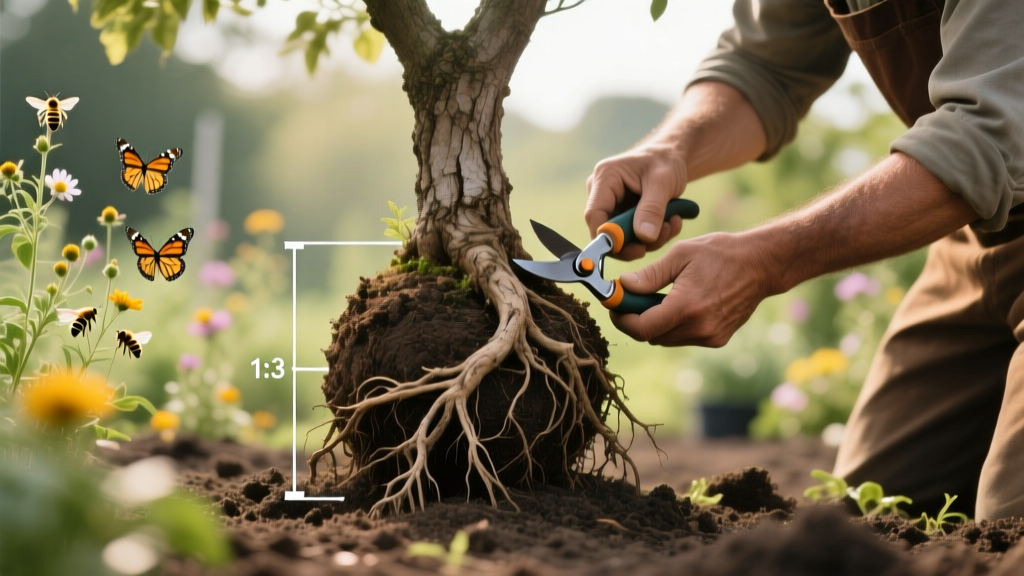
2026 Guide: Mature Tree Root Pruning and Ball Size Ratios
Emily WatsonPublished
The Shift to Mature Keystone Trees in 2026 Pollinator Gardens
Designing a truly impactful pollinator-friendly garden in 2026 goes far beyond sowing native wildflower seeds in a sunny border. Modern ecological landscaping heavily emphasizes the immediate integration of mature keystone trees to provide instant structural canopy, critical nesting habitats, and massive nectar resources. While planting saplings is a noble long-term investment, waiting thirty years for an oak or linden to reach ecological maturity is not viable for urgent habitat restoration. Transplanting semi-mature trees offers an immediate ecological anchor for your garden, supporting hundreds of Lepidoptera species right from the first season.
However, transplanting a mature tree is a high-stakes horticultural endeavor. If the tree suffers severe transplant shock, it will drop its leaves, halt the production of extrafloral nectaries, and fail to support the complex food web that pollinators rely on. The secret to a successful transplant lies in meticulous preparation, specifically understanding root pruning techniques and adhering to strict root ball size ratios. According to the Xerces Society for Invertebrate Conservation, preserving the health of keystone trees like White Oak (Quercus alba) and American Linden (Tilia americana) is paramount, as these single species can support over 400 species of native caterpillars, which in turn feed essential pollinator birds and beneficial insects.
The Mathematics of Survival: Root Ball Size Ratios
The most common reason mature tree transplants fail is an undersized root ball. When you dig up a tree, you are leaving behind the vast majority of its fine, water-absorbing feeder roots. To compensate, the root ball must be large enough to capture a sufficient percentage of the root mass to keep the canopy hydrated. In 2026, professional arborists strictly follow the ANSI A300 standards for tree care operations, which dictate precise ratios based on the trunk caliper.
Trunk caliper is measured six inches above the soil line for trees up to four inches in diameter, and twelve inches above the soil line for larger specimens. The golden rule for field-grown trees is that for every one inch of trunk caliper, the root ball must have a minimum diameter of ten to twelve inches. This ratio ensures that the tree retains enough structural and absorptive roots to survive the transition into your pollinator garden.
| Trunk Caliper (inches) | Minimum Root Ball Diameter | Root Ball Depth | Estimated Soil Weight |
|---|---|---|---|
| 2.0 | 24 inches | 16 inches | 800 lbs |
| 3.0 | 36 inches | 24 inches | 1,800 lbs |
| 4.0 | 48 inches | 30 inches | 3,500 lbs |
| 5.0 | 60 inches | 36 inches | 5,800 lbs |
As the table illustrates, a seemingly modest 5-inch caliper tree requires a root ball weighing nearly three tons. This necessitates heavy machinery, but attempting to cheat the ratio by digging a smaller ball will almost certainly result in canopy dieback, destroying the tree's value as a pollinator host.
Strategic Root Pruning: Preparing the Tree for the Move
You cannot simply dig up a mature tree and expect it to thrive. Strategic root pruning is a mandatory preparatory step that should be performed six to twelve months before the actual transplant. Root pruning involves severing the lateral roots outside the intended root ball diameter. This intentional damage stimulates the tree to produce a dense, fibrous network of new feeder roots inside the designated ball area.
Timing and Execution
The ideal time for root pruning is during the tree's dormant season or early spring before bud break. To execute this, measure the required root ball diameter from the center of the trunk and mark a circle on the ground. Using modern 2026 battery-powered trenchers or pneumatic air excavation tools (like an AirSpade), dig a narrow trench just outside your marked line. According to guidelines from Clemson University's Home and Garden Information Center, cleanly severing these roots with sharp tools prevents crushing and tearing, which can invite pathogenic fungi.
Once the roots are severed, backfill the trench with a mixture of native soil and high-quality compost. This nutrient-rich environment encourages the rapid proliferation of mycorrhizal fungi and new feeder roots. By the time you are ready to move the tree to its new pollinator habitat, the root ball will be packed with a self-sustaining, compact root system capable of immediate water uptake.
Executing the Transplant: Best Practices for 2026
When the day of the transplant arrives, precision is critical. The trenching process must follow the exact outer edge of the root-pruned zone. As you dig down, taper the root ball slightly inward at the bottom to create a saucer or ball shape, which makes it easier to slide lifting straps underneath.
Once the root ball is fully undercut, it must be immediately wrapped in natural, untreated burlap and secured with a wire basket or heavy-duty jute twine. This prevents the soil from cracking and tearing away from the roots during transport. The Morton Arboretum explicitly warns against lifting the tree by its trunk, as this can cause catastrophic internal damage to the root ball and snap the taproot or primary structural roots. Always use a tree spade, a crane with padded slings, or heavy-duty lifting straps placed directly beneath the bound root ball.
When placing the tree in its new location within your pollinator garden, ensure that the root flare (the point where the trunk widens at the base) sits slightly above the surrounding grade. Planting too deep is a leading cause of transplant failure, as it suffocates the roots and promotes trunk rot, ultimately robbing your garden of its vital canopy host.
Post-Transplant Care and Pollinator Underplanting
The first two years after transplanting are the most critical for establishment. Your watering schedule must be rigorous. A mature transplant requires deep, slow soaking directly over the root ball two to three times a week during the growing season, ensuring the water penetrates the entire depth of the ball. Avoid shallow sprinkler watering, which encourages weak, upward root growth.
Mulching and the Soil Microbiome
Apply a three-inch layer of coarse, undyed arborist wood chips in a wide donut shape around the tree, keeping the mulch at least six inches away from the trunk flare. This mulch conserves moisture, regulates soil temperature, and slowly breaks down to feed the mycorrhizal fungal networks that are essential for the tree's nutrient uptake. Never use dyed commercial mulches or rubber mulch, as these can leach chemicals into the soil that harm both the tree's roots and the ground-nesting native bees that populate a healthy pollinator garden.
Integrating Pollinator-Friendly Underplanting
Once the tree is safely in the ground, the surrounding area presents a unique microclimate for underplanting. However, you must avoid planting aggressive, deep-rooted native perennials directly over the recovering root ball, as they will compete fiercely for limited water. Instead, utilize shallow-rooted, shade-tolerant native sedges (like Carex pensylvanica) or early spring ephemerals like Bloodroot (Sanguinaria canadensis) and Virginia Bluebells (Mertensia virginica). These plants provide crucial early-season nectar for emerging bumblebee queens without stressing the newly transplanted tree.
By mastering the precise mathematics of root ball size ratios and employing disciplined root pruning techniques, you can successfully integrate mature keystone trees into your landscape. This advanced approach to 2026 garden design ensures that your pollinator habitat is not just a future promise, but a thriving, multi-tiered ecosystem from the very first season.
