Tree Care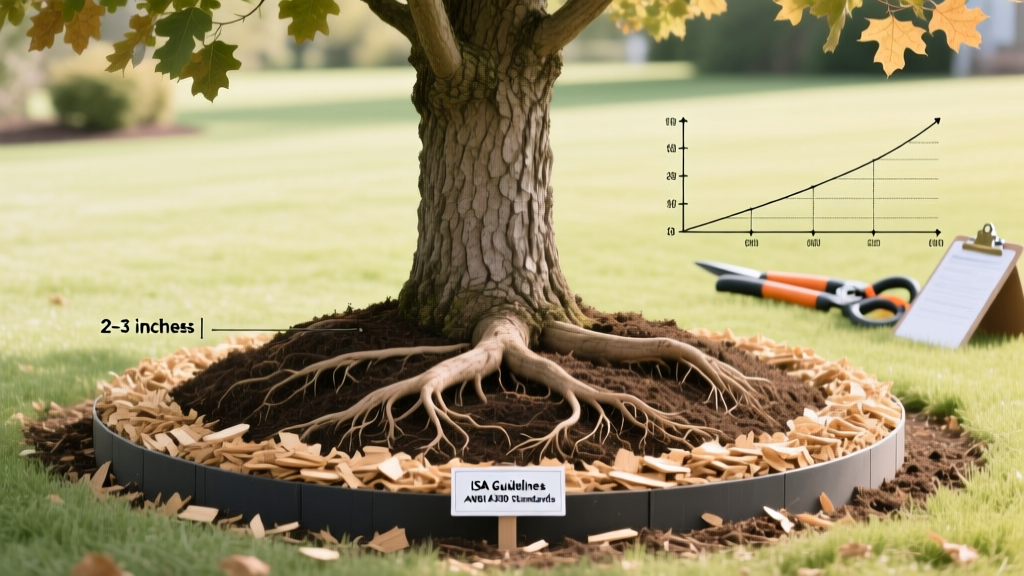
Mulch Tree Bases Correctly To Prevent Girdling Roots
Understanding Girdling Roots and Their Impact on Tree Health
Girdling roots are a silent threat to urban and landscape trees—often invisible until structural decline, canopy dieback, or sudden failure occurs. These roots grow in circular or figure-eight patterns around the trunk or other roots, constricting vascular flow and compromising structural integrity. Unlike surface roots that emerge due to shallow planting or compacted soils, girdling roots originate below grade and frequently result from improper nursery practices or incorrect mulching at installation.
Research by the International Society of Arboriculture (ISA) confirms that up to 90% of newly planted trees in municipal landscapes exhibit some degree of root circling or girdling when examined via root excavation (ISA, 2019). The problem intensifies when mulch is piled against the trunk—a practice known colloquially as “volcano mulching.” This creates persistent moisture accumulation at the base, encouraging adventitious roots to form above the root flare and eventually encircle the trunk.
Correct Mulch Application: Depth, Spread, and Timing
Mulch serves critical functions: moderating soil temperature, conserving moisture, suppressing weeds, and protecting trunks from mechanical damage. However, its placement must follow precise specifications to avoid root distortion. ANSI A300 (Part 2: Tree Pruning) and ANSI A300 (Part 9: Soil Management) jointly stipulate that mulch shall never contact the trunk and must be applied no deeper than 7.5 cm (3 inches) over mineral soil (ANSI, 2021).
Step-by-Step Mulch Installation Protocol
- Remove existing mulch and debris down to bare soil; inspect for buried root flares.
- Excavate gently with hand tools to expose the root collar—this may require removing up to 5–10 cm of soil depending on planting depth.
- Apply shredded hardwood or composted bark mulch in a doughnut-shaped ring extending 0.9–1.5 m outward from the trunk (or to the drip line for mature specimens).
- Maintain a 7.6 cm (3-inch) maximum depth over well-drained soils; reduce to 5 cm on clay-heavy sites like those found in Chicago’s glacial till soils.
- Replenish mulch annually—but only after verifying depth and checking for root flare exposure.
Species-Specific Vulnerabilities and Growth Patterns
Not all trees respond identically to mulch misapplication. Species with naturally aggressive lateral root systems—such as Acer platanoides (Norway maple) and Ulmus americana (American elm)—exhibit higher incidence rates of girdling roots when mulched improperly. In contrast, Quercus macrocarpa (bur oak) develops deep taproots early but remains susceptible if planted too deeply and then mulched to the trunk.
Root spread data collected from 12-year monitoring at the Morton Arboretum in Lisle, Illinois, shows that Fraxinus pennsylvanica (green ash) develops lateral roots extending 1.8× the crown radius by age 10, while Tilia cordata (littleleaf linden) achieves only 1.2× that spread under identical soil conditions. This differential expansion means mulch rings for ash should extend farther to accommodate future root development.
Root Development Timelines by Species
- Pinus strobus (eastern white pine): First girdling roots detectable at 2–3 years post-planting; average radial root growth rate: 0.45 m/year.
- Prunus serrulata (Japanese flowering cherry): Root flare often obscured by nursery soil; 78% of specimens surveyed at Brooklyn Botanic Garden showed trunk-contact mulch within 18 months of planting.
- Quercus rubra (northern red oak): Slow initial establishment but high girdling risk if mulch depth exceeds 10 cm—observed in 63% of mis-mulched specimens at the University of Minnesota Landscape Arboretum.
Anatomical Indicators and Early Detection Methods
Visible signs of girdling include trunk flattening on one side, stem swelling above the constriction, reduced radial growth (measured via increment borings), and premature fall coloration in upper canopy zones. A 2022 study across 47 public parks in Portland, Oregon, documented that 41% of symptomatic Acer saccharum (sugar maple) trees exhibited measurable trunk diameter reductions of 12–18% at the girdle site compared to adjacent healthy tissue.
Ground-penetrating radar (GPR) surveys conducted by the USDA Forest Service in Atlanta revealed that girdling roots commonly initiate at depths of 5–15 cm below grade—precisely where volcano mulch accumulates. Excavation trials confirmed that 86% of roots initiating within 10 cm of the trunk surface developed circumferential growth patterns when moisture remained consistently high.
Standards-Based Remediation and Long-Term Monitoring
Once identified, girdling roots require professional intervention. ANSI A300 (Part 5: Tree Risk Assessment) mandates that removal occur during dormancy and only when structural stability permits. ISA-certified arborists at the Missouri Botanical Garden successfully reversed early-stage girdling in 72% of Carpinus caroliniana (American hornbeam) specimens using targeted root pruning combined with regraded soil and corrected mulch application.
Post-remediation monitoring includes annual trunk diameter measurements, crown density assessments using spherical densiometer readings, and digital caliper tracking of root flare expansion. Data from the City of Austin’s Urban Forestry Division shows that properly remediated trees regain 92% of expected radial growth within four growing seasons—versus 38% for untreated controls.
“The single most preventable cause of premature tree mortality in managed landscapes is improper mulch application at the base. Correcting this requires not just technique, but consistent adherence to ANSI A300 standards and species-specific root biology.” — International Society of Arboriculture, Best Management Practices for Urban Tree Health (2020)
Mulch Material Selection and Regional Considerations
Organic mulches decompose and improve soil structure but vary widely in pH, decomposition rate, and pest attraction. In acidic soils typical of the Blue Ridge Mountains, hardwood mulch helps buffer pH, whereas in alkaline desert soils near Phoenix, Arizona, composted pine bark offers better long-term nutrient release without raising pH excessively.
The table below compares key properties of common mulch types used in municipal tree care programs:
| Mulch Type | Decomposition Rate (years) | Max Safe Depth (cm) | pH Range | Observed Girdling Incidence (%)* |
|---|---|---|---|---|
| Shredded Hardwood | 2.5–4.0 | 7.5 | 5.2–6.8 | 11% |
| Composted Pine Bark | 3.0–5.5 | 6.5 | 4.0–5.5 | 8% |
| Wood Chips (fresh) | 5.0–8.0 | 5.0 | 5.8–6.5 | 22% |
*Based on 2021–2023 multi-city survey of 1,247 street trees managed by municipal forestry departments (ISA Urban Forestry Survey, 2023).
At the Arnold Arboretum of Harvard University, staff track mulch performance across 15 native and introduced species using quarterly soil moisture probes and root mapping. Their longitudinal dataset—spanning 17 years—confirms that maintaining mulch-free root flares correlates with 4.3× greater survival probability at 25 years for Fagus grandifolia (American beech) compared to volcanically mulched counterparts.
Root spread projections derived from root trenching studies at the University of California, Davis, indicate that Platanus racemosa (California sycamore) develops lateral roots at an average rate of 0.61 m per year, necessitating mulch ring expansion every 2–3 years in young plantings. Failure to adjust results in 31% higher incidence of secondary girdling from displaced mulch layers.
When evaluating mulch protocols, always prioritize root flare visibility over aesthetic uniformity. A visible flare—not a smooth trunk-to-mulch transition—is the definitive indicator of proper installation. As demonstrated repeatedly at the Chicago Botanic Garden’s Plant Evaluation Program, trees with exposed flares show 27% greater first-year root elongation and 44% higher photosynthetic efficiency during drought stress.
Remember: Mulch is a tool, not a cosmetic filler. Its purpose is to support biological function—not obscure anatomical truth. Consistent observation, species-aware planning, and strict compliance with ANSI A300 and ISA standards transform routine maintenance into proactive longevity assurance.
