Tree Care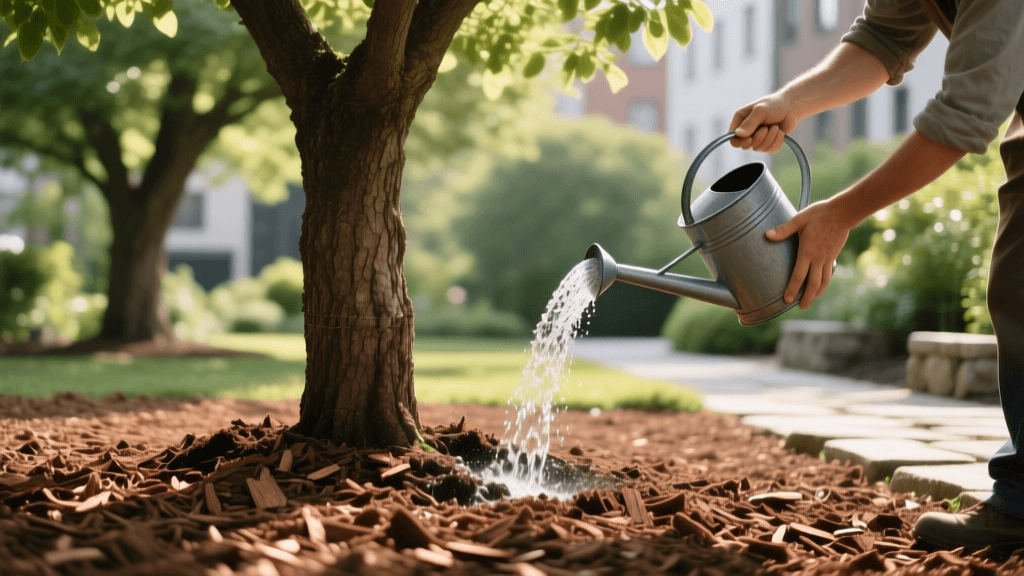
Expert Mulching and Deep Watering Guide for Mature Trees
The Hidden Lifelines: Why Mature Trees Need Targeted Care
When it comes to landscape maintenance, mature trees are often treated as self-sufficient giants. Homeowners assume that decades-old oaks, maples, and pines have root systems robust enough to weather any drought or environmental stressor without intervention. However, urban and suburban environments present unique challenges that natural forests do not. Compacted soils, competition from turfgrass, and altered drainage patterns severely restrict a mature tree's ability to access vital moisture and nutrients. As a senior arborist and lawn care specialist, I frequently see declining tree canopies that trace back to two fundamental errors: shallow watering and improper mulching. This comprehensive guide dives into the expert best practices for deep root watering and mulching, providing you with actionable measurements, product recommendations, and seasonal schedules to ensure your mature trees thrive for generations.
The Science and Strategy of Deep Root Watering
Turfgrass and mature trees have vastly different hydration needs. A standard lawn requires frequent, shallow watering to keep the top few inches of soil moist. In contrast, the critical root zone of a mature tree extends far beyond the drip line and resides primarily in the top 12 to 18 inches of soil. If you are simply running a sprinkler over your lawn, the water is being intercepted by the grass and evaporating before it ever reaches the tree's absorptive roots. This encourages the tree to grow surface roots upward in search of moisture, making it highly susceptible to drought stress, lawnmower damage, and structural instability during high winds.
Calculating Your Tree's Water Requirements
To properly hydrate a mature tree, you must calculate the volume of water required based on its Diameter at Breast Height (DBH). DBH is measured at 4.5 feet above the ground. The industry standard recommendation from the International Society of Arboriculture (ISA) is to provide approximately 10 to 15 gallons of water per inch of DBH during a deep watering session. For example, a mature red oak with a 20-inch DBH requires between 200 and 300 gallons of water per soaking. This sounds like a massive amount, but when applied slowly over the entire critical root zone, it mimics a deep, sustained rainfall event.
Expert Tool Recommendations for Deep Hydration
To deliver water directly to the root zone without causing runoff, you need the right equipment. Here are the top tools I recommend for homeowners and estate managers:
- Soaker Hoses (e.g., Melnor Flat Soaker Hose): Arrange the hose in a concentric spiral pattern starting 2 feet from the trunk and extending 5 feet past the drip line. Run the hose on a low trickle for 6 to 8 hours. Cost: $25 to $40 per 50-foot spool.
- Root Watering Probes (e.g., Dramm Deep Root Waterer or Ross Root Feeder): These attach to your garden hose and inject water directly 8 to 12 inches into the soil. This is ideal for heavily compacted clay soils where surface percolation is nearly impossible. Cost: $35 to $60.
- Tree Watering Bags (e.g., Treegator): While excellent for newly planted trees, these are less effective for mature trees whose root zones extend far beyond the trunk base. Reserve these for saplings or use them as supplemental point-waterers during extreme heat waves.
Mastering the Art of Tree Mulching
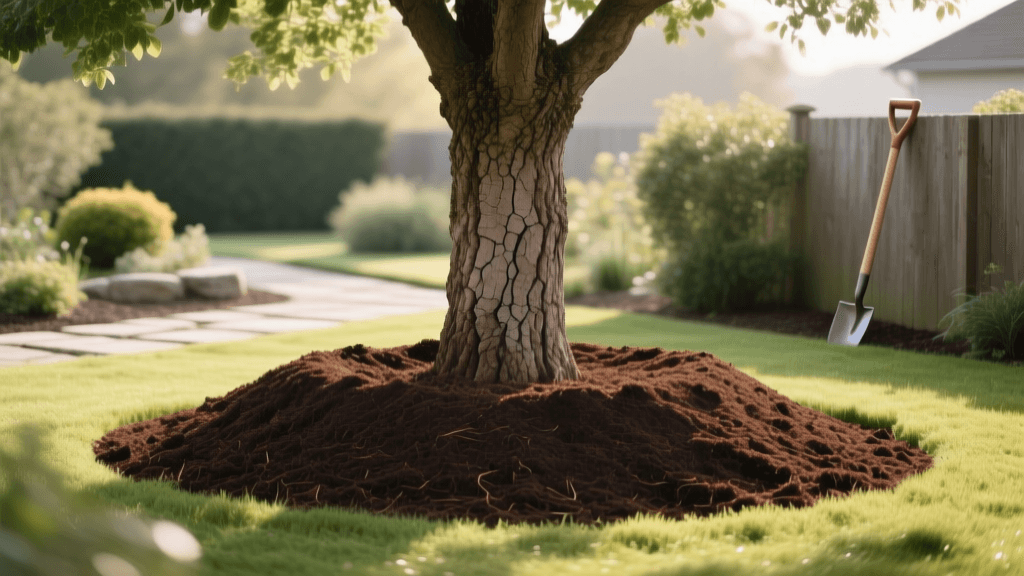
Mulching is arguably the most beneficial practice you can implement for tree health, yet it is also the most frequently botched. Proper mulching mimics the natural forest floor, regulating soil temperature, retaining moisture, and slowly releasing organic matter as it decomposes. However, improper mulching can suffocate roots, invite fungal pathogens, and harbor destructive rodents.
According to the University of Florida IFAS Extension, 'Proper mulching can reduce soil moisture loss by up to 20 percent, moderate soil temperature extremes, and significantly reduce weed competition, but piling mulch against the trunk can lead to stem girdling roots and bark decay.'
The 3-3-3 Rule of Mulching
To avoid the dreaded 'volcano mulching'—a landscaping fad that piles mulch high against the trunk—I teach my clients the 3-3-3 Rule:
- 3 Inches Deep: Apply a layer of organic mulch no deeper than 3 inches. Any thicker, and you restrict oxygen exchange to the fine feeder roots.
- 3 Feet Wide (Minimum): The mulch ring should extend at least 3 feet from the trunk in all directions. For mature trees, extending the ring to the drip line is the gold standard.
- 3 Inches Away from the Trunk: Keep the mulch completely clear of the tree's root flare. The bark at the base of the tree is not designed to hold moisture; burying it leads to rot and invites boring insects.
Comparing Organic Mulch Materials
Not all mulch is created equal. Inorganic options like rubber or stone do not improve soil biology. Always choose organic, plant-based mulches. Below is a comparison chart to help you select the best material for your specific landscape needs.
| Mulch Type | Decomposition Rate | Avg Cost (Per Cu. Yd.) | Best Use Case & Expert Notes |
|---|---|---|---|
| Arborist Wood Chips | Slow (2-4 years) | $15 - $30 (Often Free) | Ideal for large mature trees and woodland edges. Excellent weed suppression and moisture retention. Can temporarily tie up surface nitrogen if tilled into soil. |
| Double-Shredded Hardwood Bark | Moderate (1-2 years) | $35 - $50 | Best for formal landscapes and high-visibility areas. Stays in place well on slopes and breaks down to enrich clay soils. |
| Pine Needles (Pine Straw) | Fast (6-12 months) | $40 - $60 (per bale equiv.) | Excellent for acid-loving trees like pines, oaks, and dogwoods. Highly permeable to water and air, but requires annual replenishment. |
| Leaf Mold / Composted Leaves | Very Fast (3-6 months) | Free (DIY) | Superior soil biology booster. Best used as a thin top-dressing beneath a layer of wood chips to prevent blowing away. |
Seasonal Scheduling and Soil Moisture Testing
Knowing when to water is just as critical as knowing how. Mature trees generally do not need supplemental watering during the dormant winter months or in early spring when natural rainfall is abundant and evaporation rates are low. The critical window for deep watering is from late spring through early autumn, particularly during periods of less than 1 inch of natural rainfall per week.
The Screwdriver Test
Before turning on the hose, perform the screwdriver test. Take a standard 8-inch flathead screwdriver and push it into the soil within the tree's drip line. If the blade slides in easily with minimal resistance, your soil has adequate moisture. If you meet heavy resistance or cannot push the blade past 3 inches, your tree is experiencing sub-surface drought stress and requires immediate deep watering. This simple, free diagnostic tool prevents both underwatering and the equally fatal mistake of overwatering, which strips oxygen from the soil and causes root asphyxiation.
Critical Mistakes to Avoid
Even well-intentioned homeowners can inadvertently harm their trees. Avoid these common pitfalls:
- Fertilizing Drought-Stressed Trees: Never apply synthetic fertilizers to a tree suffering from drought stress. Fertilizers are salts; applying them to dry soil will draw moisture out of the roots through osmosis, accelerating the tree's decline. Always rehydrate first.
- Using Fresh, Uncomposted Wood Chips: While arborist chips are great, chips derived from diseased wood or fresh, highly resinous pine can harbor pathogens or alter soil pH drastically. Ensure chips are sourced from healthy, aged trees.
- Watering Only at the Trunk: The absorptive roots of a mature tree are not located at the base of the trunk. They are concentrated in the top 18 inches of soil, extending from the mid-canopy out to and beyond the drip line. Focus your watering efforts on this outer ring.
Final Thoughts from the Arborists
Caring for mature trees is an investment in your property's value, your local ecosystem, and the legacy of your landscape. By abandoning shallow watering habits and rejecting the harmful practice of volcano mulching, you align your landscape maintenance with proven arboricultural science. Implement the 3-3-3 mulching rule, invest in a root watering probe or soaker hose, and rely on the screwdriver test to guide your seasonal schedule. Your trees have stood guard over your home for decades; with these expert best practices, you can ensure they continue to thrive for decades to come.