
Landscaping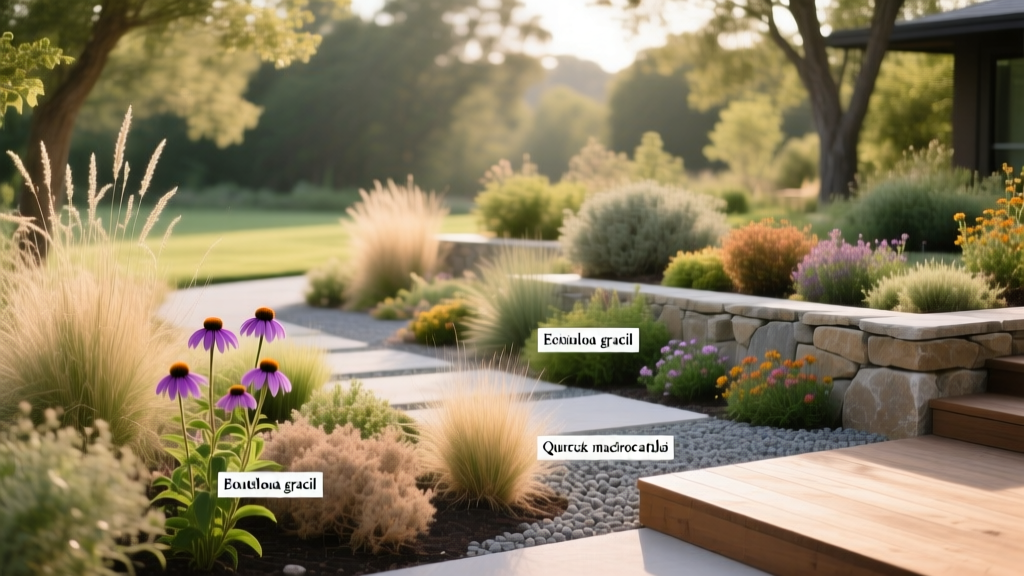
Native Plants For Landscaping By Region
Matching Plants to Place: The Regional Approach to Native Landscaping
Choosing plants that evolved where you live is one of the most practical things a landscape designer can do. Native plants are already adapted to local soils, rainfall, and temperature swings — so they usually need less watering, less fertilizer, and support local bees, butterflies, and birds. The American Society of Landscape Architects (ASLA) has long treated ecological function as a core part of design. Its 2022 Sustainable Landscapes guidelines point out that using regionally appropriate plants can cut landscape water use by 30 to 50 percent compared to conventional ornamental plantings.
This article walks through the continental U.S. region by region, listing native species that work well in designed landscapes, how they’re typically used, and what they cost for residential and commercial projects. Whether you’re working on a quarter-acre backyard or a multi-acre campus, knowing the ecology of your site helps guide every planting decision.
Pacific Northwest: Designing with Conifers and Understory Natives
The Pacific Northwest covers a wide range of conditions — from the wet, temperate rainforests west of the Cascades to the high desert steppe of eastern Oregon and Washington. In cities like Portland, Seattle, and Eugene, landscape architects deal with heavy winter rain, dry summers, and soils that vary from rich alluvial loam to compacted glacial till.
For canopy structure, Pseudotsuga menziesii (Douglas fir) defines the region, though its size — mature trees reach 200 feet — means it’s best suited for large properties and parks. A more manageable option for residential lots is Acer macrophyllum (bigleaf maple), which grows 50 to 75 feet tall and gives dense summer shade. For smaller spaces under 2,000 square feet, Cornus nuttallii (Pacific dogwood) offers spring bracts, summer foliage, and fall color, reaching 15 to 25 feet at maturity.
Understory and Ground Cover Selections
Below the canopy, Gaultheria shallon (salal) is a reliable shrub that handles deep shade and poor soils, spreading into dense colonies that hold back weeds without irrigation once established. Paired with Polystichum munitum (sword fern), these two species can cover a shaded slope of 500 square feet for about $400 to $600 in plant costs, depending on container size and local nursery pricing.
For rain gardens and bioswales — now required by stormwater codes in Portland and Seattle — Carex obnupta (slough sedge) and Juncus effusus (common rush) handle periodic flooding and offer shelter for ground-nesting birds. The University of Washington Botanic Gardens found that rain gardens planted with these species retain 85 to 90 percent of stormwater during typical winter storms.
Cost Benchmarks for Pacific Northwest Native Plantings
Installation costs in the Pacific Northwest depend heavily on project size. A typical 1,000-square-foot residential native planting — including soil prep, mulch, and plants — runs $8 to $14 per square foot installed. Commercial projects see lower costs per square foot thanks to scale: $5 to $9 per square foot for plantings over 5,000 square feet. These figures match data from the Oregon Association of Nurseries’ 2023 pricing survey.
California and the Mediterranean Climate Zone
California’s Mediterranean climate — wet winters, dry summers, mild temperatures — supports one of North America’s most diverse native floras. The California Native Plant Society estimates the state has more than 6,500 native plant species, many adapted to summer drought and fire-prone conditions. In Southern California and the Sierra Nevada foothills, landscape architects often work in wildland-urban interface zones, where balancing aesthetics with fire-safe design matters.
Quercus agrifolia (coast live oak) anchors coastal California’s canopy. It can live 250 years and provides habitat few other trees match. A 15-gallon specimen costs $80 to $150 at retail. Over time, it pays off — University of California Cooperative Extension studies show mature oaks raise nearby home values by 3 to 5 percent.
In Southern California, fire-resistant ground covers like Ceanothus species (California lilac) give dense, low growth and bloom heavily each spring. Once established after two to three years, they need no summer water. Ceanothus griseus horizontalis (Carmel creeper) spreads 6 to 8 feet wide and stays under 2 feet tall — useful on slopes and for erosion control on grades up to 30 percent.
Chaparral and Coastal Sage Scrub Palettes
Salvia leucophylla (purple sage) and Artemisia californica (California sagebrush) anchor coastal sage scrub plantings. Both are aromatic, drought-tolerant, and provide key habitat for the California gnatcatcher, a federally threatened bird. Using them near sensitive areas can help meet requirements under Section 7 of the Endangered Species Act.
A 500-square-foot coastal sage scrub planting using one-gallon containers spaced 3 feet apart needs about 55 plants. At $12 to $18 per one-gallon native, plant material costs run $660 to $990 before labor.
The Great Plains: Tallgrass and Mixed-Grass Prairie Design
The Great Plains bring their own set of challenges: big open spaces, temperature swings from -20°F to 110°F, periodic drought, and soils ranging from deep, fertile mollisols to shallow, rocky uplands. Less than 4 percent of the original 400 million acres of North American prairie remains — so native plantings here do more than look good.
Andropogon gerardii (big bluestem) is the signature grass of the tallgrass prairie, growing 6 to 8 feet tall with roots that reach 10 feet down. That deep root system makes it highly drought-tolerant and effective at storing carbon. With Sorghastrum nutans (indiangrass) and Schizachyrium scoparium (little bluestem), these grasses create layered structure that supports over 300 insect species, according to research from the Tallgrass Prairie National Preserve in Kansas.
Flowering plants matter just as much. Echinacea purpurea (purple coneflower), Ratibida pinnata (gray-headed coneflower), and Liatris spicata (dense blazing star) bloom from June through September, giving pollinators food all season. A 2,000-square-foot prairie planting with a 60/40 grass-to-forb ratio can be started from plugs for $3,000 to $5,000 in plant material, and usually fills in fully within three growing seasons.
- Andropogon gerardii (big bluestem) — 6 to 8 feet, full sun, drought-tolerant once established
- Schizachyrium scoparium (little bluestem) — 2 to 4 feet, excellent fall color, tolerates poor soils
- Echinacea purpurea (purple coneflower) — 2 to 3 feet, blooms June–August, high pollinator value
- Liatris spicata (dense blazing star) — 2 to 4 feet, blooms July–September, monarch butterfly host
- Baptisia australis (blue wild indigo) — 3 to 4 feet, nitrogen-fixing, long-lived perennial
The Southeast: Humid Subtropical Natives and Riparian Design
The southeastern U.S. — Florida, Georgia, the Carolinas, Alabama, Mississippi, and Louisiana — hosts exceptional plant diversity thanks to high rainfall, warm temperatures, and varied habitats, from longleaf pine savannas to coastal marshes. Landscape architects here deal with humidity, hurricane exposure near the coast, and soils that range from sandy, nutrient-poor sandhills to heavy clay piedmont soils.
Magnolia grandiflora (southern magnolia) is iconic, but its 60- to 80-foot height and aggressive surface roots make it a poor fit for small yards. Better options include Cercis canadensis (eastern redbud), 20 to 30 feet tall, with strong spring bloom and tolerance for partial shade, and Ilex opaca (American holly), which keeps its leaves year-round and produces winter berries for birds.
For wet areas and rain gardens, Clethra alnifolia (summersweet) handles periodic flooding and blooms mid-summer with fragrant white flowers. Itea virginica (Virginia sweetspire) works in both wet and dry spots and delivers vivid red, orange, and purple fall color. Most southeastern native nurseries sell these shrubs for $15 to $35 per three-gallon container.
"Landscape architects have a professional responsibility to specify plants that support ecological function, not merely aesthetic preference. In regions where native plant communities have been severely fragmented, designed landscapes represent a meaningful opportunity for habitat restoration at the parcel scale." — American Society of Landscape Architects, Sustainable Landscapes Position Statement, 2022
The longleaf pine (Pinus palustris) ecosystem once covered 90 million acres across the Southeast. Today it occupies less than 3 percent of that area. Projects that include longleaf pine and its understory partners — like Aristida stricta (wiregrass) and Penstemon australis (southern beardtongue) — line up with regional conservation goals set by the Longleaf Alliance, a nonprofit based in Andalusia, Alabama.
The Northeast: Deciduous Forest Natives and Urban Applications
The northeastern U.S. offers a well-documented native plant palette shaped by thousands of years of deciduous forest. From Maine to Maryland, the eastern deciduous forest is built around Quercus rubra (red oak), Acer saccharum (sugar maple), Betula lenta (sweet birch), and Fagus grandifolia (American beech). These trees form the structural base for any ecologically grounded landscape in the region.
Urban settings add complications: compacted soils, air pollution, salt spray from winter roads, and heat island effects. Brooklyn Botanic Garden research shows native oaks — especially Quercus bicolor (swamp white oak) — survive street tree plantings better than many non-native species. In New York City pilot programs, 10-year survival rates for swamp white oak exceeded 75 percent.
For residential foundation plantings and mixed borders, the shrub layer is rich with options. Viburnum dentatum (arrowwood viburnum) grows 6 to 10 feet tall and wide, handles various soils, and bears blue-black fruit that feeds migrating birds in fall. Fothergilla gardenii (dwarf fothergilla) stays under 3 feet, blooms with fragrant white flowers in spring, and turns bright red, orange, and yellow in fall. Both are widely available at northeastern native nurseries for $20 to $45 per three-gallon container.
| Region | Signature Native Tree | Typical Mature Height | Installed Cost (15-gal) | Primary Design Use |
|---|---|---|---|---|
| Pacific Northwest | Acer macrophyllum | 50–75 ft | $180–$280 | Canopy shade, riparian buffers |
| California | Quercus agrifolia | 40–70 ft | $150–$250 | Canopy, habitat, fire-adapted landscapes |
| Great Plains | Quercus macrocarpa | 60–80 ft | $200–$320 | Windbreaks, savanna restoration |
| Southeast | Cercis canadensis | 20–30 ft | $120–$200 | Understory, spring interest |
| Northeast | Quercus bicolor | 50–60 ft | $190–$300 | Street trees, urban canopy |
Ground-layer planting in the Northeast got a major boost from entomologist Douglas Tallamy’s work at the University of Delaware. He measured how many caterpillar species different native plants support. His data shows Quercus (oak) species host over 500 caterpillar species, and Prunus (cherry and plum) species host over 450 — far more than most ornamental non-natives. That research has shaped planting choices at places like the Mt. Cuba Center in Hockessin, Delaware, which runs one of the most extensive native plant trial gardens in the eastern U.S.
- Conduct a site analysis documenting existing soil type, drainage patterns, sun exposure, and any existing native vegetation before selecting species.
- Source plants from regional nurseries or seed-grown stock with documented local provenance whenever possible to preserve genetic diversity.
- Plan for a three-year establishment period during which supplemental irrigation and weed management will be necessary even for drought-tolerant species.
- Incorporate structural diversity — canopy, understory, shrub, herbaceous, and ground cover layers — to maximize habitat value and visual interest across seasons.
- Document plant selections and sources to support any future certification applications under LEED, SITES, or local green building programs.
The SITES v2 Rating System, developed by the ASLA, the Lady Bird Johnson Wildflower Center, and the United States Botanic Garden, gives the clearest framework available for measuring how well a landscape performs ecologically. Projects earn credits for using regionally appropriate native plants, managing stormwater on-site, and restoring or protecting native plant communities. As of 2023, over 200 projects across the U.S. have earned SITES certification — proof that native plant design works at any scale.
Using native plants in designed landscapes isn’t just about swapping one list for another. It means learning how native plant communities actually work — the soil microbes, the insects, the way water moves — and designing to support those connections. When that understanding shapes decisions about grading, spacing, and maintenance, the result is a landscape that supports local ecology, costs less to care for over time, and helps people feel rooted in the place where they live.

