Tree Care
Designing a Native Tree Windbreak for Privacy and Energy Savings
The Intersection of Privacy, Design, and Energy Efficiency
When homeowners seek privacy, the immediate instinct is often to erect a wooden or vinyl fence. While fencing provides an instant visual barrier, it comes with a high upfront cost—typically ranging from $30 to $50 per linear foot—and offers zero ecological or energy-saving benefits. In contrast, designing a living privacy screen using a native tree windbreak is a masterclass in functional landscape architecture. Not only does a well-planned tree windbreak create a lush, year-round visual barrier, but it also fundamentally alters your property's microclimate, reducing winter heating costs and providing a sanctuary for local wildlife.
From a design perspective, a windbreak is more than just a row of trees; it is a living, breathing infrastructure that softens hardscaping, absorbs noise pollution, and increases property value. According to the USDA Natural Resources Conservation Service (NRCS), a properly designed and placed windbreak can reduce home heating costs by 10 to 25 percent by slowing the frigid winter winds that drive cold air into your home's envelope.
The Aerodynamics of a Living Privacy Screen
To design an effective windbreak, you must understand how wind interacts with obstacles. When wind hits a solid barrier like a brick wall or a privacy fence, it creates turbulence and a harsh downdraft on the leeward side. However, when wind encounters a semi-permeable barrier like a coniferous tree canopy, the air is filtered through the branches and needles. This slows the wind velocity and creates a 'wind shadow'—a zone of calm air that extends downwind for a distance of 10 to 30 times the height of the trees.
According to the University of Minnesota Extension, the ideal windbreak density is between 50% and 60%. This specific density allows enough wind to pass through to prevent severe turbulence on the protected side, while still providing a massive reduction in overall wind speed and blowing snow.
For privacy and energy efficiency, this means planting your windbreak on the north and northwest sides of your property (in the Northern Hemisphere) to block prevailing winter winds, while strategically leaving the southern side open to capture passive solar heat during the winter months.
Cost Analysis: Living Screens vs. Traditional Fencing
Before selecting your species, consider the long-term return on investment. A standard 6-foot tall cedar privacy fence costs approximately $45 per linear foot installed. For a 100-foot property line, that is a $4,500 expense that immediately begins to depreciate, requiring staining, repairs, and eventual replacement.
Conversely, planting a row of 5-gallon native evergreens (such as Eastern Redcedar or Arborvitae) spaced 8 feet apart requires about 13 trees for a 100-foot run. At an average cost of $60 to $90 per tree, your material cost is roughly $780 to $1,170. Even with professional planting labor, the total cost rarely exceeds $2,500. Furthermore, as the trees mature, they appreciate in value, sequester carbon, and manage stormwater runoff—benefits a wooden fence simply cannot provide.
Selecting the Right Native Trees for Your Canopy
A resilient windbreak relies on species diversity to prevent a single pest or disease from wiping out your entire privacy screen. While it is tempting to plant a monoculture of a single fast-growing species, mixing native conifers and broadleaf evergreens ensures long-term stability. Below is a comparison chart of excellent native and naturalized options for North American landscapes.
| Tree Species | Mature Height | Spread | Growth Rate | Optimal Spacing |
|---|---|---|---|---|
| Eastern Redcedar (Juniperus virginiana) | 40 - 50 ft | 8 - 15 ft | Medium (1-2 ft/yr) | 8 - 12 ft |
| American Arborvitae (Thuja occidentalis) | 25 - 40 ft | 10 - 15 ft | Slow-Medium | 6 - 10 ft |
| Eastern White Pine (Pinus strobus) | 50 - 80 ft | 20 - 40 ft | Fast (2-3 ft/yr) | 15 - 20 ft |
| White Spruce (Picea glauca) | 40 - 60 ft | 10 - 20 ft | Medium | 10 - 15 ft |
| Northern Bayberry (Morella pensylvanica)* | 5 - 10 ft | 4 - 8 ft | Slow | 3 - 5 ft |
*Note: Northern Bayberry is a semi-evergreen shrub/small tree ideal for the inner row of a multi-row windbreak or for smaller suburban properties where massive conifers would overwhelm the design.
Strategic Placement: The Staggered Row Design
To achieve maximum privacy and wind deflection, avoid planting trees in a single, straight line. A single row leaves gaps at the trunk level and offers minimal protection if a tree dies. Instead, utilize a staggered, zig-zag planting design across two or three rows.
- Distance from the Home: Plant your windbreak at a distance of 50 to 100 feet from the house, or roughly 2 to 5 times the mature height of the tallest tree species you are planting. This ensures the 'wind shadow' perfectly covers your home without the tree roots threatening your foundation.
- Row Spacing: Space your rows 10 to 12 feet apart. This allows room for maintenance, prevents the canopies from competing too aggressively for sunlight, and promotes air circulation to reduce fungal diseases.
- Staggering: If a tree in Row A is planted at the 0-foot mark, plant the corresponding tree in Row B at the 5-foot mark. This overlapping geometry ensures that even as the trees mature and their trunks thicken, there are no visual or aerodynamic gaps in your privacy screen.
Soil Preparation and Site Assessment
Before breaking ground, conduct a comprehensive site assessment. Evergreens generally prefer slightly acidic soil with a pH between 5.5 and 6.5. Send a soil sample to your local cooperative extension office to determine your baseline pH and nutrient levels. If your soil is heavy clay, which retains too much water and can suffocate conifer roots, you must address drainage. Rather than amending the backfill soil (which can create a 'bathtub effect' where water pools in the planting hole), plant the trees slightly elevated. Mounding the soil 4 to 6 inches above grade and planting the root ball on top of the mound ensures critical surface roots have access to oxygen.
Step-by-Step Planting Protocol for Windbreak Trees
Proper planting technique is the difference between a thriving privacy screen and a costly failure. Follow these precise steps for balled-and-burlapped (B&B) or container-grown evergreens:
- Locate the Root Flare: The root flare (where the trunk widens at the base and transitions into roots) must be visible at or slightly above the soil surface. Planting too deep is the number one killer of landscape trees.
- Dig the Hole: Dig a hole that is 2 to 3 times wider than the root ball, but no deeper. The center of the hole should be slightly mounded so the tree rests on undisturbed soil, preventing it from sinking over time.
- Remove Containers and Wire: If planting a B&B tree, place it in the hole, then cut away the burlap and completely remove any wire baskets. Leaving wire baskets can girdle roots years later.
- Backfill and Water: Backfill with the native soil you excavated. As you fill, use a hose to gently water the soil, eliminating large air pockets without compacting it with heavy tamping.
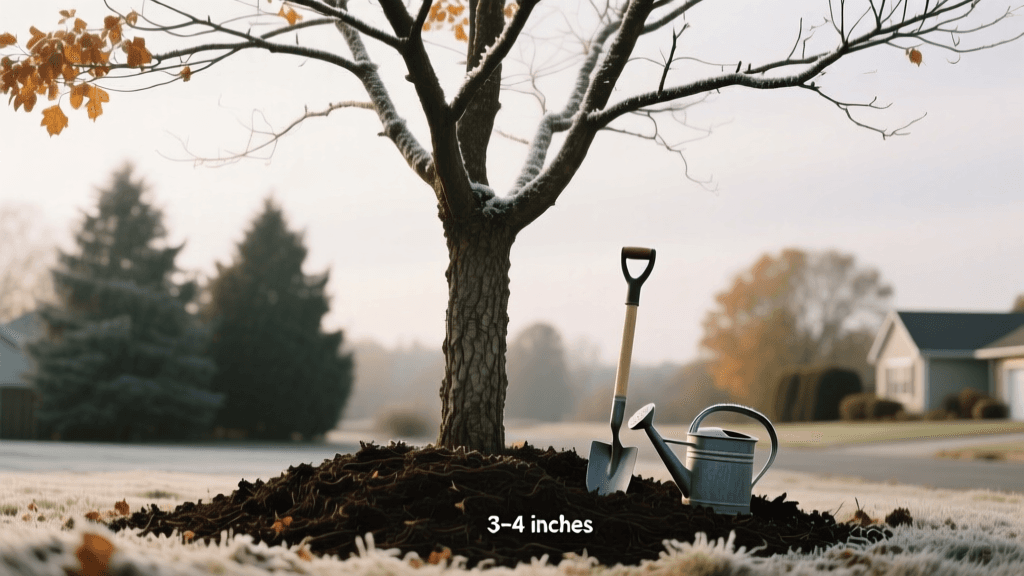
- Apply Mulch Correctly: Apply a 3-inch layer of organic wood chip mulch in a 3-foot radius around the tree. Keep the mulch at least 3 inches away from the trunk to prevent bark rot and rodent damage. Never 'volcano mulch'.
Establishment Care and Long-Term Canopy Management
The first two years are critical for establishing your windbreak. Evergreens do not show drought stress as obviously as deciduous trees; by the time an arborvitae turns brown, it is often too late to save it. Implement a strict watering schedule: provide 10 gallons of water per week for every inch of trunk caliper during the growing season. In late autumn, give all evergreens a deep, thorough watering before the ground freezes to prevent 'winter desiccation'—a condition where frozen ground prevents roots from replacing the moisture lost to harsh winter winds through the needles.
As your windbreak matures, selective pruning will be necessary to maintain density. According to guidelines published by Penn State Extension, lightly shearing the terminal leaders of species like Arborvitae in early summer encourages lateral branching, resulting in a thicker, more impenetrable privacy screen. Avoid pruning into the 'dead zone' (the inner, needle-less part of the conifer), as most evergreens will not generate new growth from old, bare wood.
Conclusion
Designing a native tree windbreak is a forward-thinking approach to landscape architecture. By carefully selecting diverse species, calculating precise spacing, and employing proper planting techniques, you transform an exposed, windy yard into a private, energy-efficient oasis. The initial investment of time and planning yields compounding returns for decades, offering a living, growing barrier that beautifies your property while actively working to lower your utility bills and support local ecosystems.