Tree Care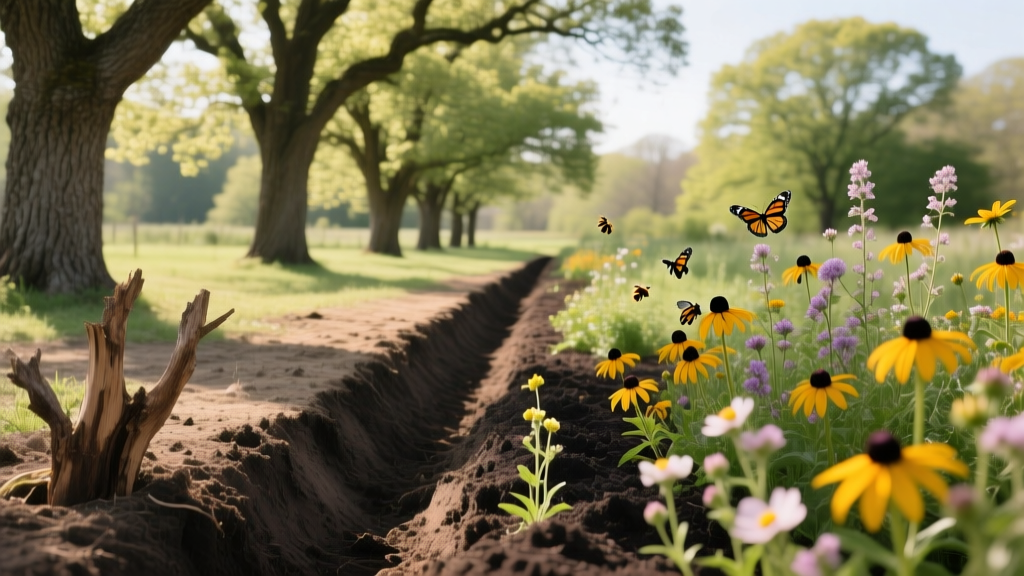
Oak Wilt Trenching and Pollinator Garden Design 2026
Robert HayesPublished
The Intersection of Tree Health and Pollinator Ecology in 2026
Oak wilt, caused by the invasive fungal pathogen Bretziella fagacearum, remains one of the most destructive tree diseases in North America. As we navigate the 2026 growing season, arborists and ecologists are increasingly focused on holistic landscape management. While saving your majestic oaks is paramount, the methods used to contain the disease must not come at the expense of your local ecosystem. The trenching containment method is the gold standard for halting the below-ground spread of oak wilt, but it inherently involves severing roots and disrupting significant stretches of soil. For the eco-conscious homeowner, this presents a unique challenge: how do we execute necessary tree surgery while preserving and enhancing pollinator habitats?
In 2026, the paradigm of landscape design has shifted toward regenerative practices. We no longer view a disease containment trench as a mere scar on the landscape; instead, we view it as an opportunity to establish a linear pollinator corridor. By understanding the biology of both the oak tree and native pollinators, you can implement an oak wilt prevention strategy that doubles as a sanctuary for bees, butterflies, and beneficial insects.
Understanding the Trenching Containment Method
Oak wilt spreads in two primary ways: above ground via sap-feeding nitidulid beetles, and below ground through interconnected root grafts. While Red Oaks are highly susceptible to beetle transmission, Live Oaks and White Oaks often spread the disease rapidly through their extensive, grafted root systems. To stop this subterranean highway, arborists use mechanical trenching to physically sever the root connections between infected and healthy trees.
According to the Texas Oak Wilt Information Partnership, a properly executed trench must be at least 48 inches deep to ensure all major root grafts are severed. In 2026, the industry standard relies on specialized vibratory plows equipped with narrow, heavy-duty blades that slice through the soil with minimal surface disruption compared to traditional backhoes. The trench is typically placed at least 100 feet away from the outermost symptomatic trees, or just outside the dripline of the last apparently healthy tree in the infection center.
While the vibratory plow is efficient, the resulting trench leaves a band of highly disturbed, compacted soil that is entirely devoid of microbial life and structural integrity. If left untreated, this barren strip becomes a haven for invasive weeds. However, with strategic pollinator-friendly garden design, this exact strip can be transformed into a thriving, deep-rooted native habitat that requires zero chemical fertilizers and actively supports local food webs.
Timing Trenching to Protect Ground-Nesting Bees
When planning your oak wilt containment strategy, timing is everything. Approximately 70% of native bee species, including crucial genera like Andrena (mining bees) and Halictus (sweat bees), are ground-nesting. They dig small burrows in undisturbed, well-draining soil to lay their eggs and overwinter. Trenching during the spring or early summer can devastate local populations of these vital pollinators by destroying their active nests and crushing overwintering larvae.
To align tree care with pollinator conservation, the Xerces Society for Invertebrate Conservation recommends scheduling major soil-disturbing activities during the late fall or winter months. By trenching between November and February, you avoid the peak foraging and nesting seasons. During this dormant window, the oak tree is also less stressed, and the risk of fresh pruning wounds attracting sap beetles is virtually zero. Once the trench is backfilled in late winter, the soil has time to settle and integrate before the spring pollinator emergence.
2026 Best Practice: Never apply broad-spectrum soil fumigants or neonicotinoid soil drenches in or around the trench line. These chemicals persist in the soil, leach into nearby groundwater, and are lethal to ground-nesting bees and soil-dwelling mycorrhizal fungi essential for oak health.
Designing the Trench Line Pollinator Corridor
Once the physical barrier is established and the trench is backfilled with native topsoil, the restoration phase begins. The goal is to plant a diverse, linear pollinator garden that thrives in the disturbed soil without compromising the oak wilt barrier. It is critical to avoid planting any species that could potentially bridge the root gap or introduce new susceptible hosts near the containment line. Therefore, we focus on herbaceous perennials, native grasses, and non-host shrubs.
When selecting plants, consult the regional eco-regions maps provided by the Pollinator Partnership to ensure your choices are indigenous to your specific zip code. Native plants have co-evolved with local pollinators, providing the exact nectar, pollen, and host-leaf structures required by specialist bee species and butterfly caterpillars. Furthermore, deep-rooted native perennials help break up the compacted soil left behind by the heavy trenching equipment, naturally aerating the ground and improving water infiltration for the remaining oak roots nearby.
Top Pollinator-Friendly Plants for Trench Line Restoration
The following table outlines highly recommended native plants that thrive in the linear, often sun-baked environment of a backfilled trench line, while providing maximum ecological benefit.
| Plant Name | Bloom Time | Pollinator Benefit | Root Depth & Soil Impact |
|---|---|---|---|
| Purple Coneflower (Echinacea purpurea) | Early to Late Summer | Attracts native bees, butterflies, and goldfinches (seeds). | Deep taproot (up to 5 ft) breaks up heavy clay compaction. |
| Wild Bergamot (Monarda fistulosa) | Mid to Late Summer | Primary nectar source for bumblebees and specialist sweat bees. | Fibrous, spreading roots stabilize loose backfilled soil. |
| Butterfly Weed (Asclepias tuberosa) | Early Summer | Essential host plant for Monarch butterfly caterpillars. | Massive, drought-tolerant taproot requires zero supplemental irrigation. |
| Aromatic Aster (Symphyotrichum oblongifolium) | Late Fall | Critical late-season energy source for migrating Monarchs and overwintering queens. | Dense, shallow root mat prevents topsoil erosion along the trench edge. |
| Little Bluestem (Schizachyrium scoparium) | Non-flowering grass | Provides overwintering shelter for solitary bees and butterfly chrysalises. | Extensive root system (up to 8 ft) deeply aerates and rebuilds soil carbon. |
Soil Remediation and Eco-Friendly Maintenance
The soil extracted from an oak wilt trench is often depleted of organic matter and microbial life. Before planting your pollinator corridor, you must remediate the backfill. In 2026, leading soil scientists recommend top-dressing the trench line with a mixture of coarse compost, native leaf litter, and a generous application of indigenous mycorrhizal fungal inoculants. These beneficial fungi form symbiotic relationships with the roots of your newly planted perennials, helping them access water and nutrients in the disturbed soil without the need for synthetic fertilizers.
Maintenance of this newly established pollinator corridor should mimic natural ecological processes. Avoid using string trimmers near the base of the oak trees to prevent bark damage, which could invite secondary pests. Instead, allow the native grasses and perennials to grow right up to the oak's root flare, leaving a natural, undisturbed buffer. In the fall, leave the plant stalks and seed heads standing. Hollow stems serve as vital overwintering habitats for stem-nesting bees, and the decaying plant matter will slowly return nutrients to the soil, feeding the very trees you worked so hard to protect.
Conclusion
Managing oak wilt requires decisive, sometimes invasive action, but it does not require sacrificing your garden's ecological value. By timing your trenching to respect ground-nesting bee life cycles, utilizing precise mechanical barriers, and thoughtfully restoring the scarred earth with native, deep-rooted pollinator plants, you create a landscape that is resilient on multiple fronts. In 2026, the most beautiful gardens are those that protect our legacy trees while actively welcoming the pollinators that sustain our broader environment.
