Lawn Care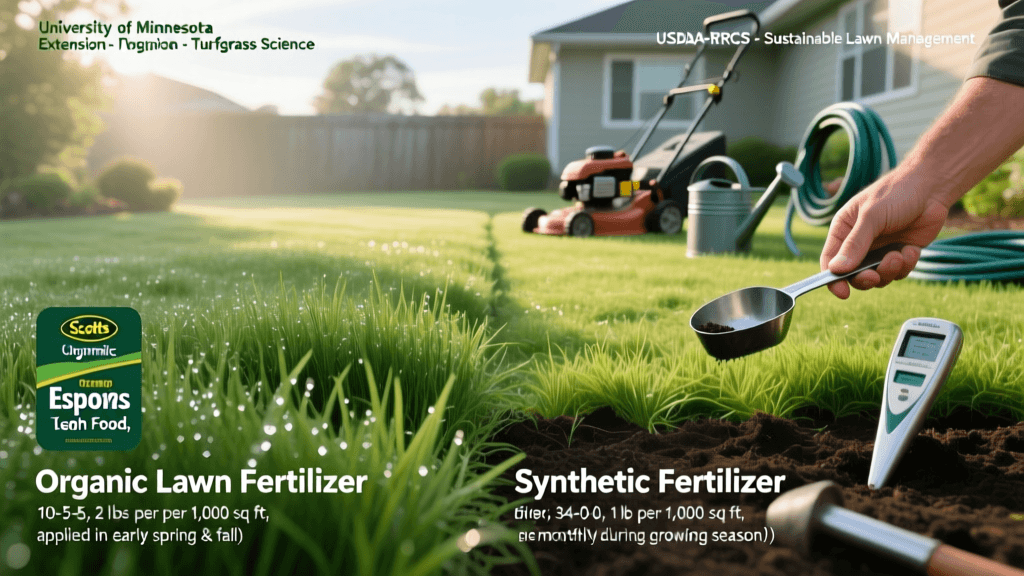
Organic Lawn Fertilizer Vs Synthetic Which Is Better
The Case for Feeding Your Lawn the Right Way
Every spring, homeowners face the same question at the garden center: grab the bright bag of synthetic fertilizer promising a green lawn in days, or spend more on the organic option with the earthy smell and slower results? The choice affects more than just this season’s grass. It shapes your soil’s health over time, influences what runs off into local streams, and changes how well your lawn handles drought or disease. Knowing how organic and synthetic fertilizers actually work — based on turfgrass research, not label claims — helps narrow things down.
How Each Type Works in the Soil
Synthetic fertilizers deliver nutrients as water-soluble minerals. When you apply something like Scotts Turf Builder (32-0-10), the nitrogen dissolves quickly and moves straight into grass roots. You’ll often see greening within 3 to 5 days. The process is simple: nitrate and ammonium ions dissolve in soil water and pass through root membranes without needing microbes to break them down first.
Organic fertilizers take a different route. Products like Milorganite (6-4-0) or Espoma Organic Lawn Food (18-0-3) contain complex molecules — proteins, amino acids, humic substances — that soil microbes must break apart before grass can use them. That breakdown, called mineralization, depends on soil temperature and usually takes 2 to 6 weeks. The result is a gradual feed instead of a sudden surge.
The University of Maryland Extension has found that soils treated with organic amendments over several years tend to have more active microbes and higher enzyme activity than soils getting only synthetics. That activity helps improve soil structure, hold water better, and cycle nutrients naturally — benefits that build up over time.
Nitrogen Release Rates and Burn Risk
One clear difference between the two is how fast nitrogen becomes available — and how easily it can burn your grass. If you apply more than 1 pound of actual nitrogen per 1,000 square feet in one go using a soluble synthetic, you risk tip burn or full blade scorch, especially during hot weather or when the lawn is already dry. Kentucky bluegrass (Poa pratensis) and perennial ryegrass (Lolium perenne) are especially prone.
Organic sources rarely cause burn because their nitrogen stays locked in larger molecules until microbes slowly release it. Milorganite, for example, contains about 85% water-insoluble nitrogen (WIN), so most of its nitrogen feeds the lawn steadily over 8 to 10 weeks. That gives some wiggle room if your spreader isn’t perfectly calibrated.
Phosphorus, Potassium, and Micronutrients
Synthetic fertilizers let you match nutrients closely to what your soil test shows. If phosphorus is fine but potassium is low, you can pick a product like 30-0-12. Organic fertilizers usually supply a wider mix of nutrients, based on what’s in their source material. Compost-based options often include calcium, magnesium, sulfur, and traces of iron and manganese — nutrients many synthetics leave out.
For warm-season grasses like bermudagrass (Cynodon dactylon) and zoysiagrass (Zoysia japonica), iron matters for deep color without pushing too much growth. Organic matter in soil holds onto iron more reliably across different pH levels than synthetic iron sulfate does.
Environmental Impact and Runoff Concerns
It’s not true that “natural” automatically means safer for the environment. Both types can pollute water if used carelessly — but they behave differently.
Soluble synthetic nitrogen moves easily with rainwater. Studies from the Chesapeake Bay Program link residential lawn fertilizer to nutrient loading in the Bay, estimating lawn products contribute 8 to 15 percent of total nitrogen in some suburban watersheds. A heavy rain soon after applying synthetics can wash much of that nitrogen into storm drains before the grass has a chance to absorb it.
Organic nitrogen stays tied up in soil particles and breaks down more slowly — especially when it’s cool or wet, which also slows runoff. But some organic fertilizers made from biosolids, including Milorganite, have raised questions about PFAS (per- and polyfluoroalkyl substances). The Maine Department of Environmental Protection flagged this concern in a 2021 review of biosolid-based products.
Carbon Contribution and Soil Health
Organic fertilizers add carbon to the soil each time you use them. Research from the Rodale Institute shows that applying compost-based fertilizers regularly for five years can raise soil organic matter by 0.5 to 1.0 percentage points in the top 4 inches. That extra organic matter boosts the soil’s cation exchange capacity (CEC), helping it hold onto nutrients longer and cutting down on how much fertilizer you need later.
Synthetic fertilizers don’t add carbon. Using them year after year — with nothing else added — can reduce microbial life and make soils more compacted, especially clay-heavy ones common in the Midwest and Southeast.
Application Rates, Timing, and Practical Schedules
No matter which fertilizer you choose, timing matters. Apply nitrogen when your grass is actively growing — not when it’s dormant or stressed by heat. Doing it at the wrong time wastes product and increases runoff.
- Cool-season grasses (tall fescue, Kentucky bluegrass, perennial ryegrass): Feed most heavily in early fall (September–October) and again in late spring (April–May). Fall feeding supports root growth and stores energy for winter.
- Warm-season grasses (bermudagrass, zoysiagrass, St. Augustinegrass, centipedegrass): Feed from late spring through midsummer (May–August), when soil temperatures stay above 65°F. In transition zones, skip nitrogen after late August.
- Organic fertilizers work best when applied 2 to 4 weeks earlier than synthetics — especially in early spring — to account for the lag while microbes get going.
The North Carolina State University Turfgrass Program suggests testing your soil every 2 to 3 years. Without knowing your soil’s pH, phosphorus, and potassium levels, you’re guessing — and likely putting on more of at least one nutrient than your lawn needs.
| Fertilizer Type | Typical N-P-K | Nitrogen Release | Application Rate (N per 1,000 sq ft) | Burn Risk |
|---|---|---|---|---|
| Scotts Turf Builder (synthetic) | 32-0-10 | Rapid (3–7 days) | 0.75–1.0 lb | Moderate–High |
| Milorganite (organic biosolid) | 6-4-0 | Slow (8–10 weeks) | 0.75 lb | Very Low |
| Espoma Organic Lawn Food | 18-0-3 | Slow (6–8 weeks) | 0.9 lb | Very Low |
| Polymer-coated urea (synthetic slow-release) | 43-0-0 | Controlled (8–16 weeks) | 0.5–0.75 lb | Low |
Cost, Availability, and Long-Term Economics
Organic fertilizers usually cost 2 to 4 times more per pound of actual nitrogen than synthetics. A 32-pound bag of Milorganite covers about 2,500 square feet and costs $18 to $22 — delivering roughly 1.9 pounds of nitrogen. You could get the same amount of nitrogen from a synthetic 32-0-10 product for $6 to $9. That price gap is real.
But long-term costs tell a different story. Lawns with more organic matter in the soil often need less water, handle dry spells better, and sometimes need fewer fungicides — because healthy soil microbes help keep certain diseases in check. A University of Connecticut study found that turf plots treated with organic amendments for four years needed 20 to 25 percent less irrigation to look just as good as synthetically fed plots — a real saving where water is scarce or expensive.
Many turf managers split the difference: using organic fertilizer for most feedings, and adding one targeted dose of quick-release synthetic — like the fall feeding for cool-season lawns or an early summer boost for warm-season grasses — when speed matters most.
- Get a soil test through your state’s cooperative extension service (usually $15–$25) before starting any fertilization plan.
- Measure your lawn area carefully — most people overestimate by 20 to 30 percent, leading to consistent over-application.
- Calibrate your spreader once a year; the settings listed on fertilizer bags are rough estimates, and output changes as spreaders age or wear.
- Water in synthetic fertilizers within 24 hours to move nutrients into the root zone and cut down on nitrogen loss to the air.
- Sweep fertilizer off driveways and sidewalks right after spreading — granules left there wash straight into storm drains.
The Penn State Extension Turfgrass Program, widely followed in the northeastern U.S., advises homeowners apply no more than 3 to 4 pounds of nitrogen per 1,000 square feet each year for cool-season lawns — and never more than 1 pound in a single application. That guidance holds whether the nitrogen comes from organic or synthetic sources.
"Soil health is the foundation of sustainable turfgrass management. Fertilizer programs that feed the soil biology, not just the plant, consistently outperform input-intensive approaches over a 5- to 10-year horizon." — Dr. Tina Nieto, Turfgrass Soil Ecology, Rutgers University Cooperative Extension, 2023
Neither organic nor synthetic fertilizer is always the better choice. What works best depends on your soil’s current state, your grass type, your local weather, how patient you are with results, and what environmental concerns matter most to you. What the research shows clearly is this: a plan built around soil testing, proper timing for your grass, and accurate application rates will beat any program based solely on brand loyalty — no matter which kind of fertilizer you prefer.