
Landscaping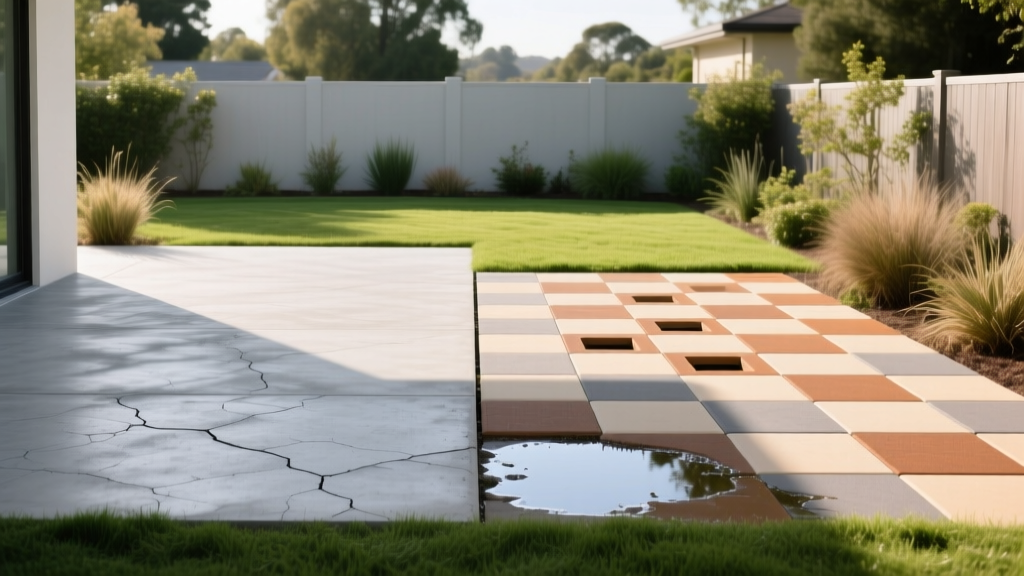
Permeable Pavers vs Concrete Patios: Cost & Drainage
Mike RodriguezPublished
The Hardscaping Dilemma: Choosing the Right Patio Material
Designing a functional and beautiful outdoor living space requires careful consideration of hardscaping materials. Your patio serves as the foundation for outdoor furniture, dining areas, and entertainment zones. However, beyond mere aesthetics, modern landscaping demands a rigorous approach to drainage solutions and sustainable practices. Homeowners frequently find themselves debating between two dominant hardscaping materials: permeable pavers and traditional poured concrete. Both options offer distinct advantages, but they interact with your property's ecosystem in vastly different ways. This comprehensive guide compares Product A (Permeable Pavers) and Product B (Poured Concrete) across cost, drainage, durability, and installation, helping you make an informed decision for your landscape design.
Product A: Permeable Pavers Explained
Permeable pavers are modular hardscaping units designed with wider joints than traditional pavers. Instead of being laid on a bed of impermeable sand and sealed tightly together, they are installed over a deep, open-graded crushed stone base. The joints are filled with small, uniform aggregate (typically ASTM No. 8 stone) rather than fine sand or polymeric compounds. This intentional spacing and specialized base layer allow rainwater to pass directly through the surface, infiltrate the underlying stone reservoir, and slowly percolate into the native soil below. Leading brands like Belgard, Unilock, and Techo-Bloc offer specialized permeable lines that mimic the look of natural stone, brick, and cobblestone while providing critical environmental benefits.
Product B: Traditional Poured Concrete
Poured concrete is the quintessential hardscaping material, formed by pouring a liquid mixture of cement, water, sand, and gravel into wooden or metal forms. Once leveled and finished, it cures into a solid, continuous, and entirely impervious slab. Standard residential patios are typically poured to a thickness of 4 to 6 inches, often reinforced with wire mesh or rebar to prevent structural failure. Because concrete is impermeable, landscape architects must design the surrounding topography with precise grading—usually a minimum slope of 1/4 inch per foot—to direct stormwater away from the home's foundation and toward municipal storm drains or designated drainage swales.
Head-to-Head Comparison Chart
| Feature | Permeable Pavers | Poured Concrete |
|---|---|---|
| Average Cost | $15 - $30 per sq. ft. | $8 - $15 per sq. ft. |
| Water Permeability | High (Infiltrates surface) | None (100% Impervious) |
| Base Requirement | 6-12 inches open-graded aggregate | 4-6 inches compacted gravel |
| Cure/Use Time | Immediate use after installation | 48 hours to walk, 28 days to cure |
| Repairability | High (Replace individual units) | Low (Requires patching or slab replacement) |
| Lifespan | 25 - 50+ years | 20 - 30 years |
Drainage and Stormwater Management
Water management is arguably the most critical factor in modern hardscaping. When rain hits an impermeable surface like poured concrete, it becomes surface runoff. This runoff picks up fertilizers, pesticides, oil, and debris, carrying them directly into local waterways. The United States Geological Survey (USGS) identifies urban stormwater runoff as a leading cause of water pollution and localized flooding. By contrast, permeable pavers act as a green infrastructure tool. According to the Environmental Protection Agency (EPA), permeable pavements reduce runoff volume, filter out pollutants through the aggregate base, and help recharge local groundwater aquifers. Furthermore, many municipalities now offer stormwater utility fee reductions or tax rebates for homeowners who install permeable hardscaping, effectively offsetting the higher initial material costs.
Upfront Costs and Installation Timelines
Cost is often the primary deciding factor for homeowners, and poured concrete wins the upfront financial battle. A standard brushed concrete patio costs between $8 and $15 per square foot, depending on regional labor rates and site accessibility. If you opt for stamped or stained concrete to mimic natural stone, expect to pay between $12 and $25 per square foot. Installation is relatively fast; forms are built, gravel is compacted, and the concrete is poured in a single day. However, you must wait at least 48 hours before walking on it and a full 28 days for the slab to reach its maximum compressive strength before placing heavy furniture or fire pits.
The Permeable Paver Investment
Permeable pavers are a premium product, typically ranging from $15 to $30 per square foot installed. The higher cost is driven by the intensive site preparation required. Installers must excavate 12 to 18 inches deep to accommodate a layered base system: a sub-base of large ASTM No. 57 crushed stone, a base layer of smaller ASTM No. 8 stone, and a bedding layer of coarse chips. In areas with heavy clay soils, a non-woven geotextile fabric must be laid at the very bottom to prevent soil migration into the stone reservoir. While the excavation and base-laying process takes several days, the patio is ready for immediate use the moment the final aggregate is swept into the joints and the surface is compacted.
Durability, Repairs, and Maintenance
Patios endure harsh environmental conditions, particularly in climates with severe freeze-thaw cycles. Poured concrete is highly susceptible to cracking. When water penetrates microscopic fissures in the concrete and freezes, it expands, causing the slab to heave and crack. Once a concrete slab cracks, repairs are largely cosmetic; you can fill the crack with epoxy or resurface the top layer, but the structural integrity is permanently compromised. Eventually, severe damage requires jackhammering and replacing the entire slab.
Permeable pavers, however, are inherently flexible. Because they are modular units resting on an aggregate bed, they shift slightly with ground movement and freeze-thaw cycles without cracking. If a paver becomes stained, chipped, or damaged by a heavy impact, you simply pry it up with two flathead screwdrivers and drop in a replacement unit. Maintenance for permeable pavers primarily involves monitoring the joints. Over time, wind-blown soil and organic matter can clog the aggregate joints, reducing permeability. Homeowners should use a stiff broom and a leaf blower to keep the surface clean, and occasionally vacuum the joints with a wet/dry shop vac before topping them off with fresh ASTM No. 8 stone every few years.
Aesthetics and Curb Appeal
From a design perspective, both materials offer distinct visual advantages. Poured concrete provides a sleek, modern, and continuous surface that is ideal for contemporary landscape designs. With modern stamping mats and integral color hardeners, concrete can convincingly mimic slate, flagstone, or brick at a fraction of the cost of natural materials. However, the visual appeal can degrade over time as surface sealers wear off and UV exposure causes fading.
Permeable pavers offer unparalleled design versatility. Available in a vast array of colors, textures, and shapes, they allow for intricate laying patterns such as herringbone, basketweave, or running bond. You can easily incorporate contrasting borders, circular medallions, or banding to define different zones within your outdoor living space. Because the color is consistent throughout the entire thickness of the paver (unlike surface-stained concrete), they do not fade or reveal a different color if chipped, ensuring long-lasting curb appeal.
The Final Verdict: Which Should You Choose?
Ultimately, the choice between permeable pavers and poured concrete depends on your budget, your local climate, and your commitment to sustainable landscaping practices. The EPA Green Infrastructure Overview highly encourages residential adoption of permeable surfaces to mitigate urban heat island effects and reduce strain on municipal sewer systems.
- Choose Permeable Pavers if: You live in an area with strict stormwater runoff regulations, you want to eliminate puddling and ice formation in winter, you prefer a highly customizable and repairable surface, and you are willing to invest more upfront for long-term durability and environmental benefits.
- Choose Poured Concrete if: You are working with a tighter budget, you prefer a seamless and modern minimalist aesthetic, your property already has excellent natural grading and drainage swales to handle surface runoff, and you want a faster, less invasive installation process.
Pro Tip: If you love the look of concrete but need better drainage, consider a hybrid approach. Use poured concrete for the primary dining and seating areas, but border the patio with a 3-foot perimeter of permeable pavers or a French drain integrated into a gravel trench to capture and manage the runoff before it reaches your lawn or foundation.
By carefully weighing the drainage capabilities, lifecycle costs, and aesthetic potential of both materials, you can create a stunning, functional patio that enhances your home's value and respects the local ecosystem.

