Tree Care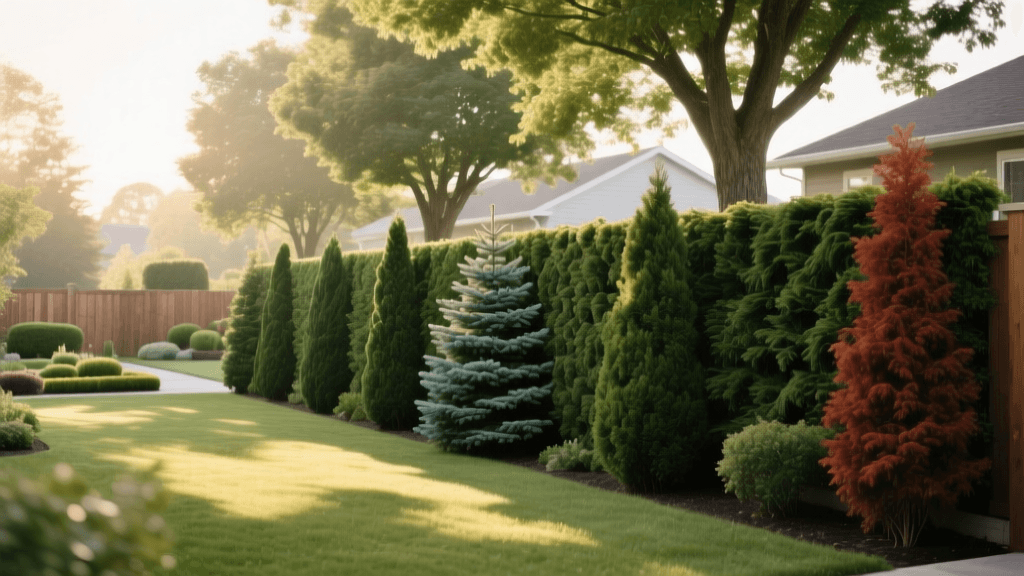
Planning a Privacy Tree Screen: Species and Spacing Guide
Designing the Ultimate Privacy Tree Screen
Creating a living privacy screen is one of the most rewarding landscape design projects a homeowner can undertake. Unlike wooden fences or vinyl barriers, a well-planned tree screen offers dynamic beauty, seasonal interest, noise reduction, and vital wildlife habitat. However, designing a privacy screen requires more than simply digging holes in a straight line. It demands careful planning regarding species selection, spatial geometry, soil preparation, and long-term maintenance.
Whether you are looking to block a neighbor's second-story window, shield your patio from prevailing winter winds, or create a secluded garden room, this comprehensive planning guide will walk you through the exact steps, measurements, and species choices needed to achieve year-round seclusion.
Step 1: Site Assessment and Microclimate Analysis
Before selecting your trees, you must understand the environmental constraints of your planting bed. Trees planted in unsuitable conditions will stagnate, suffer from disease, or fail to provide the dense foliage required for privacy.
Sunlight and Exposure
Most evergreen privacy trees require full sun (at least 6 to 8 hours of direct sunlight daily) to maintain dense branching from the ground up. If your planting site is heavily shaded by existing structures or larger trees, you will need to select shade-tolerant species like the Canadian Hemlock (Tsuga canadensis) or American Holly (Ilex opaca), though these grow significantly slower than sun-loving arborvitae.
Soil Drainage and Composition
Conduct a simple percolation test before purchasing trees. Dig a hole 12 inches deep and 12 inches wide, fill it with water, and let it drain. Refill it and measure how long it takes to drain. If the water level drops less than 1 inch per hour, you have poorly draining clay soil. In these conditions, avoid Thuja (arborvitae), which are highly susceptible to root rot in wet soils, and opt for moisture-tolerant species like the Dawn Redwood (Metasequoia glyptostroboides) or Bald Cypress (Taxodium distichum), keeping in mind these are deciduous conifers and will drop their needles in winter.
Step 2: Selecting the Right Evergreen Species
Choosing the right cultivar is critical for balancing your budget, space constraints, and desired timeline for privacy. While Leyland Cypress was once the industry standard, it is now heavily discouraged by horticulturists due to its susceptibility to Seiridium canker and bagworms. Instead, modern landscape designers rely on disease-resistant alternatives.
According to the Penn State Extension, planting a diverse mix of species is highly recommended to prevent the total loss of your screen in the event of a species-specific pest outbreak or disease.
Privacy Tree Comparison Chart
| Species / Cultivar | Mature Height | Mature Width | Growth Rate | USDA Zones | Est. Cost (6-7ft B&B) |
|---|---|---|---|---|---|
| Thuja 'Green Giant' | 40-60 ft | 12-18 ft | Fast (3-5 ft/yr) | 5-8 | $120 - $180 |
| Ilex x 'Nellie Stevens' | 20-30 ft | 10-15 ft | Moderate (2-3 ft/yr) | 6-9 | $150 - $250 |
| Juniperus 'Taylor' | 20-25 ft | 3-5 ft | Moderate (1-2 ft/yr) | 3-9 | $90 - $140 |
| Picea abies (Norway Spruce) | 40-60 ft | 25-30 ft | Moderate (2-3 ft/yr) | 3-7 | $180 - $300 |
| Thuja 'Emerald Green' | 12-15 ft | 3-4 ft | Slow (6-12 in/yr) | 3-8 | $60 - $90 |
Note: B&B stands for Balled and Burlapped. Container-grown specimens are generally cheaper but smaller, requiring more time to achieve full privacy.
Step 3: Strategic Layouts and Spacing Formulas
The most common mistake homeowners make when planting a privacy screen is placing trees too close together. Overcrowding leads to intense competition for water and nutrients, increased humidity within the canopy (which breeds fungal diseases), and dieback of lower branches due to light deprivation.
Single Row vs. Staggered Double Row
Single Row Layout: Best for narrow property lines. Trees are planted in a straight line. To achieve a continuous screen without overcrowding, space the trees at roughly 50% to 75% of their mature width. For example, if a 'Green Giant' has a mature width of 15 feet, plant them 8 to 10 feet apart, center-to-center.
Staggered Double Row (Zig-Zag): Ideal for wider spaces where rapid, impenetrable privacy is desired. By planting two offset rows, you eliminate the 'gaps' that occur in single rows while the trees are maturing. Space the rows 6 to 8 feet apart, and offset the trees in a triangular pattern. This allows you to use slightly wider spacing within each individual row while still achieving a solid visual barrier.
Calculating Your Tree Count
To calculate the number of trees needed for a single row, use this formula:
Total Linear Feet ÷ Desired Spacing = Number of Trees Needed
Example: 60 feet of fence line ÷ 8 feet spacing = 7.5 (Round up to 8 trees).
Step 4: Execution, Planting, and Soil Preparation
Proper planting technique ensures your investment survives the critical first two years. The Arbor Day Foundation emphasizes that planting depth is the number one cause of transplant failure in balled-and-burlapped trees.
The Planting Process
- Digging the Hole: Dig a hole that is 2 to 3 times wider than the root ball, but no deeper. The root flare (where the trunk widens at the base) must sit slightly above the surrounding soil grade.
- Amending the Soil: Avoid creating a 'bathtub effect' by filling the hole entirely with rich potting soil. Instead, use the native soil you dug out, mixing in up to 20% organic compost to improve structure without drastically altering the drainage dynamics.
- Root Stimulants: Incorporate a mycorrhizal inoculant and a starter fertilizer like Espoma Bio-tone Starter Plus (4-3-3) into the backfill to encourage rapid root hair development.
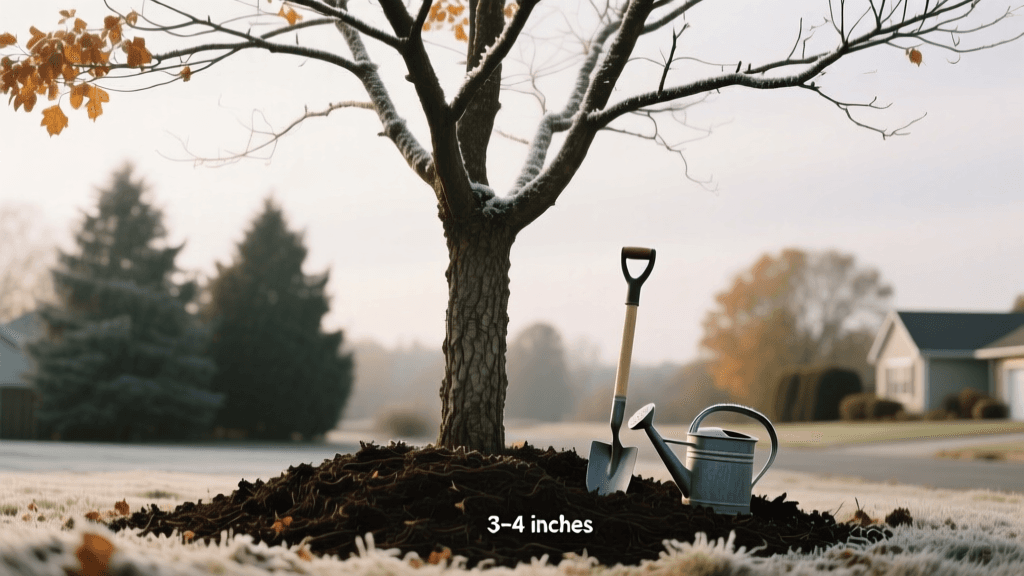
- Mulching: Apply a 2 to 3-inch layer of shredded hardwood mulch over the root zone to retain moisture and regulate soil temperature. Keep the mulch at least 3 inches away from the trunk to prevent rodent damage and bark rot.
Step 5: Irrigation and Long-Term Maintenance
A newly planted privacy screen requires a dedicated watering strategy. Hand-watering with a hose is often insufficient for deep root penetration. We recommend installing a temporary drip irrigation system or using soaker hoses woven through the tree line.
As noted by the University of Minnesota Extension, deep, infrequent watering is vastly superior to shallow, daily watering. Provide 10 to 15 gallons of water per tree, once or twice a week, depending on rainfall and soil type.
Pruning for Density
While many privacy trees like the 'Green Giant' arborvitae naturally maintain a tight, pyramidal form, light shearing in early summer (after the first flush of spring growth has hardened off) can encourage lateral branching. Never cut back into the 'dead zone' (the inner brown foliage of conifers), as these branches will not regenerate. Use sterilized bypass pruners or lightweight electric hedge trimmers to lightly shape the outer canopy, promoting a denser, more impenetrable screen.
Winter Protection and Windburn Prevention
Evergreen privacy screens are particularly vulnerable to winter desiccation, commonly known as windburn. When the ground freezes, the roots cannot absorb water, but the foliage continues to lose moisture to harsh, drying winter winds. This results in brown, scorched-looking needles on the windward side of your screen.
To prevent this, ensure your trees are deeply hydrated in late autumn before the first hard freeze. Apply an anti-desiccant spray like Wilt Pruf to the foliage in late November and again in mid-January on a day when temperatures are above 40°F (4°C). For newly planted, smaller specimens, wrapping the trees in burlap or installing a temporary burlap windbreak fence on the prevailing wind side can drastically reduce moisture loss and protect the tender terminal leaders from snapping under heavy snow loads.
Budgeting Your Privacy Screen Project
When planning your budget, factor in not just the cost of the trees, but also delivery, soil amendments, mulch, and irrigation. For a 50-foot staggered screen using 6-foot B&B 'Green Giants', expect to purchase approximately 10 to 12 trees. At an average of $150 per tree, the plant material alone will cost between $1,500 and $1,800. Add roughly $400 for bulk mulch, compost, and starter fertilizers. If you hire a professional landscape crew to auger the holes and plant the heavy root balls, expect labor costs to add an additional $800 to $1,500 depending on site accessibility and terrain.
By investing the time in proper planning, species selection, and spatial design, your privacy tree screen will transform from a vulnerable row of saplings into a lush, impenetrable sanctuary that adds immense value and tranquility to your property for decades to come.