Lawn Care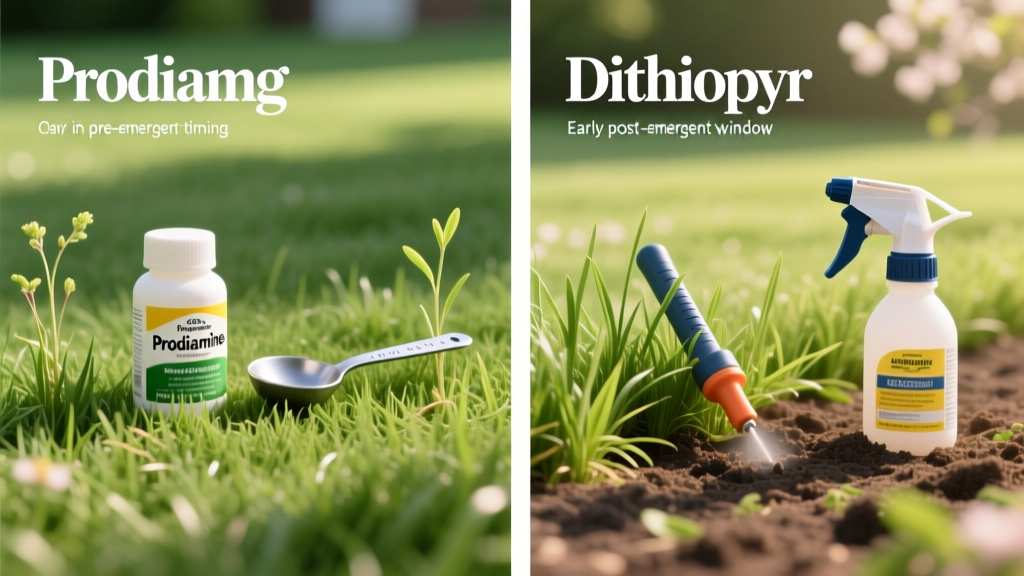
Prodiamine vs Dithiopyr: Choosing the Best Pre-Emergent
Mike RodriguezPublished
The Pre-Emergent Dilemma: Prodiamine vs. Dithiopyr
Every spring, lawn care enthusiasts and professionals face the same formidable enemy: crabgrass. This aggressive, warm-season annual weed can quickly overtake a pristine cool-season lawn, choking out desirable turf and leaving behind bare patches when it dies off in the autumn. The most effective defense against this invasion is a robust pre-emergent herbicide program. However, when browsing the shelves of your local agricultural supply store or shopping online, you will inevitably encounter the two undisputed heavyweights of the pre-emergent world: Prodiamine (commonly known by the brand name Barricade) and Dithiopyr (widely recognized as Dimension).
Choosing between these two chemical giants can be confusing. While both are highly effective at preventing weed seeds from germinating, they operate with slightly different modes of action, offer different application windows, and come with distinct price tags. In this comprehensive guide, we will break down the science, cost, and practical application of Prodiamine versus Dithiopyr to help you make the best decision for your lawn care regimen.
Understanding Prodiamine (Barricade)
Prodiamine is a dinitroaniline herbicide that has been a staple in the turfgrass industry for decades. It works primarily as a root inhibitor. When applied to the soil surface and watered in, it creates a chemical barrier in the top layer of the soil. As weed seeds germinate and their emerging roots come into contact with this barrier, cell division is halted, effectively killing the seedling before it ever breaches the soil surface.
Pros of Prodiamine
- Exceptional Longevity: Prodiamine is renowned for its long residual control. A single application at the maximum labeled rate can provide crabgrass prevention for up to six to eight months, easily covering the entire germination window of most annual grassy weeds.
- Cost-Effective: When purchased in larger quantities, such as the popular 65 WDG (Water Dispersible Granule) formulation, the cost per thousand square feet is remarkably low, making it a favorite for budget-conscious homeowners and large-scale commercial operators.
- Stability: It binds tightly to soil organic matter and is relatively resistant to breaking down from UV light, meaning surface application delays before watering in are less detrimental compared to other chemicals.
Cons of Prodiamine
- Strictly Pre-Emergent: Prodiamine has zero post-emergent activity. If a crabgrass seedling has already sprouted and developed a shoot, Prodiamine will not kill it.
- Staining Potential: The WDG formulation can leave a slight yellowish residue on concrete driveways and sidewalks if not swept or blown off immediately after application.
Understanding Dithiopyr (Dimension)
Dithiopyr belongs to the pyridine carboxylic acid family. Like Prodiamine, it inhibits root development in germinating seeds. However, Dithiopyr possesses a unique secondary mode of action: it also inhibits early shoot development. This dual-action capability gives Dithiopyr a distinct advantage in the turf management world.
Pros of Dithiopyr
- Early Post-Emergent Control: This is the "secret weapon" of Dithiopyr. It can control crabgrass that has already germinated and emerged, provided the weed is in its very early stages of growth (typically up to the one-tiller stage). This extended window is a lifesaver for homeowners who missed their early spring application deadline.
- No Staining: The most common liquid formulation, Dimension 2EW (Emulsifiable in Water), is completely clear and will not stain concrete or hardscapes, making it ideal for complex landscapes with many walkways.
- Excellent Broadleaf Bonus: While primarily a grassy weed herbicide, Dithiopyr has some efficacy against certain annual broadleaf weeds like chickweed and spurge when applied early.
Cons of Dithiopyr
- Higher Cost: Dimension is generally more expensive per square foot of coverage than Prodiamine, particularly when purchasing the liquid 2EW formulation in smaller, homeowner-friendly quantities.
- Shorter Residual Window: While still effective, its residual soil activity is slightly shorter than a maximum-rate application of Prodiamine, often necessitating a split-application strategy for season-long control in warmer climates.
Head-to-Head Comparison Chart
To visualize the differences between these two powerhouse herbicides, review the comparison table below:
| Feature | Prodiamine (Barricade 65 WDG) | Dithiopyr (Dimension 2EW) |
|---|---|---|
| Active Ingredient Class | Dinitroaniline | Pyridine Carboxylic Acid |
| Primary Mode of Action | Root Inhibitor | Root & Early Shoot Inhibitor |
| Early Post-Emergent Control | No | Yes (up to 1-tiller stage) |
| Longevity (Residual) | 6 to 8 months | 4 to 6 months |
| Average Cost per 1,000 sq ft | $4.00 - $6.00 | $10.00 - $14.00 |
| Staining Risk | Moderate (Yellow residue) | None (Clear liquid) |
| Best Application Timing | Early Spring (Soil temps 50-55°F) | Mid-Spring (Allows for late starts) |
Application Timing and Soil Temperature
The success of any pre-emergent herbicide relies entirely on timing. A common myth among novice gardeners is to apply pre-emergent when the forsythia bushes bloom. While this is a helpful visual cue, it is not scientifically reliable. According to turfgrass experts at Penn State Extension, crabgrass germination is driven by soil temperature, not air temperature or the blooming of ornamental shrubs.
Crabgrass seeds begin to germinate when the soil temperature at a 2-inch depth reaches 50°F to 55°F for three to five consecutive days. This is your trigger to apply Prodiamine. Because Prodiamine needs time to establish its chemical barrier before the seeds sprout, applying it slightly early is always better than applying it late.
Dithiopyr, on the other hand, offers a bit more flexibility. If you missed the 50°F soil temperature window and suspect that some crabgrass has already begun to sprout, Dithiopyr can still salvage your lawn. Its early post-emergent properties allow it to kill young, invisible crabgrass seedlings that have not yet developed tillers (side shoots). This makes Dithiopyr the superior choice for late-spring applications or for homeowners who simply forgot to treat their lawn in early April.
Cost Analysis and ROI
When managing a lawn, the return on investment (ROI) is a major factor. Let us break down the mathematics for a standard 10,000 square foot lawn.
Prodiamine 65 WDG: A standard 1-pound bottle of generic Prodiamine 65 WDG costs approximately $75 to $85. The application rate for a high-level, season-long barrier is roughly 0.185 ounces per 1,000 square feet. Therefore, a 1-pound bottle (16 ounces) will treat over 86,000 square feet. For your 10,000 square foot lawn, the chemical cost is a mere $9.30 per year. This makes Prodiamine the undisputed champion of budget-friendly lawn care.
Dimension 2EW: A half-gallon (64 ounces) of Dimension 2EW typically retails for $130 to $150. The standard application rate for crabgrass control is roughly 0.5 to 0.75 ounces per 1,000 square feet. A half-gallon will treat approximately 85,000 to 128,000 square feet depending on the exact rate used. For a 10,000 square foot lawn, the cost equates to roughly $15.00 to $17.00 per year.
While Dithiopyr is nearly twice the cost of Prodiamine, the ability to rescue a lawn from an early crabgrass infestation without having to buy and apply harsh post-emergent chemicals later in the summer often justifies the premium price.
Calibration and Watering In
Regardless of whether you choose Prodiamine or Dithiopyr, the application methodology remains the same. Pre-emergents must be moved from the grass blades and thatch layer down into the top half-inch of the soil to be effective.
Pro-Tip: Always use a calibrated backpack or push sprayer for liquid applications. Measure a 500 square foot test area in your driveway, fill your sprayer with a known volume of water, and spray the area using your normal walking pace. Multiply the water used by two to determine your output per 1,000 square feet. This ensures you are applying the correct concentration of herbicide.
After application, the lawn must receive approximately 0.5 inches of water, either from rainfall or manual irrigation, within 48 hours. This "waters in" the active ingredient, activating the chemical barrier. If the product sits on the surface exposed to direct UV sunlight for several days without water, the active ingredients will begin to photodegrade, severely reducing their efficacy.
Overseeding Restrictions
One critical warning applies to both Prodiamine and Dithiopyr: they do not discriminate between weed seeds and desirable grass seeds. If you apply either of these pre-emergents, you cannot overseed your lawn with new grass seed for an extended period. According to turf management guidelines published by NC State Extension, applying standard pre-emergents will prevent fescue, ryegrass, and Kentucky bluegrass seeds from germinating.
If you plan to overseed in the fall, you must carefully time your spring pre-emergent application. Generally, you need a window of 12 to 16 weeks between your pre-emergent application and your fall seeding date. If your lawn requires extensive spring renovation and overseeding, you should skip the Prodiamine/Dithiopyr application entirely and instead rely on cultural practices, such as mowing high and promoting thick turf density, or utilize alternative herbicides like Mesotrione (Tenacity), which is safe for use at the time of seeding.
Final Verdict: Which Should You Choose?
The choice between Prodiamine and Dithiopyr ultimately depends on your lawn care habits, budget, and the current state of your turf.
Choose Prodiamine if you are a proactive planner who strictly monitors soil temperatures, wants to maximize budget efficiency, and desires the longest possible residual control with a single early-spring application. It is the workhorse of the commercial lawn care industry for a reason.
Choose Dithiopyr if you tend to procrastinate your spring chores, if you have complex hardscaping that you want to protect from chemical stains, or if you notice the very first signs of crabgrass emergence and need a product that can act as both a preventative barrier and an early-stage eradicator.
By understanding the unique strengths of both products, you can tailor your weed control strategy to ensure your lawn remains a thick, green, and crabgrass-free carpet from the first thaw of spring until the first frost of winter.