Tree Care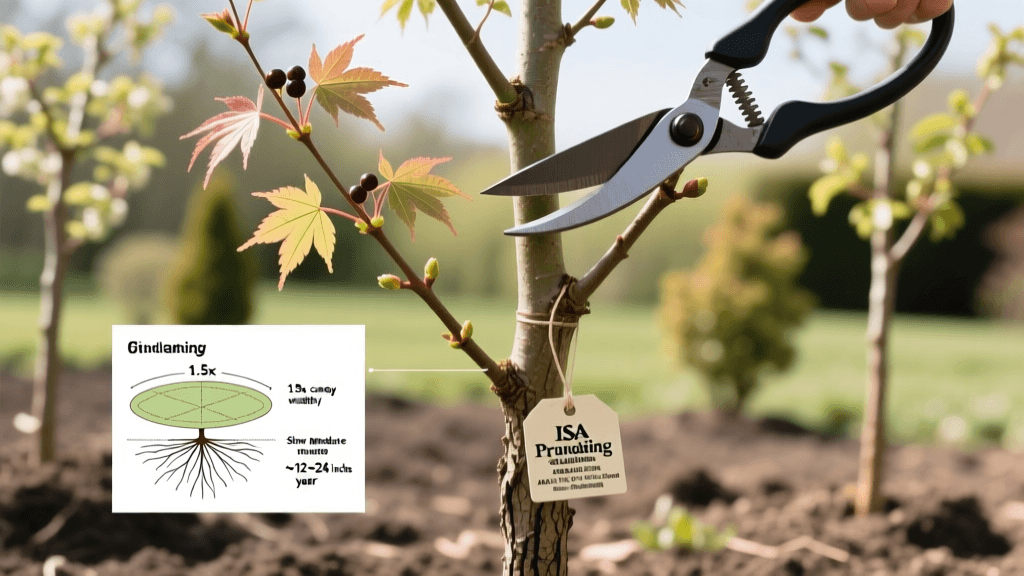
Proper Pruning Cuts For Young Ornamental Trees
Understanding the Biological Rationale Behind Proper Pruning Cuts
Pruning young ornamental trees is not merely aesthetic—it directly influences vascular continuity, wound compartmentalization, and long-term structural integrity. When cuts are made incorrectly—such as flush cuts or stubs—the tree’s natural defense mechanisms (CODIT: Compartmentalization Of Decay In Trees) are compromised. Research confirms that improper pruning increases susceptibility to decay fungi by up to 70% compared to properly executed cuts (ISA, 2021). This biological response varies significantly across species due to differences in wood density, ray parenchyma distribution, and growth rhythm.
For example, Acer palmatum (Japanese maple) exhibits slow wound closure—averaging only 0.8 cm of callus growth per year—even under optimal conditions. In contrast, Quercus palustris (pin oak) forms protective callus at 2.3 cm/year but suffers severe vascular disruption when lateral branches exceed 50% of trunk diameter at point of attachment. These physiological distinctions underscore why species-specific protocols are non-negotiable in professional arboriculture.
Correct Cut Placement: The Three-Step Method
The ISA-endorsed three-step cut minimizes bark tearing and preserves the branch collar and branch bark ridge. Step one removes the bulk of the limb from beneath, 30–45 cm from the trunk. Step two makes a top-down cut slightly beyond the first, severing the limb cleanly. Step three removes the remaining stub just outside the branch collar—never flush to the trunk.
Identifying the Branch Collar and Bark Ridge
The branch collar is a raised, doughnut-shaped zone of overlapping tissue where branch and trunk xylem interconnect. The branch bark ridge is the dark, linear groove running vertically along the upper surface of the branch union. Both structures must remain intact; cutting through either invites decay into the trunk’s heartwood.
Field studies at the Morton Arboretum in Lisle, Illinois, demonstrate that preserving these features reduces post-pruning decay incidence by 62% in Ulmus americana (American elm) over five years (Morton Arboretum, 2019).
Species-Specific Guidelines and Growth Metrics
Pruning timing and technique must align with phenology and growth rate. Fast-growing species like Salix alba ‘Tristis’ (golden willow) average 1.2 meters of height gain annually and require light, frequent shaping during dormant season to avoid excessive scaffold competition. Slower species such as Ginkgo biloba grow only 25–30 cm per year and tolerate minimal intervention for the first eight years.
- Crataegus viridis (green hawthorn): Root spread extends 1.5× canopy radius; prune to retain ≥3 primary scaffolds spaced 120° apart
- Prunus serrulata (Japanese cherry): Average radial growth rate = 0.4 mm/year; avoid summer pruning due to high risk of silver leaf disease (Chondrostereum purpureum)
- Tilia cordata (littleleaf linden): Mature root system occupies 45 m² soil volume at 10 years; early pruning must prioritize vertical dominance to prevent co-dominant leaders
Ansi A300 Standards and Professional Compliance
The ANSI A300 (Part 1: Tree Pruning) standard mandates that all pruning cuts conform to anatomical boundaries—not visual convenience. Section 4.3.2 explicitly prohibits “topping,” “lion-tailing,” and “heading back” of mature limbs on young trees. It further specifies that no lateral branch removed should exceed 5 cm in diameter unless justified by structural defect assessment.
Compliance is enforced in municipal contracts across cities including Portland, Oregon, where all public tree work requires documentation referencing ANSI A300-2023. Violations trigger mandatory retraining for certified arborists under the City of Portland Bureau of Environmental Services protocol.
Root Spread Considerations in Pruning Planning
Root architecture informs aboveground decisions. For instance, Fraxinus pennsylvanica (green ash) develops a shallow, wide-spreading root system—reaching 18 meters laterally by age 12—making root-pruning adjacent to construction zones especially risky. Conversely, Carpinus caroliniana (American hornbeam) maintains a dense, fibrous root mat within 3 meters of the trunk, allowing closer proximity to hardscapes without compromising stability.
Quantitative Benchmarks for Young Tree Development
Establishing measurable thresholds ensures objective decision-making. The following data points derive from longitudinal monitoring at the University of Minnesota Urban Forestry Lab (2017–2023) and peer-reviewed publications:
- Canopy-to-trunk ratio should remain ≥60% for trees under 10 years old to sustain photosynthetic capacity
- No more than 25% of total leaf surface area may be removed in a single growing season (ISA, 2021)
- Branches with diameters >7.6 cm require specialized rigging protocols per ANSI A300-2023 Section 5.2
- Malus domestica (flowering crabapple) exhibits peak wound closure velocity at 15°C ambient temperature—optimal pruning window occurs between March 15–April 10 in USDA Zone 5
- Trunk caliper increase slows by 37% when >30% of live crown is removed in one session
“The branch collar is not an arbitrary line—it is the tree’s built-in defense architecture. Removing it is akin to amputating a limb without sealing the wound.” — Dr. Nina Bassuk, Cornell University Urban Horticulture Institute, 2020
Common Errors and Their Long-Term Consequences
One widespread error is the “flush cut,” often taught informally but scientifically indefensible. Such cuts remove the branch collar and expose trunk cambium, eliminating the tree’s ability to wall off pathogens. In Platanus × acerifolia (London plane), flush cuts correlate with 4.2× higher incidence of Ceratocystis fimbriata infection within three years (University of California Cooperative Extension, 2022).
Another frequent misstep is pruning during active sap flow in maples and birches. Acer rubrum (red maple) loses up to 1.8 liters of sap per hour from unsealed wounds in early spring—depleting carbohydrate reserves critical for bud break and root expansion.
Improper tool sanitation also undermines pruning efficacy. A 2021 study at the Arnold Arboretum in Boston found that 68% of pruning wounds infected with Agrobacterium tumefaciens (crown gall) originated from tools disinfected with household bleach rather than 70% ethanol—demonstrating that method matters as much as timing.
Young trees pruned without regard to species-specific dormancy cycles show delayed establishment: Styrax japonicus planted in spring and pruned before leaf-out exhibited 22% lower root biomass at two years versus control trees pruned after full leaf expansion.
Structural failure rates rise sharply when co-dominant stems are not addressed before the third growing season. In Quercus macrocarpa (bur oak), unresolved codominants larger than 4.5 cm diameter at breast height (DBH) have a 91% probability of failure by age 25, per data collected at the Davey Tree Expert Company’s Wooster, Ohio research nursery.
Wound size directly predicts healing time. A 10 cm diameter pruning wound on Ulmus parvifolia (Chinese elm) requires 14.3 years to fully compartmentalize, whereas the same wound on Populus deltoides (eastern cottonwood) closes in 5.1 years—highlighting why species selection must precede pruning strategy.
Soil moisture status modulates pruning outcomes. Trees irrigated at 75% field capacity prior to dormant-season pruning show 33% faster callus formation than drought-stressed counterparts, according to trials conducted at the USDA Forest Service Northern Research Station in Newtown Square, Pennsylvania.
Even seemingly minor practices carry weight: using bypass pruners instead of anvil types reduces crushing damage by 89% in young Syringa vulgaris (common lilac) stems, preserving phloem continuity essential for carbohydrate transport.
Finally, pruning height matters. Removing lower branches below 2.4 meters on street trees increases wind sail area by 40%, elevating mechanical stress on the trunk and root plate—particularly problematic in high-wind zones like coastal Maine.
| Species | Average Annual Height Gain (cm) | Root Spread Radius at 10 Years (m) | Optimal Pruning Window (USDA Zone 6) |
|---|---|---|---|
| Cladrastis kentukea | 45 | 6.2 | Mid-March to late April |
| Parrotia persica | 32 | 4.8 | Late February to mid-March |
| Zelkova serrata | 58 | 7.5 | Early March to early April |