Tree Care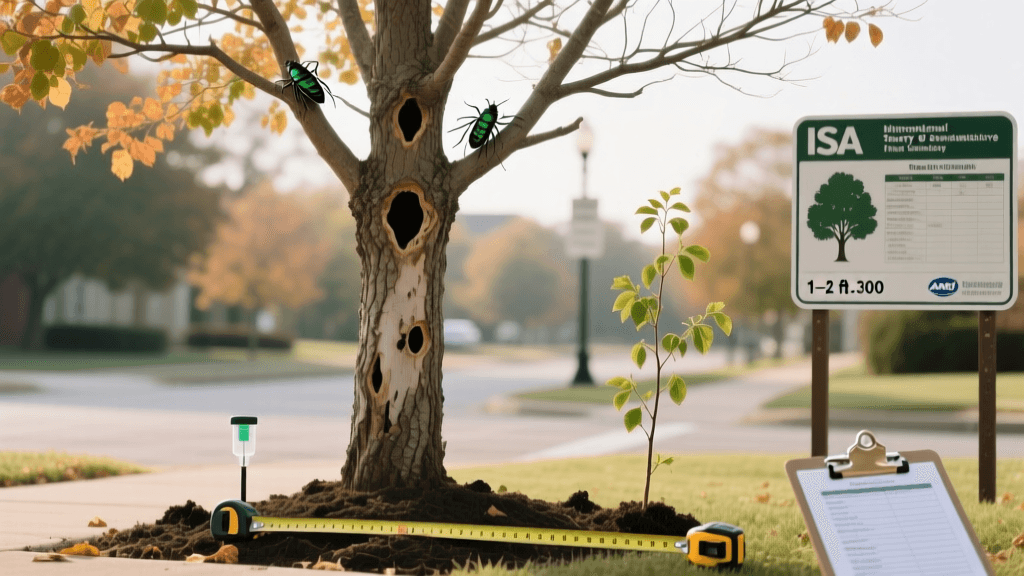
Signs Of Emerald Ash Borer Infestation And Response
Early Detection of Emerald Ash Borer Activity
The emerald ash borer (Agrilus planipennis), an invasive beetle native to Asia, has killed over 100 million ash trees across North America since its discovery in Michigan in 2002. Early identification of infestation is critical—by the time canopy dieback exceeds 30%, tree viability drops sharply. Look for D-shaped exit holes (approximately 3.5 mm wide) on bark surfaces, serpentine larval galleries beneath the phloem, and increased woodpecker activity—a telltale sign known as “flecking,” where patches of outer bark are stripped away to expose lighter inner layers.
Symptoms often begin in the upper third of the crown. Within one to two years of initial attack, thinning foliage, epicormic sprouting along the trunk, and vertical bark splits become visible. In mature green ash (Fraxinus pennsylvanica), decline typically accelerates after three years of infestation; in white ash (Fraxinus americana), mortality may take four to five years due to slightly greater resistance. Monitoring should occur annually between May and August—the peak adult flight period—and intensified in high-risk zones such as urban corridors adjacent to infested forests.
Species-Specific Vulnerability and Growth Characteristics
Ash species vary significantly in susceptibility, growth rate, and structural integrity—factors that directly inform management decisions. Green ash, widely planted in municipal landscapes across the Midwest, grows at an average rate of 1.5–2.0 feet per year and reaches 50–70 feet tall at maturity. Its shallow, fibrous root system spreads horizontally up to 2–3 times the drip line, making it prone to soil compaction damage and limiting compatibility with pavement or utility infrastructure.
White ash exhibits slower growth (0.75–1.25 ft/yr) but develops a deeper taproot system extending 4–6 feet vertically with lateral roots spanning 1.8–2.5× the crown radius. Blue ash (Fraxinus quadrangulata), less common but regionally significant in Ohio and Indiana, shows moderate resistance due to higher tannin concentrations and grows at 0.5–1.0 ft/yr. According to the USDA Forest Service (2021), blue ash mortality rates remain below 40% in areas where EAB pressure exceeds 90% for green and white ash.
Root Spread and Soil Interaction Data
- Green ash root spread: up to 60 feet from trunk in loam soils (University of Minnesota Extension, 2020)
- White ash taproot depth: averages 5.2 feet in well-drained silt loam (ISA Tree Risk Assessment Manual, 2019)
- Soil oxygen diffusion threshold for ash health: <10% volumetric air-filled porosity triggers measurable decline in root respiration
- Compaction-induced root mortality begins at bulk densities >1.4 g/cm³ in surface 12 inches
- Maximum safe trenching distance from trunk: 3× the diameter at breast height (DBH) per ANSI A300 Part 5 (2023)
Diagnostic Confirmation and Professional Assessment
Visual inspection alone cannot confirm EAB presence with certainty. ISA-certified arborists recommend coring or debarking sample sections from symptomatic limbs or trunk zones showing bark fissures. Larval galleries appear as winding, S-shaped tunnels 1–2 mm wide filled with compacted frass. Microscopic examination reveals larvae with flattened, metallic-green bodies and bell-shaped abdominal segments.
Confirmatory testing is available through state agricultural laboratories, including the Ohio Department of Agriculture’s Plant Health Division and the University of Wisconsin–Madison’s Pest Diagnostic Clinic. These institutions offer free or low-cost identification services for suspected specimens submitted in ethanol-preserved vials with precise collection coordinates.
Under ANSI A300 Part 3 (Tree Health Management), diagnostic protocols require documentation of symptom progression over ≥12 weeks, mapping of affected quadrants, and cross-referencing with local EAB detection maps maintained by the USDA Animal and Plant Health Inspection Service (APHIS).
Canopy Dieback Thresholds and Treatment Eligibility
- 0–15% dieback: Strong candidate for systemic insecticide treatment (e.g., emamectin benzoate trunk injection)
- 16–35% dieback: Conditional treatment possible only if structural defects are absent and soil conditions permit root absorption
- 36–65% dieback: Removal recommended unless historically significant (e.g., landmark trees in Chicago’s Millennium Park)
- >65% dieback: Immediate hazard assessment required per ISA Tree Risk Assessment Qualification (TRAQ) standards
Response Protocols Aligned With Industry Standards
Management response must comply with both ecological responsibility and municipal code. The International Society of Arboriculture (ISA) mandates that all pruning associated with EAB mitigation follow ANSI A300 Part 1 (Pruning) guidelines—specifically prohibiting topping, lion’s tailing, or removal of >25% live crown mass in a single season. For trees under active treatment, pruning should be limited to deadwood removal and structural correction using directional cuts no larger than 2 inches in diameter.
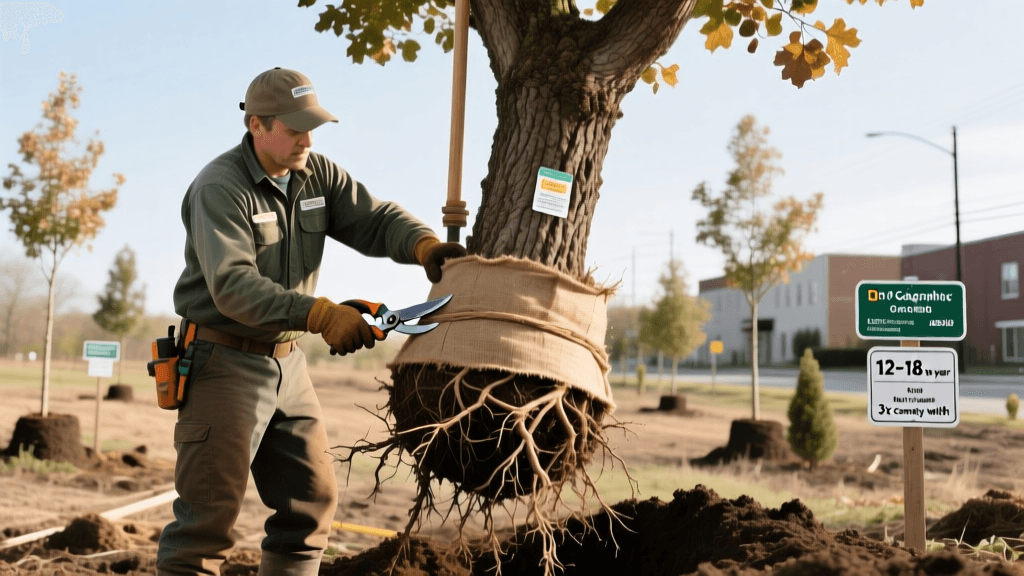
When removal is necessary, stump grinding must extend to at least 6 inches below grade to disrupt potential larval development in residual phloem tissue. Wood from infected ash must not be moved beyond county lines without heat-treatment certification (≥60°C core temperature sustained for 60 minutes), per APHIS Domestic Quarantine Regulations (2022). Municipalities including Indianapolis and Minneapolis enforce transport bans verified via certified mill certificates.
Replacement Strategy and Long-Term Site Planning
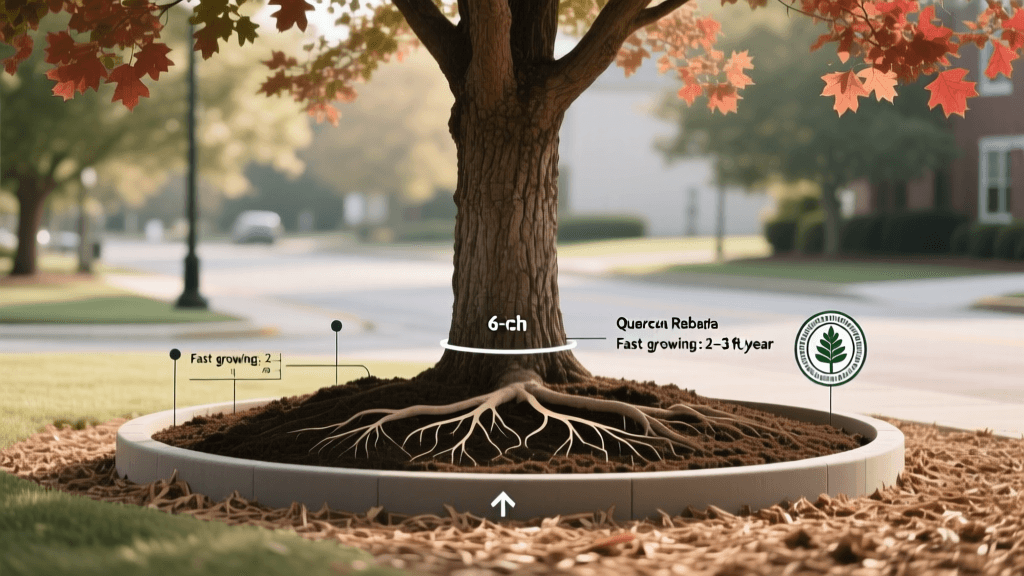
Post-removal planting requires species diversification to avoid future monoculture vulnerability. Recommended replacements include disease-resistant American elm cultivars (e.g., ‘Valley Forge’), Kentucky coffee tree (Gymnocladus dioicus), and bur oak (Quercus macrocarpa). Bur oak achieves 0.5–0.75 ft/yr growth, develops a deep taproot exceeding 8 feet, and tolerates urban stressors including drought and compacted soils.
Spacing must account for mature dimensions: bur oaks require minimum 30-foot spacing between trunks; Kentucky coffee trees need 25 feet. Root barrier installation—minimum 36-inch depth, 60-mil HDPE—is advised within 10 feet of sidewalks when planting near hardscapes, per specifications outlined in the City of Portland’s Urban Forestry Code (2023).
Soil volume provision is non-negotiable: the minimum viable root zone for a 2-inch caliper replacement tree is 1,000 cubic feet (37 m³), calculated as π × r² × depth, where r = 5 ft and depth = 12.7 ft. This aligns with ISA’s 2019 “Soil Volume Guidelines for Street Trees” and ensures adequate oxygen diffusion and water infiltration capacity.
“Treatment is not a substitute for sound risk management. Trees exhibiting advanced structural decay—even with minimal canopy loss—must be evaluated for mechanical failure potential before any chemical intervention.” — International Society of Arboriculture, Tree Risk Assessment Manual, 2019
Economic and Ecological Implications of Delayed Action
Delaying response by even one growing season increases removal costs by 18–22%, according to a 2020 cost-benefit analysis conducted by the Davey Tree Expert Company across 12 Midwestern municipalities. Structural instability escalates rapidly once internal larval density surpasses 250–300 larvae per square foot of phloem area—a threshold commonly reached by year three of infestation.
Urban forest canopy loss correlates strongly with localized temperature rise: neighborhoods in Cleveland with >40% ash mortality recorded summer surface temperatures 4.3°F higher than matched control zones with diverse canopy cover (Case Western Reserve University, Urban Climate Lab, 2021). Additionally, untreated ash stands lose 62% of their carbon sequestration capacity within 18 months of confirmed EAB presence, per data compiled by the USDA Forest Service Northern Research Station.
Replanting budgets must reflect realistic establishment timelines: bur oak requires 7–10 years to achieve functional stormwater interception; Kentucky coffee tree needs 5–8 years to provide meaningful shade. Prioritizing species with documented longevity—such as bur oak’s 200–300 year lifespan—supports long-term resilience goals aligned with ANSI A300 Part 11 (Specimen Tree Management).
Soil remediation post-removal is essential. Ash-specific mycorrhizal networks degrade within 12–18 months of host death, necessitating inoculation with broad-spectrum ectomycorrhizal blends during replanting. Field trials at the Morton Arboretum demonstrated 41% improved first-year survival in inoculated bur oak transplants versus controls.
Documentation of all interventions—including treatment dates, product lot numbers, pruning annotations, and pre- and post-removal site photos—is required under ANSI A300 Part 9 (Reports and Records) and supports eligibility for USDA EAB Cost-Share Program reimbursement in eligible counties.
| Species | Avg. Mature Height (ft) | Root Spread Ratio (vs. Crown Radius) | Decadal Growth (in DBH) | Drought Tolerance Rating (1–5) |
|---|---|---|---|---|
| Green ash | 60 | 2.2× | 1.8 inches | 3 |
| White ash | 70 | 1.9× | 1.4 inches | 4 |
| Bur oak | 80 | 2.5× | 0.9 inches | 5 |