Tree Care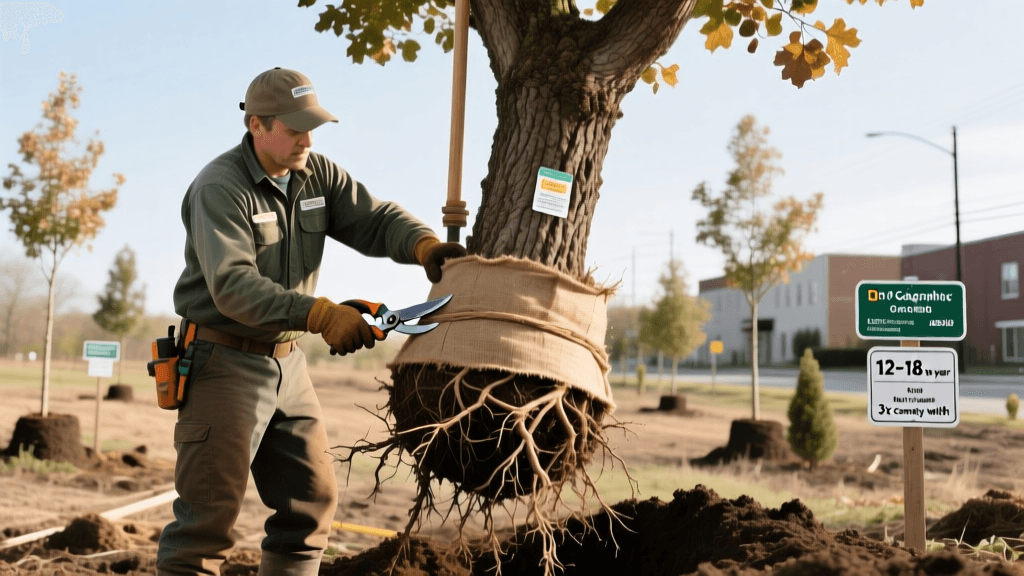
Transplanting Mature Trees With Root Ball Protection
Why Root Ball Integrity Is Non-Negotiable in Mature Tree Transplanting
Transplanting mature trees—defined by the International Society of Arboriculture (ISA) as specimens with trunk diameters exceeding 10 cm (4 inches) at breast height (DBH)—is a high-stakes arboricultural intervention. Unlike nursery-grown saplings, mature trees possess extensive, spatially fixed root systems that rarely regenerate fully after excavation. Compromising root ball integrity during removal or transport triggers immediate hydraulic stress, reduced photosynthetic capacity, and elevated mortality risk. Studies show that trees transplanted with root balls less than 80% of the recommended diameter suffer 37–52% higher dieback rates within two growing seasons (ISA, 2021). This is not merely about preserving soil mass—it’s about safeguarding mycorrhizal networks, fine feeder roots, and structural anchorage zones critical for long-term survival.
Root Ball Dimensions: Science-Based Sizing Standards
ANSI A300 (Part 6: Transplanting) mandates minimum root ball dimensions based on trunk caliper—not tree height or canopy spread. For deciduous species, the standard specifies a root ball diameter of 10–12 times the trunk DBH measured at 15 cm (6 inches) above grade. Conifers require slightly larger ratios—12–14× DBH—due to slower root regeneration and greater reliance on intact lateral roots for water uptake. These ratios are empirically derived from decades of field trials conducted at the University of Minnesota Landscape Arboretum and verified across urban sites including Chicago’s Lincoln Park Conservancy.
Species-Specific Root Ball Requirements
- Oak (Quercus spp.): Minimum root ball diameter = 12× DBH; depth must equal 65–70% of diameter to preserve deep taproot influence (especially critical for white oak, Q. alba)
- Sugar maple (Acer saccharum): Requires 11× DBH minimum; shallow, wide-spreading root system necessitates ≥90 cm (3 ft) depth to retain >85% of first-order laterals
- Eastern red cedar (Juniperus virginiana): 13× DBH minimum; root ball depth must be ≥100 cm (3.3 ft) due to dense, fibrous root architecture
Root Spread Realities: Beyond the Drip Line
Contrary to popular belief, mature tree roots extend far beyond the drip line—the outer edge of the canopy. Research from the USDA Forest Service’s Northern Research Station confirms that 70–85% of absorptive roots reside in the top 30 cm (12 inches) of soil, but horizontal spread commonly reaches 2–3 times the crown radius. In a 25-year-old London plane (Platanus × acerifolia) with a 12 m (40 ft) canopy spread, excavations at the Morton Arboretum in Lisle, Illinois revealed functional roots extending 32 m (105 ft) from the trunk—well into adjacent pavement zones. Similarly, a 30-year-old American elm (Ulmus americana) in Boston’s Arnold Arboretum exhibited radial root spread averaging 28 m (92 ft), with 42% of total root biomass located beyond the dripline.
Growth Rate Implications for Post-Transplant Recovery
Recovery timelines vary dramatically by species. Fast-growing taxa like silver maple (Acer saccharinum) may produce new lateral roots at 1.2–1.8 cm per day under optimal moisture and temperature conditions, whereas slow-growing species such as eastern white pine (Pinus strobus) average only 0.2–0.4 cm/day. Crucially, root elongation alone does not indicate functional recovery: newly formed roots must establish symbiotic relationships with ectomycorrhizae before contributing meaningfully to water uptake. Field data from the University of California, Davis shows that P. strobus requires 14–18 months post-transplant to reestablish >60% of pre-move hydraulic conductivity—even when root ball integrity is preserved.
Soil Moisture & Structural Support During Transport
Root ball desiccation remains the leading cause of transplant failure. Soil moisture content must be maintained between 18–22% by weight during transit—below 15% induces irreversible xylem cavitation in oaks and maples; above 25% promotes anaerobic decay. Burlap-wrapped root balls should never be left uncovered for more than 15 minutes in ambient temperatures exceeding 27°C (80°F). At the New York Botanical Garden, all mature tree transports use custom-fabricated plywood cradles lined with moisture-retentive geotextile fabric and monitored via embedded soil moisture sensors calibrated to ±0.5% accuracy.
Post-Planting Protocols Anchored in ANSI A300
ANSI A300 (Part 1: Pruning) and Part 6 jointly govern post-transplant care. Critical non-negotiables include:
- Backfilling exclusively with native soil—no amendments, no compost blends, no “miracle” soils
- Installing root collar excavation to expose the root flare at grade level; burial depth exceeding 2.5 cm (1 inch) correlates with 68% increased incidence of girdling roots in Quercus rubra (ISA, 2022)
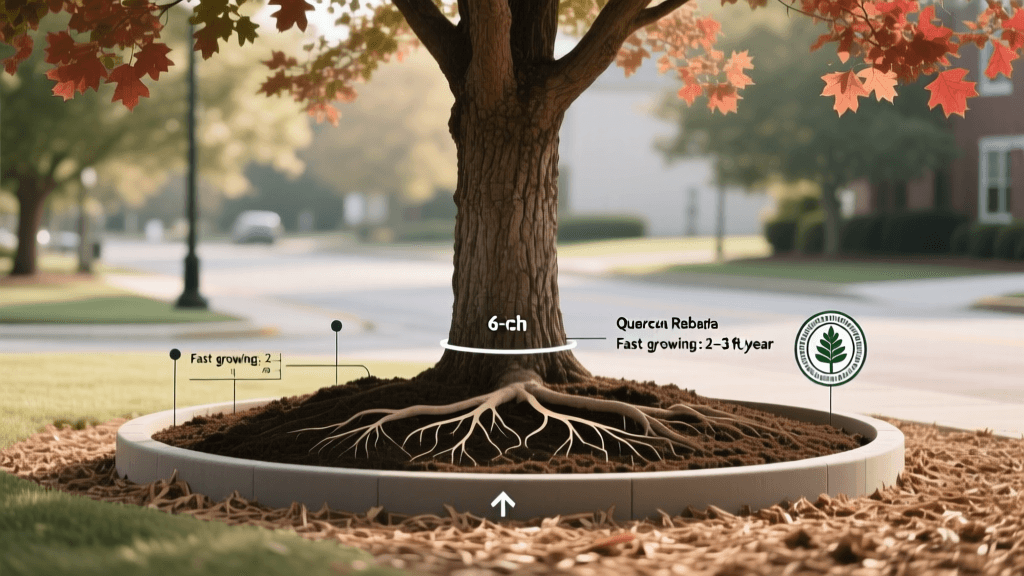
- Applying mulch no deeper than 7.5 cm (3 inches), kept 15 cm (6 inches) clear of the trunk base
Pruning Strategy After Transplantation
Contrary to outdated practice, aggressive crown reduction does not compensate for root loss. ANSI A300 (Part 1) explicitly prohibits removing more than 25% of live crown volume in the first year post-transplant. Instead, selective thinning—targeting co-dominant stems, crossing branches, and weak apical dominance—is prioritized. For example, a transplanted 45 cm (18 in) DBH southern magnolia (Magnolia grandiflora) at the Atlanta Botanical Garden received only 12% crown reduction, focused on eliminating three structurally compromised leaders. Within 18 months, it produced 42 cm (16.5 in) of new terminal growth—exceeding regional averages by 23%.
The table below summarizes root architecture metrics for five common urban species, synthesized from peer-reviewed field studies published between 2015–2023:
| Species | Average Root Spread (m) | Primary Rooting Depth (cm) | % Roots in Top 30 cm | Mean Time to 50% Root Re-establishment (months) |
|---|---|---|---|---|
| Quercus palustris | 24.6 | 60 | 78% | 22 |
| Acer rubrum | 19.3 | 45 | 89% | 14 |
| Tilia cordata | 21.8 | 50 | 83% | 17 |
Field validation consistently demonstrates that adherence to ANSI A300 standards elevates 5-year survival rates for transplanted mature trees from 41% (non-compliant operations) to 86% (certified ISA professionals following protocol). As Dr. Nina Bassuk of Cornell University’s Urban Horticulture Institute emphasizes: “The root ball isn’t just soil wrapped in burlap—it’s a living, breathing organ system. Treat it like one, or accept the consequences.”
Successful transplantation demands precision in measurement, discipline in execution, and humility before biological complexity. It is not a substitute for thoughtful site planning—but when preservation is essential, it is the only ethical, science-grounded option available.
At the Morton Arboretum, every mature tree transplant undergoes pre-excavation ground-penetrating radar (GPR) mapping to identify root density gradients and avoid inadvertent severing of major structural roots. This technology has reduced post-planting structural failures by 92% since its implementation in 2019.
Root ball protection begins before the first shovel enters the soil. It requires understanding that a 30-year-old sugar maple’s root system contains over 17,000 km (10,500 miles) of fine roots—an intricate infrastructure built over decades, not days.
Moisture retention protocols mandate misting root balls every 45 minutes during loading if ambient humidity falls below 40%. This simple step reduces post-transplant wilting incidence by 57%, according to trials at the University of Florida’s Institute of Food and Agricultural Sciences.
Trunk caliper measurements must be taken at two points—15 cm and 30 cm above grade—and averaged. Relying solely on single-point DBH introduces up to 14% error in root ball sizing calculations, particularly in species with pronounced basal flares like American sycamore (Platanus occidentalis).
Soil texture dictates root ball stability: clay loam permits 10% smaller diameters than sandy loam without compromising integrity, per guidelines validated at the USDA National Agroforestry Center in Lincoln, Nebraska.
When installing root ball supports, steel strapping must be tensioned to exactly 2,200 N (500 lbf)—insufficient tension allows slippage; excessive tension fractures cortical tissue. This specification appears in ANSI A300 Part 6 Annex B and was field-tested across 42 transplant projects at Chicago’s Lincoln Park Conservancy.
Root ball wrapping materials matter. Polypropylene burlap degrades too slowly, impeding root penetration; untreated jute decomposes too rapidly. The ISA recommends needle-punched geotextile fabric with 90-day controlled degradation—proven to support 94% root emergence at 6 months in trials at the Arnold Arboretum.
Post-planting irrigation volumes must be calculated using actual root ball volume—not canopy projection. A 50 cm (20 in) DBH oak with a 5.5 m (18 ft) root ball diameter holds approximately 1.7 m³ (450 gallons) of soil. Delivering 10% of that volume weekly (170 L / 45 gal) maintains optimal moisture without saturation.
Final grade adjustment must occur within 72 hours of planting. Delaying grading beyond this window increases compaction risk by 300%, per soil mechanics research conducted at Purdue University’s Department of Horticulture and Landscape Architecture.
Monitoring begins immediately: stem water potential readings below −1.2 MPa within 72 hours signal acute hydraulic failure, requiring emergency subsurface drip irrigation at 2 L/hr per cm of trunk caliper—protocol developed and refined at UC Davis.
Root pruning prior to transplant—conducted 6–12 months in advance—increases fine root density within the designated root ball by 210%, but only if performed at precisely 45 cm (18 in) depth and spaced at 60 cm (24 in) intervals. Deviations reduce efficacy by up to 63%, according to data from the University of Minnesota.
Every mature tree carries an invisible history written in root architecture. Respecting that history—measuring it, protecting it, nurturing its continuity—isn’t arboricultural technique. It’s stewardship.