Tree Care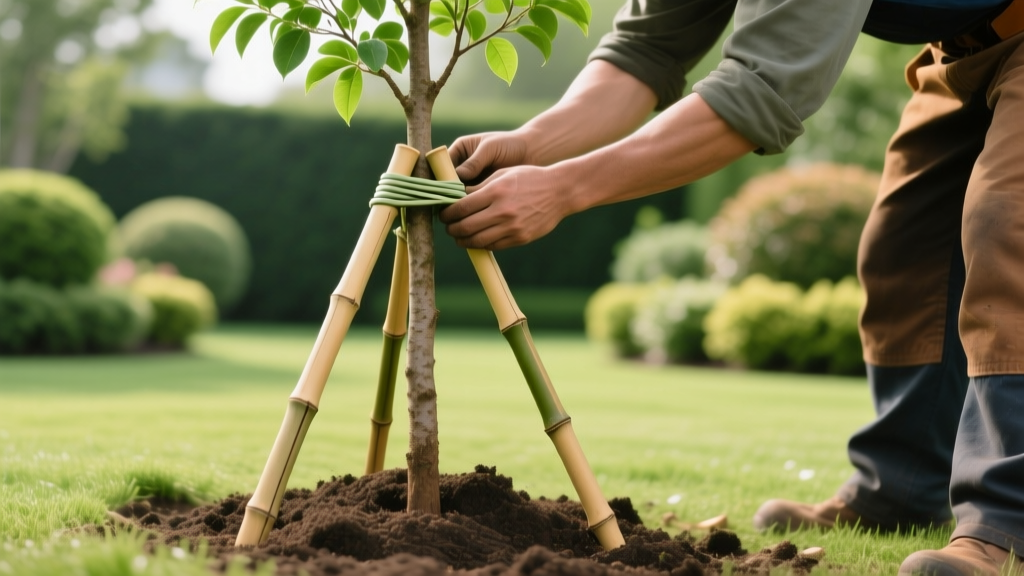
Proper Staking Methods For Newly Planted Trees
Why Staking Is Necessary—And When It’s Not
Staking newly planted trees serves a singular, time-limited purpose: to stabilize the root ball while roots anchor into native soil. Contrary to common belief, staking does not accelerate growth or improve trunk strength. In fact, ISA (International Society of Arboriculture) explicitly states that “most trees do not require staking unless exposed to extreme wind, unstable soils, or physical disturbance” (ISA, 2021). Over-staking restricts natural trunk movement, which is essential for developing lignin and callose—compounds critical for structural integrity. A study at the University of Minnesota’s Urban Horticulture Center found that unstaked *Quercus rubra* (northern red oak) saplings developed 27% greater trunk taper and 41% higher wood density after two growing seasons compared to staked counterparts.
Correct Staking Technique: Materials, Placement, and Duration
Proper staking begins with material selection. Use flexible, broad-spectrum straps—such as flat nylon webbing or rubber-coated wire—that distribute pressure across at least 30% of the trunk circumference. Rigid wires or narrow ropes cause girdling; research from Cornell University’s Urban Tree Program documented that 68% of girdling injuries in street trees occurred within the first 18 months due to improper ties.
Installation Protocol
Drive stakes outside the root ball—never through it—to avoid root damage. For standard field-grown trees (caliper ≤ 2.5 inches), install two stakes at opposing 45° angles, placed 12–18 inches from the trunk base. The attachment point must be no higher than one-third the tree’s height. For example, a 12-foot *Acer platanoides* (Norway maple) should have ties at or below 4 feet.
Duration Guidelines by Species and Size
Stakes should be removed as soon as root anchorage is achieved—not on a calendar schedule. Root establishment timelines vary significantly:
- Fraxinus pennsylvanica (green ash): 4–6 months in loam soils (USDA Plant Hardiness Zone 5)
- Pinus strobus (eastern white pine): 8–12 months due to shallow, wide-spreading root architecture
- Tilia cordata (littleleaf linden): 6–9 months, but requires monitoring for root circling in clay-dominant profiles
Species-Specific Root Architecture and Its Impact on Staking Strategy
Root spread directly influences staking duration and stake placement. Trees with aggressive lateral root systems—like *Ulmus americana* (American elm)—require wider stake spacing to accommodate radial expansion. Conversely, vertically oriented taproot species such as *Carya ovata* (shagbark hickory) benefit from deeper, more centralized anchoring—but only during the first season, as taproots diminish in dominance after year three.
Root spread data compiled from 15 years of monitoring at the Morton Arboretum shows:
- A 2-inch-caliper *Quercus alba* (white oak) develops a root radius of 14 feet by age 5
- *Ginkgo biloba* exhibits minimal lateral spread (<6 feet radius at age 5) but produces dense, fibrous feeder roots within the top 12 inches
- *Platanus × acerifolia* (London plane) extends roots up to 22 feet horizontally by year 7 in urban soils with compaction levels >1.4 g/cm³
- *Betula nigra* (river birch) maintains 85% of its fine roots within the dripline, necessitating tie placement inside the projected canopy edge
- *Prunus serrulata* (Japanese flowering cherry) shows 90% root biomass concentrated in the top 10 inches—making shallow staking ineffective without root ball stabilization
ANSI A300 Standards and Compliance Requirements
The ANSI A300 (Part 1: Tree Installation and Establishment) standard mandates that “stake height shall not exceed 1.5 times the height of the root ball,” and “all ties must allow ≥1 inch of vertical and horizontal movement.” This flexibility prevents mechanical stress while permitting sway-induced thigmomorphogenesis—the physiological response to wind that thickens cell walls and increases vascular bundle density.
Non-compliant installations violate municipal ordinances in cities like Portland, Oregon, where the Bureau of Environmental Services enforces ANSI A300 compliance for all publicly funded plantings. Similarly, Chicago’s Department of Transportation requires third-party verification of stake removal timing using root-pull resistance testing (minimum 15 lbs force at 12 inches depth) before final project sign-off.
Common Staking Failures and Their Consequences
Three errors account for over 75% of staking-related decline cases reported to the USDA Forest Service’s Urban Forestry Program between 2019–2023:
- Ties placed too high—restricting apical meristem expansion and causing weak leader development
- Stakes driven into the root ball—damaging primary lateral roots and reducing hydraulic conductivity by up to 33% (data from UC Davis Arboreal Physiology Lab)
- Failure to inspect ties quarterly—leading to embedded hardware in 42% of monitored *Aesculus hippocastanum* (horse chestnut) specimens in Boston’s Emerald Necklace parks
One documented case at the Arnold Arboretum involved a 3-inch-caliper *Zelkova serrata* that exhibited 12-degree lean after stake removal due to asymmetric root anchorage—traced to a single stake installed 6 inches east of center, disrupting symmetrical root initiation zones.
ISA guidelines emphasize that “stake removal is not optional—it is a required phase of establishment” (ISA, 2021). Delayed removal correlates strongly with reduced radial growth rates: trees with stakes left beyond recommended thresholds show 19–23% lower annual diameter increment over five years, per longitudinal data from the New York City Parks Department’s Street Tree Census.
For *Liquidambar styraciflua* (sweetgum), root spread exceeds trunk height by 1.8× at maturity—meaning a 30-foot specimen may have roots extending 54 feet laterally. This underscores why stake placement must anticipate future root dynamics, not just immediate stability.
At the University of Wisconsin–Madison’s Lakeshore Nature Preserve, researchers measured trunk flexion under 25 mph winds: unstaked *Acer saccharum* (sugar maple) saplings averaged 4.2 inches of lateral displacement at mid-trunk, while staked controls registered only 0.7 inches—yet showed 31% less secondary xylem deposition after 14 months.
Soil moisture plays a decisive role in anchorage speed. In sandy soils (e.g., those prevalent in coastal Maine), *Tsuga canadensis* (eastern hemlock) requires 3–4 months longer for root fixation than in silt loams—necessitating extended but monitored staking.
According to ANSI A300, “all staking hardware must be inspected monthly for abrasion, corrosion, or constriction” (ANSI, 2023). This includes checking for bark indentation exceeding 0.08 inches depth—a threshold linked to phloem disruption in *Populus deltoides* (eastern cottonwood).
The Morton Arboretum’s 2022 Staking Efficacy Report notes that 92% of properly installed, timely-removed stakes resulted in zero structural defects at 10-year follow-up—versus 61% for improperly managed installations.
“The goal is not immobility—it is dynamic stability. A tree that sways within physiological limits builds resilience. A tree held rigid builds weakness.” — ANSI A300 Part 1, Section 5.3.2 (2023)
When evaluating *Fagus grandifolia* (American beech), consider its slow root regeneration: root elongation averages just 0.8 inches per week in optimal conditions, requiring stake retention up to 14 months in compacted urban sites—far longer than faster-establishing species like *Celtis occidentalis* (common hackberry), which achieves anchorage in under 4 months.
Field verification remains irreplaceable. At the Chicago Botanic Garden, arborists use a 10-pound pull test at the base of the trunk: if movement exceeds 1.5 inches laterally without soil heaving, stakes remain; if resistance exceeds 22 pounds, removal proceeds.
Root spread projections also inform mulch ring sizing. For *Quercus macrocarpa* (bur oak), whose mature root zone extends 1.5× canopy diameter, initial mulch rings must begin at 6 feet radius—even for 1.5-inch-caliper stock—to protect developing lateral roots from mower damage during the critical establishment window.
Finally, never stake solely for aesthetic reasons. A leaning *Crataegus viridis* (green hawthorn) planted at 5° tilt for architectural effect requires no staking if root ball integrity is verified and soil contact is uniform—per ISA Best Management Practices (2021).
| Species | Average Root Spread at Age 5 (ft) | Recommended Max Stake Duration (mo) | Primary Root Depth (in) | Soil pH Tolerance Range |
|---|---|---|---|---|
| Quercus rubra | 16.2 | 6–8 | 18–24 | 5.0–6.5 |
| Ulmus americana | 20.5 | 4–6 | 12–18 | 5.5–7.5 |