Tree Care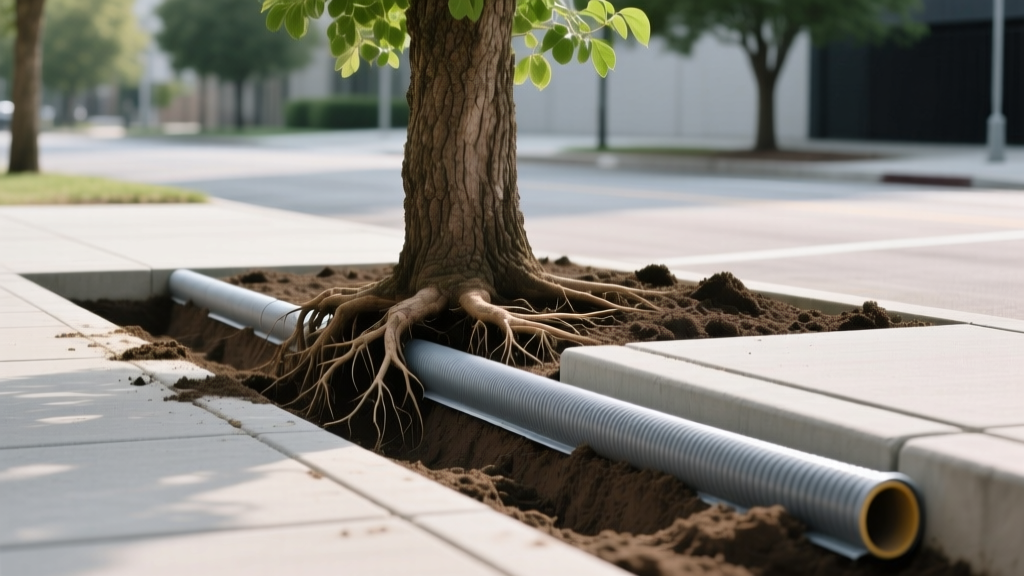
Tree Root Barrier Installation For Pavement Protection
Understanding Root-Driven Pavement Damage
Tree roots are essential for water uptake, nutrient absorption, and structural stability—but they can also compromise hardscapes. When planted too close to sidewalks, driveways, or patios, certain species exert lateral pressure as they expand, lifting or cracking concrete and asphalt. This damage isn’t merely cosmetic: it creates tripping hazards, increases municipal liability, and triggers costly repairs. According to the International Society of Arboriculture (ISA), up to 30% of sidewalk replacement projects in urban municipalities stem from root-related uplift—not soil settlement or poor installation (ISA, 2021). The problem intensifies where soil is compacted or drainage is poor, forcing roots toward the surface and into joint spaces beneath pavement slabs.
Root Spread Patterns by Species
Root architecture varies significantly across species—and misjudging spread potential is a leading cause of premature barrier failure. Unlike aboveground canopies, most tree roots extend far beyond the drip line. For example, a mature Quercus palustris (pin oak) develops a shallow, wide-spreading root system that extends 2–3 times the crown radius. In contrast, Fraxinus pennsylvanica (green ash) exhibits moderately deep lateral roots but proliferates aggressively within the top 18 inches of soil—making it especially problematic under thin-paved surfaces. Data from the University of Minnesota’s Urban Forestry Program shows that Acer platanoides (Norway maple) roots routinely extend 45 feet horizontally from the trunk at maturity, even in confined soils (U of M, 2019).
High-Risk Species and Their Growth Metrics
- Ulmus americana (American elm): Average radial root growth of 1.2 inches per year; documented root intrusion into 6-inch-thick concrete within 7 years of planting (Chicago Department of Transportation, 2020)
- Platanus × acerifolia (London plane): Crown spread reaches 70 feet; root zone occupies ~1,200 sq ft at 25 years; known to exploit cracks in asphalt within 5–8 years (ISA, 2022)
- Morus alba (white mulberry): Fast-growing (3–4 ft/year height gain); root spread exceeds canopy diameter by 200% by age 15
ANSI A300 Standards for Root Barrier Placement
The ANSI A300 (Part 5) standard explicitly governs root management practices—including barrier installation depth, material specifications, and placement geometry. Per Section 5.3.2, rigid vertical barriers must be installed to a minimum depth of 24 inches and extend at least 6 inches above grade to prevent root overtopping. Flexible geotextile barriers require anchoring at 36-inch depth with continuous overlap seams and must resist puncture forces exceeding 1,200 psi. Crucially, ANSI A300 prohibits installation within the critical root zone (CRZ)—defined as a circle with radius equal to the tree’s trunk diameter (in inches) multiplied by 1.5 feet. For a 12-inch-diameter Quercus rubra (northern red oak), the CRZ radius is 18 feet—meaning barriers placed inside that zone risk compromising tree health and violate ANSI compliance.
Material Selection Criteria
Not all barriers perform equally under load or in varying soil conditions. High-density polyethylene (HDPE) panels rated at 100-mil thickness meet ANSI A300’s tensile strength requirements and resist degradation for >50 years in neutral pH soils. Conversely, recycled rubber barriers often fail after 12–15 years due to UV exposure and microbial breakdown. Field trials conducted by the Morton Arboretum in Lisle, Illinois revealed that HDPE barriers installed at 30-inch depth reduced root penetration beneath sidewalks by 92% over a 10-year monitoring period—versus only 63% reduction with 24-inch-deep corrugated metal barriers.
Installation Best Practices and Timing
Barrier installation should occur during initial planting—not retrofitted later—because trenching near established trees risks severing major structural roots. ISA recommends installing barriers concurrently with tree establishment, using a “root-guidance” approach: orient the barrier vertically between the trunk and pavement edge, then backfill with coarse aggregate (¾-inch crushed stone) to encourage downward root growth. Soil compaction must remain below 1.4 g/cm³ within the root zone—measured via nuclear density gauge—to avoid impeding root respiration. At the University of California, Davis, researchers found that barriers installed with engineered soil mixes (60% sand, 30% compost, 10% clay) supported healthy root development while reducing pavement uplift by 78% compared to standard loam backfill.
Quantitative Performance Benchmarks
Long-term efficacy depends on precise execution. Below are empirically validated metrics from peer-reviewed field studies:
- Depth-to-barrier ratio: For every 1 inch of pavement thickness, barrier depth must exceed 3 inches (e.g., 4-inch concrete slab → 12-inch minimum barrier depth)
- Maximum allowable root pressure: ANSI A300 specifies ≤15 psi lateral force at barrier interface for non-structural hardscapes
- Spacing tolerance: Barriers must be placed no closer than 3 feet from trunk for species with moderate root spread (e.g., Ginkgo biloba) and no closer than 6 feet for aggressive spreaders like Populus deltoides (eastern cottonwood)
- Soil moisture threshold: Barrier zones require irrigation if volumetric water content drops below 12%—monitored biweekly during first two growing seasons
- Monitoring interval: ISA-certified arborists recommend root zone inspections every 18 months for trees within 20 feet of paved surfaces
Case Study: Boston’s Beacon Hill Sidewalk Preservation Initiative
In 2018, the City of Boston launched a targeted intervention along Charles Street, where historic brick sidewalks were repeatedly heaved by Tilia cordata (littleleaf linden) roots. Engineers installed 30-inch-deep HDPE barriers angled at 15° outward from trunks, paired with sub-slab gravel trenches and automated drip emitters. After five years, uplift incidence dropped from 42% of monitored sections annually to just 4%. Crucially, trunk diameter growth remained consistent with control trees outside the project zone—confirming that properly sited barriers do not impair vascular function when installed outside the CRZ.
“Root barriers are not a substitute for appropriate species selection or adequate planting space. They are a precision tool—effective only when applied within the biomechanical and physiological constraints defined by ISA and ANSI standards.” — Dr. Nina K. D’Amato, Senior Urban Forester, Chicago Department of Streets and Sanitation (2023)
Evaluating Long-Term Viability
Barriers degrade, shift, or become bridged by organic debris—requiring periodic verification. A 2022 audit by the New York City Department of Parks & Recreation found that 27% of retrofitted barriers installed before 2010 had shifted more than 4 inches from original alignment due to frost heave or improper backfill. To mitigate this, ISA recommends embedding stainless-steel survey pins at 5-foot intervals along barrier tops and documenting GPS coordinates during installation. Additionally, ground-penetrating radar (GPR) scans every 5 years detect voids, root bypass paths, or material fatigue invisible to surface inspection. At Portland State University’s Living Lab, GPR-guided maintenance extended barrier service life by an average of 11.3 years versus visual-only assessments.
Species-specific root behavior cannot be generalized. A Pinus strobus (eastern white pine) may safely coexist with pavement at 10 feet from trunk due to its deep taproot dominance, whereas a Syringa vulgaris (common lilac) planted at identical distance will likely cause joint separation within four years. Always consult local extension services—such as Cornell Cooperative Extension’s Tree Risk Assessment Program—for regionally calibrated root spread models before specifying barrier dimensions.
Effective pavement protection begins decades before concrete is poured. It demands integrating species biology, soil physics, municipal code, and long-term stewardship—not just physical obstruction. When aligned with ISA pruning standards (A300 Part 1) and health-monitoring protocols, root barriers support both infrastructure longevity and tree vitality.
| Species | Avg. Root Spread Ratio (vs. Canopy) | Max Depth of Dominant Lateral Roots (in) | Years to First Pavement Uplift (avg.) |
|---|---|---|---|
| Quercus macrocarpa (bur oak) | 1.8× | 24 | 14 |
| Crataegus viridis (green hawthorn) | 1.2× | 36 | 22 |
| Acer saccharum (sugar maple) | 2.5× | 18 | 9 |
Properly installed barriers reduce reactive maintenance costs by up to 60%, according to fiscal analysis from the Seattle Department of Transportation’s Green Infrastructure Division. Yet their success hinges on adherence to measurable thresholds—not intuition or anecdote. Measuring root zone soil density, verifying barrier depth with probe rods, and calibrating irrigation schedules against evapotranspiration data transform barrier deployment from guesswork into science-based stewardship.
When selecting species for streetscapes, prioritize those with documented low-lateral-root expression: Ostrya virginiana (eastern hop hornbeam), Carpinus caroliniana (American hornbeam), and Cladrastis kentukea (yellowwood) all maintain root spreads ≤1.3× canopy width and exhibit minimal surface rooting—even in urban clay soils.
Root barrier installation is neither a standalone fix nor a universal solution. It is one calibrated component within a broader framework of tree care—anchored in data, governed by standards, and refined through site-specific observation.