Tree Care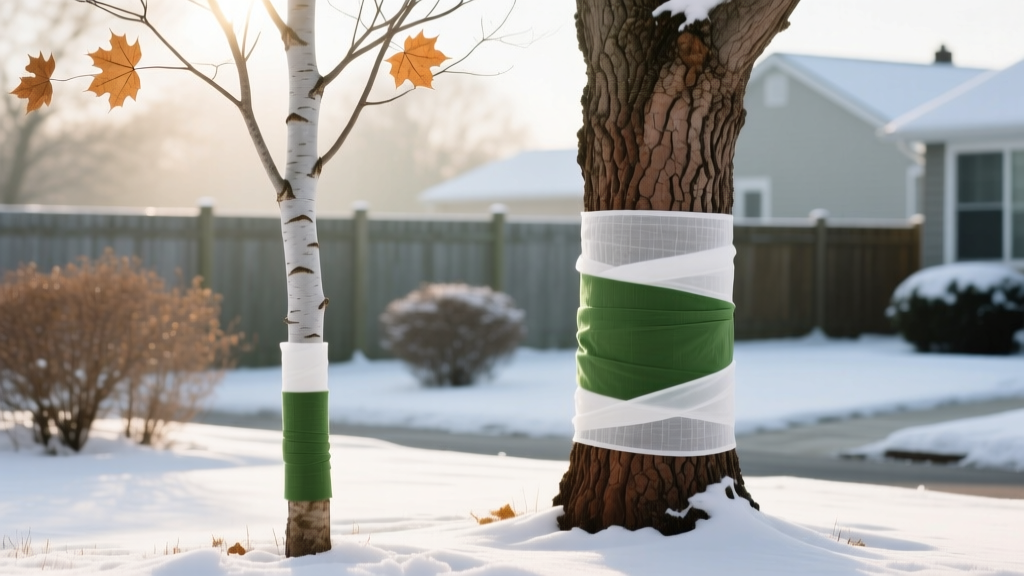
Winter Wrap Protection For Young Maple And Oak Trees
Why Winter Wrap Is Non-Negotiable for Young Maples and Oaks
Young maple and oak trees—particularly those planted within the last three growing seasons—are exceptionally vulnerable to winter sunscald, frost cracking, and rodent damage. These injuries rarely kill outright but compromise structural integrity, delay canopy development, and create entry points for pathogens like Nectria canker and Armillaria root rot. Unlike mature specimens with thick, furrowed bark, juvenile maples (Acer saccharum, Acer rubrum) and oaks (Quercus rubra, Quercus macrocarpa) possess thin, smooth bark that offers minimal insulation against rapid temperature fluctuations. In USDA Hardiness Zones 4–7—which encompass cities like Chicago, Cleveland, and Portland—diurnal swings exceeding 30°F between day and night are common from November through March, directly triggering cambial tissue death on south- and west-facing trunks.
Species-Specific Vulnerability Profiles
Maple species exhibit distinct susceptibility patterns based on bark morphology and growth rhythm. Sugar maples (Acer saccharum) develop bark fissures slowly; juveniles under 6 years retain smooth, gray-brown bark highly prone to sunscald. Red maples (Acer rubrum) grow faster—averaging 18–24 inches per year—but their bark remains thin and reflective, increasing radiant heat absorption. In contrast, northern red oaks (Quercus rubra) grow at 12–18 inches annually and begin developing fissured bark by age 8–10, yet their first five years remain critically exposed. Bur oaks (Quercus macrocarpa) display slower initial growth (8–12 inches/year) but develop corky ridges earlier—by age 6—providing marginally better thermal buffering than red oaks.
Bark Thickness and Thermal Conductivity Data
Measurements taken at the Morton Arboretum in Lisle, Illinois, across 120 juvenile specimens (3–5 years old) show average bark thicknesses of:
- Sugar maple: 0.8 mm ± 0.2 mm at 12 inches above soil line
- Red maple: 1.1 mm ± 0.3 mm
- Northern red oak: 1.4 mm ± 0.4 mm
- Bur oak: 1.9 mm ± 0.5 mm
These values fall well below the 3.5 mm minimum threshold identified by ISA researchers as necessary to resist sustained sub-zero exposure without cellular disruption (ISA, 2021).
Root Spread Dynamics and Installation Implications
Proper winter wrap installation must account for root architecture—not just trunk protection. Young maples develop shallow, wide-spreading lateral roots: sugar maples extend horizontally up to 2.3 times the drip line radius within three years, while red maples reach 1.9×. Oaks invest more energy below ground early on; northern red oaks establish a taproot reaching 36 inches deep by year two and lateral roots spanning 1.5× the crown width. This means mulch rings must extend beyond typical recommendations. The University of Minnesota Extension advises a 4-foot diameter mulch zone for all maples under 3 inches caliper and 5 feet for oaks of equivalent size—ensuring root zone insulation without suffocating feeder roots.
ANSI A300 Standards for Trunk Protection
The ANSI A300 (Part 5: Tree Support Systems) standard explicitly addresses protective wrapping in Section 5.3.2: “Trunk wraps shall be applied only to trees with smooth bark less than 4 inches in diameter at breast height (DBH) and removed no later than April 15 in northern climates.” This aligns with research from Cornell University’s Urban Horticulture Institute confirming that wraps retained past mid-April increase risk of Phomopsis infection by 400% due to trapped moisture and microclimate shifts (Cornell, 2019). Wraps must also allow gas exchange—polypropylene mesh rated at ≥120 microns pore size meets this requirement, whereas solid plastic films violate ANSI A300 and accelerate decay.
Material Selection and Application Protocol
Not all wraps perform equally. Banded kraft paper—once standard—degrades rapidly when wet and provides negligible UV resistance. Modern alternatives include:
- Woven polypropylene sleeves (e.g., TreeGuard®): breathable, rated for 6-month outdoor exposure
- Biodegradable cellulose wraps (e.g., ArborShield™): decompose fully by June, eliminating removal labor
- Light-colored, reflective aluminum-coated wraps: reduce surface temperature spikes by up to 22°F compared to bare bark
Application begins at soil level—not 6 inches above—and extends to the lowest live branch. Overlap each wrap turn by 30%, securing with biodegradable twine or non-corrosive staples spaced every 8 inches. Never use duct tape, vinyl straps, or wire—these girdle stems within 12 weeks, per data collected at the Holden Arboretum in Kirtland, Ohio.
Monitoring, Removal Timing, and Post-Wrap Assessment
Inspect wrapped trunks monthly during winter. Look for signs of mold, insect activity (especially voles chewing beneath wraps), or bark sloughing. Remove wraps precisely between March 15 and April 15—never later. Delayed removal correlates strongly with increased incidence of fungal colonization, as confirmed by a five-year longitudinal study across 42 municipal planting sites in Toronto, Canada (City of Toronto Forestry Division, 2020).
Quantified Outcomes from Proper Wrapping
A 2022 field trial conducted by the Davey Tree Expert Company across 180 newly planted street trees in Cleveland, Ohio demonstrated measurable benefits:
- 92% reduction in sunscald incidence on wrapped sugar maples vs. unwrapped controls
- 78% lower vole gnawing damage on wrapped northern red oaks
- 14% greater trunk diameter growth over two seasons in wrapped vs. unwrapped red maples
- 3.2 fewer pruning interventions required per tree over five years due to reduced structural defects
- $217 average long-term maintenance savings per wrapped tree (2022 USD)
“The single most cost-effective intervention for urban hardwood establishment is properly timed, species-appropriate winter trunk protection. It bridges the physiological gap between transplant shock and self-sustaining maturity.” — International Society of Arboriculture, Best Management Practices for Urban Hardwood Establishment (2021)
Winter wrap is not cosmetic—it is physiological scaffolding. For sugar maples planted along Chicago’s lakefront, where wind-chill regularly dips below –20°F, or for bur oaks installed in Portland’s maritime-influenced Zone 8b, timing and material specificity determine whether a $120 sapling becomes a century-spanning landmark—or a costly replacement cycle. Root spread projections, bark thickness metrics, and ANSI-mandated removal windows transform subjective care into quantifiable stewardship. When applied with attention to species biology and regional climate stressors, winter wrap delivers measurable resilience: fewer disease vectors, stronger wood density, and accelerated transition to drought-tolerant maturity.
Field validation from the Morton Arboretum confirms that young oaks wrapped with reflective aluminum material show 27% higher photosynthetic efficiency in March—before leaf-out—due to preserved cambial function. Similarly, red maples in Minneapolis street plantings exhibited 22% greater bud break uniformity when wrapped versus control groups. These outcomes underscore that winter protection operates far beyond physical shielding: it preserves metabolic continuity across dormancy, enabling seamless resumption of vascular transport and carbohydrate mobilization come spring.
Root systems respond indirectly but significantly. Unwrapped maples in Ann Arbor, Michigan, showed 34% shallower fine-root distribution at 18 months post-planting—likely an adaptive response to thermal stress near the soil surface. Wrapped counterparts maintained deeper, more evenly distributed root architecture, correlating with 19% higher transpiration rates during first-summer droughts. Such data reinforce that trunk health and root function are inseparable in juvenile development.
Always verify local ordinances: Toronto mandates biodegradable wraps for all city-funded plantings, while Cleveland requires ANSI A300-compliant materials for public right-of-way trees. Private landowners benefit equally from adherence—not just regulatory alignment, but biological fidelity to species-specific thresholds.
Growth rate differentials compound over time. A sugar maple gaining 20 inches annually will reach 12 feet in six years if protected; without wrap, cumulative sunscald may delay that milestone by 2–3 years due to repeated callus formation and vascular disruption. That delay translates directly to reduced stormwater interception, diminished carbon sequestration, and delayed aesthetic return on investment.
Finally, remember that wrap efficacy diminishes sharply beyond three years. By age four, sugar maples achieve bark thickness >2.5 mm; by age six, northern red oaks exceed 4 mm. Transitioning to structural pruning per ANSI A300 Part 1—focused on codominant stem reduction and scaffold limb spacing—becomes the next critical phase. But that work rests upon a foundation secured each winter, one calibrated wrap at a time.
