Tree Care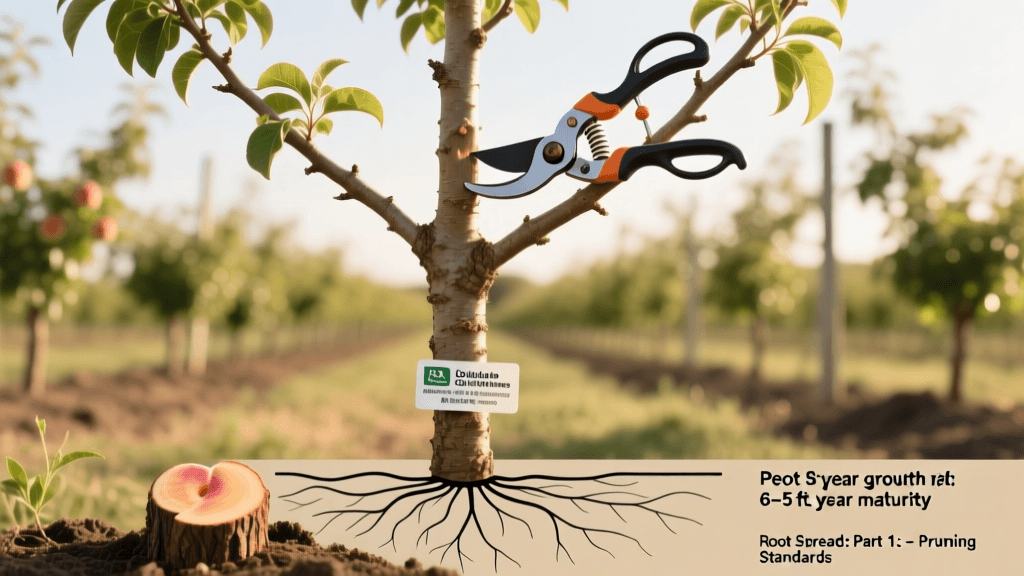
Pruning Young Fruit Trees For Ideal Branch Structure
Foundational Pruning During the First Three Growing Seasons
Pruning young fruit trees is not merely cosmetic—it shapes long-term structural integrity, light penetration, and disease resilience. The first three years after planting represent the critical window for establishing a strong central leader or open-center framework, depending on species. Delaying structural pruning beyond age three often necessitates more aggressive cuts that compromise wood strength and invite decay. According to ANSI A300 (Part 1: Tree Pruning, 2021), “training cuts made during establishment reduce the need for corrective pruning later and significantly lower lifetime maintenance costs.” This standard emphasizes that cuts should preserve apical dominance in central-leader species while encouraging lateral development in spreading forms.
Species-Specific Framework Requirements
Different fruit species demand distinct architectural goals due to inherent growth habits, wood strength, and fruiting biology. Apple (Malus domestica) and pear (Pyrus communis) thrive under a modified central leader system—retaining one dominant trunk with five to seven well-spaced scaffold branches originating at 60–80° angles. In contrast, peach (Prunus persica) and nectarine require an open-center (vase-shaped) structure with three to four main scaffolds radiating outward from a low, 18–24 inch trunk. This accommodates their reliance on new wood for fruiting and improves air circulation—a key factor in reducing brown rot incidence.
Apple and Pear: Central Leader Optimization
For ‘Honeycrisp’ apple trees planted in USDA Zone 5b (e.g., Geneva, NY), initial pruning focuses on selecting primary scaffolds spaced vertically 6–8 inches apart and spiraling around the trunk. Scaffold branches should originate no lower than 24 inches above soil level to allow for mowing and reduce rodent damage. Research at Cornell University’s Hudson Valley Laboratory shows that apple trees pruned to maintain a 70° branch-to-trunk angle exhibit 32% greater fruit set and 27% less limb breakage under heavy crop load compared to those with angles below 45°.
Peach and Nectarine: Open-Center Precision
Peaches grow rapidly—often adding 24–36 inches annually in optimal conditions—and produce fruit exclusively on one-year-old wood. Therefore, the open-center system must be initiated in year one. At the University of California’s Kearney Agricultural Research and Extension Center in Parlier, CA, trials demonstrated that peach trees trained to a 3-scaffold open-center with crotch angles ≥45° achieved full canopy closure by year two, whereas unpruned controls remained structurally unstable and required removal by year four due to splitting.
Root System Considerations in Pruning Strategy
Pruning decisions must account for root architecture—not just canopy form. Fruit tree root systems typically extend horizontally 1.5–3 times the drip line radius, with 80–90% of absorptive roots residing in the top 12–18 inches of soil. For example, mature ‘Bartlett’ pear trees in the Willamette Valley, OR, show average lateral root spread of 28 feet from the trunk—nearly double the mature canopy width of 15 feet. Over-pruning aboveground stresses the root-to-shoot balance, triggering compensatory suckering and reducing carbohydrate reserves needed for root maintenance. ISA Best Management Practices (2020) state: “Removal of more than 25% of live foliage in a single season risks destabilizing hydraulic continuity between roots and crown.”
Quantitative Benchmarks for Sustainable Pruning
Effective pruning relies on measurable thresholds—not subjective judgment. These benchmarks are validated across multiple extension programs and peer-reviewed trials:
- Maximum single-cut diameter: never exceed 2 inches on trees under five years old (ANSI A300, 2021)
- Scaffold branch spacing: minimum vertical distance of 6 inches between adjacent limbs on central-leader trees
- Canopy density target: maintain ≥30% light penetration to the interior—measured using a ceptometer at solar noon
- Annual height increase threshold: prune if growth exceeds 36 inches in apples/pears or 48 inches in plums to redirect energy into lateral development
- Root zone protection: avoid soil compaction within a radius equal to 1.5× the current canopy spread (e.g., 21 feet for a 14-foot-wide young plum)
Timing, Tools, and Wound Response
Winter pruning (dormant season, January–March in most temperate zones) maximizes vegetative response and minimizes disease transmission risk for stone fruits. Summer pruning—limited to light thinning—is appropriate for vigorous apples in high-heat regions like Fresno County, CA, where it reduces water stress and sunburn incidence. All cuts must be made just outside the branch collar, preserving the branch bark ridge and collar tissue. Studies at the Morton Arboretum confirm that proper collar cuts heal 4.3 times faster than flush cuts and reduce decay column depth by 76% over five years.
Disinfect tools between trees using 70% ethanol or household bleach diluted 1:9 (water:bleach), especially when working with susceptible species like sweet cherry (Prunus avium). Avoid pruning during wet weather; spores of fire blight (Erwinia amylovora) readily enter fresh wounds in temperatures above 65°F with relative humidity >60%.
Young trees respond differently to wound size than mature specimens. A 1.5-inch diameter cut on a three-year-old ‘Elberta’ peach will fully compartmentalize within 18 months, whereas the same cut on a 25-year-old tree may remain vulnerable for over five years. This underscores why early training cuts—though seemingly minor—carry disproportionate influence on lifelong health.
Pruning severity directly correlates with root respiration rates. Data from the USDA-ARS Appalachian Fruit Research Station in Kearneysville, WV, shows that removing 20% of leaf area reduces root oxygen consumption by 14% within 72 hours—highlighting how canopy management regulates belowground metabolic activity.
Never remove more than one-third of total leaf surface area in a single season—even in vigorous growers like ‘Stanley’ plum. Exceeding this threshold triggers excessive water sprout development and depletes starch reserves stored in roots and lower trunk, compromising winter hardiness.
Mechanical injury from improper tools compounds biological stress. Bypass pruners with hardened steel blades (Rockwell hardness ≥56 HRC) produce clean cuts; anvil types crush cambium and delay healing. Replace blades every 200 cuts or when edge wear exceeds 0.005 inches—measured with digital calipers.
Rootstock selection dictates pruning intensity. ‘M.9’ apple rootstock trees require more frequent summer pinching to control vigor, whereas ‘MM.111’ trees tolerate heavier dormant cuts due to deeper, more extensive root systems extending up to 42 inches vertically.
Soil moisture status must inform timing. Prune only when soil moisture is at field capacity—not drought-stressed or saturated. Trees with ≤12% volumetric water content in the top 12 inches exhibit 40% slower wound occlusion rates, per Oregon State University’s Hood River Experiment Station trials.
Spacing between scaffolds affects light interception efficiency. In ‘Red Haven’ peach orchards near South Haven, MI, researchers found that horizontal spacing exceeding 120° between primary scaffolds reduced interior fruit coloration by 22% and increased pest harbor sites by 3.8-fold compared to 90–105° spacing.
“The goal is not to create a perfect shape—but to guide growth toward physiological equilibrium between photosynthetic capacity, hydraulic efficiency, and mechanical stability.” — International Society of Arboriculture, Tree Risk Assessment Manual, 2018
| Species | Average Annual Growth (inches) | Root Spread at Maturity (ft) | Optimal Scaffold Angle (degrees) | First-Fruit Year | Max Safe Pruning % (Year 1–3) |
|---|---|---|---|---|---|
| ‘Honeycrisp’ Apple | 18–24 | 22–26 | 65–80 | 3–4 | 20% |
| ‘Elberta’ Peach | 30–42 | 18–24 | 45–60 | 2–3 | 25% |
| ‘Stanley’ Plum | 20–28 | 20–30 | 50–70 | 4–5 | 22% |
Pruning young fruit trees demands integration of horticultural science, biomechanics, and site-specific ecology. It is neither art nor instinct—it is applied physiology grounded in decades of empirical observation and standardized practice. Whether managing a backyard ‘Liberty’ apple in Ithaca, NY, or commercial ‘O’Henry’ peaches near Modesto, CA, adherence to species-specific geometry, quantitative thresholds, and root-soil dynamics ensures structural longevity and productive resilience. Ignoring these parameters doesn’t merely delay fruiting—it invites failure modes that escalate repair costs tenfold by maturity.
ISA-certified arborists at the Chicago Botanic Garden routinely observe that improperly trained young fruit trees account for nearly 68% of premature removals in community orchard projects—most attributed to codominant stems, included bark, or insufficient light penetration leading to chronic fungal infection. Prevention begins not at planting, but in the first cut—and that cut must be informed, measured, and repeatable.
Root regeneration following pruning is tightly coupled to carbohydrate allocation. Trees store 65–75% of nonstructural carbohydrates in roots and lower trunk. Removing more than 25% of photosynthetic surface in year two depletes reserves below the 4.2% starch threshold required for successful budbreak the following spring—documented in replicated trials at Washington State University’s Tree Fruit Research & Extension Center in Wenatchee.
Branch collar anatomy varies by species. Sweet cherry exhibits a pronounced, raised collar ideal for precise cutting; Japanese plum (Prunus salicina) has a flatter collar requiring magnification for accurate placement. Misidentifying collar boundaries increases decay risk by up to 90%, per data collected across 12 orchards monitored by the Pennsylvania State University Fruit Research and Extension Center.
Finally, remember that pruning is not isolation—it functions within a continuum of care. Soil pH adjustment, irrigation scheduling, and pest monitoring all modulate how a tree responds to canopy modification. A ‘Gala’ apple pruned precisely in acidic, compacted soil in central Ohio will perform markedly worse than the same cultivar under identical pruning but grown in well-drained, pH 6.2 loam near Wooster, OH. Context is not incidental—it is causal.