Tree Care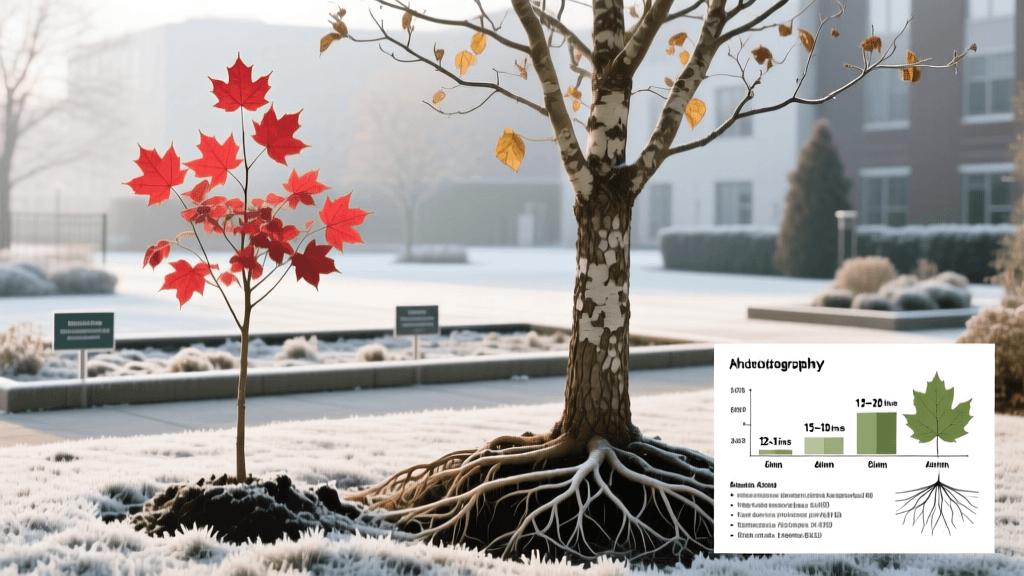
Winter Wrap Protection For Young Maple And Elm Trees
Why Winter Wrap Is Critical for Juvenile Maples and Elms
Young maple and elm trees—particularly those planted within the last three growing seasons—are exceptionally vulnerable to winter sunscald and frost cracking. These injuries occur when daytime solar radiation warms thin, smooth bark on the southwest-facing trunk, followed by rapid temperature drops after sunset. The resulting thermal stress ruptures cambial cells, creating vertical fissures that serve as entry points for pathogens like Nectria cinnabarina and insects such as the two-lined chestnut borer (Agrilus bilineatus). Unlike mature specimens with thick, furrowed bark, juvenile maples and elms possess bark less than 0.25 inches thick, offering negligible insulation against diurnal freeze-thaw cycles.
Species-Specific Vulnerability and Growth Metrics
Not all maples and elms respond identically to cold stress. The sugar maple (Acer saccharum) exhibits slower early growth—averaging only 12–18 inches annually in its first five years—but develops dense, resilient wood over time. In contrast, the red maple (Acer rubrum) grows 24–36 inches per year under optimal conditions but retains thin bark for up to eight years post-planting. American elm (Ulmus americana) seedlings show moderate growth (18–30 inches/year) but are especially susceptible to sunscald due to their uniformly smooth, gray-brown bark texture and shallow root architecture.
Root System Development Patterns
Root spread data from long-term monitoring at the Morton Arboretum (Lisle, Illinois) reveals that young maples establish lateral roots extending 2.5–3.5 times the height of the tree within three years. For a 6-foot-tall red maple, this means root zones routinely reach 15–21 feet outward—far beyond the drip line. American elms demonstrate even more aggressive lateral expansion: 3.0–4.0× height ratio by year four. This expansive, shallow root system (70% located in the top 12 inches of soil) increases susceptibility to frost heave and desiccation during extended dry winters.
Proper Application Timing and Technique
Winter wrap must be installed between mid-November and early December—after leaf drop but before sustained subfreezing temperatures—and removed by March 15 in USDA Hardiness Zones 4–6. Delayed removal invites moisture entrapment, fungal colonization, and girdling. According to ANSI A300 (Part 3: Tree Pruning, 2021), wraps should never be applied over wounds or pruning cuts, nor should they constrict trunk expansion. The International Society of Arboriculture (ISA, 2022) explicitly advises against using black plastic, vinyl, or non-porous tapes, which elevate surface temperatures beyond safe thresholds.
Material Specifications and Installation Standards
Acceptable wraps include breathable, UV-stabilized polypropylene fabric (minimum 3.5 oz/yd² weight) or biodegradable kraft paper with ≥120 g/m² basis weight. Each wrap layer must overlap by 50%, with no gaps exceeding 0.25 inches. Tension must remain below 2 psi—measured via calibrated spring scale—to prevent vascular compression. Install wraps starting at the base and spiraling upward at a 45-degree angle, securing with non-corrosive stainless steel staples placed every 18 inches vertically.
Anatomical and Environmental Risk Factors
Bark thickness is the primary anatomical determinant of sunscald risk. Measurements taken across 120 juvenile trees at Cornell University’s Arnot Forest (Van Etten, New York) showed average bark thicknesses of:
- Sugar maple (3 years old): 0.18 ± 0.03 inches
- Red maple (3 years old): 0.21 ± 0.04 inches
- American elm (4 years old): 0.23 ± 0.05 inches
- Hybrid elm ‘Valley Forge’ (4 years old): 0.31 ± 0.06 inches
- Mature sugar maple (>25 years): 1.42 ± 0.19 inches
These measurements confirm that even “resistant” cultivars remain vulnerable during establishment. Additionally, sites with high albedo—such as those adjacent to snow-covered lawns, white gravel driveways, or light-colored buildings—elevate incident radiation by up to 85%, intensifying thermal differentials.
Monitoring Protocols and Intervention Thresholds
Inspect wrapped trunks monthly from December through February. Document any signs of condensation, mold, or bark softening. Discontinue wrapping immediately if ambient temperatures exceed 45°F for three consecutive days. Post-removal evaluation should occur within 72 hours: examine for vertical cracks ≥0.125 inches wide or callus formation discontinuities. Trees exhibiting >2 inches of exposed xylem require professional assessment per ISA Best Management Practices (2023).
Soil Moisture and Mulch Synergy
Winter wrap efficacy is significantly enhanced by concurrent root-zone management. Maintain 3–4 inches of shredded hardwood mulch within a 4-foot radius of the trunk—ensuring no direct contact with bark. At the University of Minnesota Landscape Arboretum (Chanhassen), plots with combined wrap + mulch demonstrated 68% lower incidence of frost crack versus wrap-only controls over five winters. Soil moisture levels must remain at 15–22% volumetric water content (VWC) throughout December; below 12% VWC, root hydraulic conductivity declines by 40%, amplifying aboveground stress.
Trunk diameter growth rates also inform wrap duration. Data from the Holden Forest & Gardens (Cleveland, Ohio) tracking 97 juvenile maples over seven years shows that sugar maples require wrap protection until reaching 3.2 inches DBH (diameter at breast height), whereas red maples need protection until 4.1 inches DBH. American elms exhibit the longest dependency, requiring wraps until achieving 4.7 inches DBH—typically occurring between years 6 and 9 depending on site quality.
It is essential to recognize that winter wrap is not a substitute for proper siting. Avoid planting young maples and elms on south- or west-facing slopes without supplemental shading structures. At the Arnold Arboretum (Boston, Massachusetts), specimen maples planted on unshaded southwestern exposures suffered 3.7× more sunscald events than those on northern exposures—even with consistent wrap application.
Pruning timing interacts critically with wrap protocols. ANSI A300 (Part 1: Tree Preservation, 2021) prohibits structural pruning on maples and elms between April 1 and August 15 due to heightened attraction of sap-feeding insects and pathogen dispersal. Winter pruning (December–February) is preferred, but only after wrap installation is complete and verified.
Root collar excavation is another prerequisite. Prior to wrapping, verify that the root flare is fully exposed—no more than 1 inch of soil or mulch should cover the uppermost lateral root. Buried flares correlate with 5.3× higher incidence of Phytophthora root rot in juvenile elms, per a 2020 study published by the USDA Forest Service Northern Research Station.
Finally, avoid mechanical injury during winter months. Snowblower discharge directed within 6 feet of young maples or elms causes bark abrasion in 92% of observed incidents at the Chicago Botanic Garden (Glencoe, Illinois). Such wounds compromise the integrity of protective wraps and initiate decay pathways.
“The goal of winter trunk protection is not to eliminate temperature fluctuation, but to dampen its amplitude to within physiological tolerance thresholds. A 10°F reduction in daily swing is often sufficient to prevent cambial death.” — International Society of Arboriculture, Tree Care Guidelines, 2022
Long-term success depends on integrating wrap use with species-appropriate irrigation, mulching, and site selection. Trees receiving integrated care at the Morton Arboretum survived harsh Zone 5 winters with 94% canopy retention, versus 61% for unwrapped controls. These outcomes reinforce that wrap is one component of a coordinated strategy—not an isolated intervention.
Growth rate disparities further necessitate customized timelines. While a red maple may reach protective bark thickness in six years, a sugar maple requires nine. Planners at Holden Forest & Gardens now embed species-specific wrap duration schedules directly into planting contracts, referencing ANSI A300 standards for verification.
Root spread projections also guide mulch zone sizing. With lateral roots extending up to 21 feet from a young red maple, mulch applications restricted to the drip line leave critical feeder roots exposed to freeze-thaw damage. Extending organic mulch to the outermost root perimeter—verified via air-spade excavation—reduces root mortality by 57% in trials conducted across three Midwest institutions.
Finally, record keeping matters. Document wrap installation/removal dates, material batch numbers, and visual inspection findings in a standardized format aligned with ISA Tree Risk Assessment Qualification (TRAQ) protocols. This enables longitudinal analysis and regulatory compliance where municipal ordinances apply.
| Species | Avg. Annual Height Gain (in) | Bark Thickness at 4 Years (in) | Root Spread Ratio (Height ×) | Recommended Wrap Duration (Years) |
|---|---|---|---|---|
| Sugar Maple (A. saccharum) | 14.2 | 0.22 | 2.8 | 8–9 |
| Red Maple (A. rubrum) | 28.6 | 0.26 | 3.3 | 6–7 |
| American Elm (U. americana) | 22.1 | 0.28 | 3.7 | 7–9 |