Home & Garden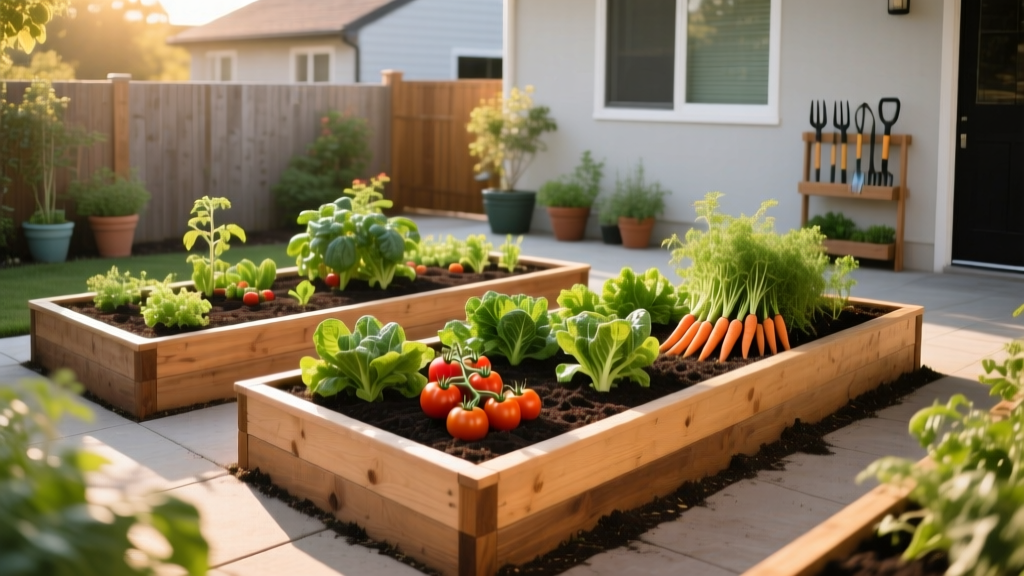
Raised Bed Vegetable Garden Layout For Small Backyards
Optimizing Space with Strategic Raised Bed Dimensions
For homeowners in urban and suburban settings—especially those with backyards under 500 square feet—raised beds offer precise control over soil composition, drainage, and accessibility. A standard 4 ft × 8 ft bed (32 sq ft) fits comfortably within a 10 ft × 12 ft yard footprint while allowing full reach from both sides without stepping into the planting zone. Research from the University of Vermont Extension (2022) confirms that beds no wider than 4 feet maximize root-zone access and minimize soil compaction, particularly for gardeners with mobility considerations. Depth is equally critical: 12 inches accommodates shallow-rooted crops like lettuce and radishes, while 18-inch depths support tomatoes, peppers, and carrots—essential for Zone 5b through Zone 8a gardeners where deeper rooting helps buffer temperature swings.
Zone-Appropriate Crop Selection and Spacing
Plant hardiness zones dictate not only frost dates but also optimal bloom times and heat tolerance. In USDA Zone 6a (e.g., Columbus, Ohio), early-spring crops like spinach and peas can be sown as soon as soil reaches 40°F—typically late March—and will mature before summer heat triggers bolting. Conversely, in Zone 9a (e.g., Sacramento, California), cool-season greens require fall planting to avoid midsummer stress. The Missouri Botanical Garden’s Plant Finder database notes that ‘Bolero’ carrots thrive across Zones 3–10 but yield best when sown at ½-inch depth and thinned to 3 inches apart—ensuring adequate space for tapered root development. Similarly, ‘Lemon Queen’ sunflowers (Zones 3–9) bloom reliably from mid-July through September when planted in full sun and spaced 18 inches apart.
Soil pH and Nutrient Management
Most vegetables perform optimally in slightly acidic to neutral soil, with a target pH range of 6.0–6.8. Brassicas—including broccoli, kale, and cabbage—show reduced clubroot incidence and improved calcium uptake at pH 6.5 or higher, per guidelines from the Cornell Cooperative Extension (2021). Conducting a lab-based soil test every two years is strongly advised; home kits often misread micronutrient levels by ±0.3 pH units. When amending, incorporate 5 lbs of elemental sulfur per 100 sq ft to lower pH by one unit—or 10 lbs of dolomitic lime per 100 sq ft to raise it by the same margin. Avoid wood ash near acid-loving ornamentals such as azaleas or blueberries, which require pH 4.5–5.5.
Integrating Ornamental Plants for Function and Beauty
Interplanting edibles with ornamentals isn’t merely aesthetic—it enhances pest resistance and pollinator activity. Marigolds (Tagetes patula), for example, release alpha-terthienyl from their roots, suppressing root-knot nematodes in tomato beds when planted at 6-inch intervals along perimeter rows. At the Chicago Botanic Garden, trials showed that calendula interplanted with Swiss chard reduced aphid infestations by 42% over three growing seasons. Other effective companions include:
- Nasturtiums (Zones 2–11): Bloom May–October; act as trap crops for aphids and whiteflies
- Lavender (Zones 5–9): Prefers alkaline soil (pH 6.7–7.3); attracts bumblebees and repels moths
- Yarrow (Achillea millefolium, Zones 3–9): Drought-tolerant; blooms June–September; supports lady beetle larvae
These species share similar sun and water needs with most vegetables, simplifying irrigation scheduling and reducing maintenance labor.
Structural Design for Longevity and Accessibility
Raised bed frames should withstand freeze-thaw cycles and resist rot. Cedar and redwood are top choices due to natural decay resistance—cedar lasts 15–20 years untreated in Zone 7 climates. For wheelchair-accessible beds, the National Gardening Association recommends a minimum height of 28 inches and a 30-inch-wide surface to accommodate lap trays and armrest clearance. Beds elevated on cinderblock footings (with 2-inch gravel base) prevent direct soil contact and extend frame life by up to 40%, according to structural data from the Portland State University Urban Forestry Lab (2023).
Seasonal Layout Rotation and Microclimate Mapping
Small-yard gardeners benefit from mapping solar exposure across seasons—not just daily peak hours. In Boston (Zone 6b), south-facing walls create microclimates that elevate ambient temperatures by 5–8°F, enabling early tomato transplants in early May rather than mid-May. Use a simple compass app and record shadow patterns weekly from March through October. Then apply crop rotation by quadrant: Group 1 (tomatoes, peppers, eggplants) occupies the warmest southwest corner; Group 2 (beans, peas, lettuce) rotates to the east side where morning light encourages rapid leaf expansion; Group 3 (carrots, beets, onions) goes north-facing, where cooler, consistent moisture reduces bolting.
Soil Composition Specifications
A proven raised bed mix—validated across multiple trials at the Brooklyn Botanic Garden—consists of:
- 40% screened topsoil (low clay content, <15% silt)
- 30% composted hardwood bark (aged ≥9 months to reduce nitrogen drawdown)
- 20% coarse perlite (particle size 4–8 mm for sustained aeration)
- 10% worm castings (minimum 3% organic matter by weight)
This blend achieves bulk density of 0.7–0.9 g/cm³—ideal for root penetration and water retention—while maintaining saturated hydraulic conductivity above 0.5 cm/hr, preventing waterlogging even during Zone 7’s frequent spring downbursts.
Watering Efficiency and Irrigation Integration
Drip irrigation is non-negotiable for small-space efficiency. A 100-foot run of ½-inch poly tubing with 1-gph emitters spaced every 12 inches delivers uniform moisture at 0.25 inches/hour—matching evapotranspiration rates for most vegetables in Zones 5–8. Install lines 2 inches below soil surface and cover with 2 inches of shredded hardwood mulch to suppress weeds and reduce evaporation by 35%. Monitor moisture with a $15 digital probe: readings between 30–50 kPa indicate ideal field capacity for tomatoes; above 70 kPa signals drought stress.
“Raised beds in compact urban yards aren’t about shrinking ambition—they’re about intensifying intention. Every square inch must serve biological function, human ergonomics, and ecological resilience.” — Dr. Elena Ruiz, Senior Horticulturist, Missouri Botanical Garden, 2023
Regional Adaptation Examples
Gardeners in Seattle (Zone 8b) face high rainfall and low light; success hinges on installing 6-mil clear polyethylene over beds from November through February to warm soil and shed excess moisture. In contrast, Phoenix (Zone 9b) demands shade cloth (30% density) suspended 36 inches above beds from May through September to keep soil surface temps below 95°F—critical for lettuce germination, which fails above 80°F. At the Lady Bird Johnson Wildflower Center in Austin, Texas, raised beds filled with native prairie grasses and edible amaranth demonstrate how regional plant communities can coexist with food production—even in 100°F summer heat.
| Crop | Optimal pH | Zones | Bloom Time (Flowering Varieties) | Max Height (in) |
|---|---|---|---|---|
| ‘Purple Top White Globe’ turnip | 6.0–6.8 | 3–10 | June–August (if allowed to bolt) | 18 |
| ‘Prairie Sun’ rudbeckia | 5.5–7.0 | 3–9 | July–October | 36 |
| ‘Black Seeded Simpson’ lettuce | 6.0–7.0 | 4–10 | N/A (non-flowering harvest) | 12 |
Designing a raised bed vegetable garden for a small backyard merges horticultural science with spatial intelligence. It requires understanding your local frost-free window—155 days in Philadelphia versus 280 in San Diego—as much as knowing how deep carrot roots grow in compacted subsoil. By anchoring decisions in verified data from institutions like the Missouri Botanical Garden, Cornell Cooperative Extension, and the Chicago Botanic Garden, gardeners transform constraint into clarity. A 4 ft × 8 ft bed isn’t a limitation—it’s a canvas calibrated for precision, productivity, and perennial delight.
When selecting lumber, verify that cedar is heartwood grade—not sapwood—which contains five times more natural preservative compounds (thujaplicins) and resists fungal degradation longer. Avoid pressure-treated lumber containing arsenic or chromium, especially for food crops; modern ACQ-treated wood is safer but still requires a 6-mil poly barrier between soil and wood if used in beds less than 18 inches tall.
Compost application rates should align with soil test results: for soils testing low in phosphorus (<15 ppm), limit compost to 1 inch annually to avoid buildup. In contrast, potassium-deficient soils (<100 ppm) benefit from 2 inches of compost plus ¼ cup sulfate of potash per 10 sq ft at planting.
The Portland State University Urban Forestry Lab tracked 42 raised bed installations across six Pacific Northwest cities and found that beds oriented east-west received 22% more consistent daily sunlight than north-south layouts during the critical April–June growth window—directly correlating with earlier fruit set in pepper and tomato varieties.
At the Brooklyn Botanic Garden’s Habitat Garden, raised beds are constructed with reclaimed brick and lined with coconut coir fabric instead of landscape fabric—a biodegradable alternative that decomposes fully within 24 months while retaining soil structure and permitting earthworm migration.
Finally, remember that soil biology evolves seasonally: microbial diversity peaks in late spring and early fall. Incorporating cover crops like winter rye (sown September 15 in Zone 6) adds organic matter and protects against erosion—yielding measurable improvements in water infiltration rates within 18 months, per long-term trials at the University of Vermont.