Tree Care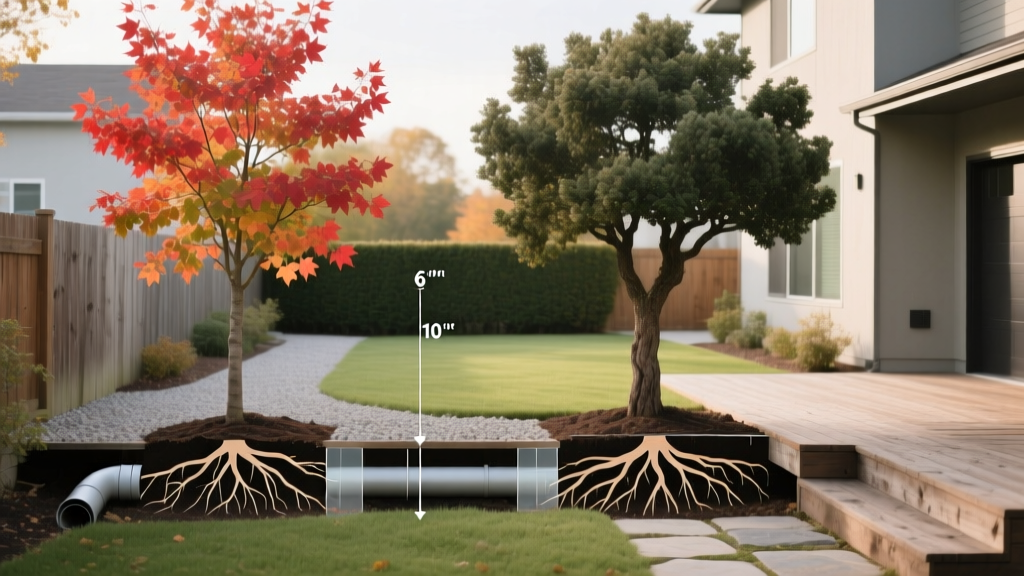
Red Maple vs Live Oak: Small Yard Drainage Pipes 2026
Sarah ChenPublished
Shade Tree Selection and Subsurface Infrastructure in 2026
When designing a small yard in 2026, homeowners face a complex underground puzzle. Above ground, the goal is often to maximize shade, aesthetic appeal, and property value. Below ground, however, modern small yards rely heavily on intricate landscape drainage pipe networks to manage stormwater, protect foundations, and prevent soil erosion. Choosing the right shade tree is no longer just about canopy size or fall color; it is fundamentally about how a tree's root system will interact with your subsurface French drains, downspout extensions, and PVC drainage lines.
Two of the most popular shade trees for residential landscapes are the Red Maple (Acer rubrum) and the Live Oak (Quercus virginiana). Both offer tremendous benefits, but they possess drastically different root architectures and moisture-seeking behaviors. If you have a small yard heavily reliant on landscape drainage pipes, understanding these differences is critical to preventing costly pipe ruptures, blockages, and soil subsidence. In this comprehensive 2026 guide, we will compare these two species specifically through the lens of landscape drainage infrastructure protection.
The Science of Tree Roots and Drainage Pipes
To understand why trees threaten drainage systems, we must look at root biology. Tree roots do not actively seek out and crush pipes out of malice; they are driven by hydrotropism—the biological imperative to grow toward moisture. Landscape drainage pipes, particularly those that collect surface runoff or groundwater, are perpetual sources of moisture. Furthermore, pipes made of flexible corrugated materials often feature weep holes or loose joints that emit tiny amounts of water vapor and condensation into the surrounding soil.
According to research from the University of Minnesota Extension, the majority of a tree's fine, water-absorbing roots are located in the top 12 to 18 inches of soil. This is the exact same depth at which most residential landscape drainage pipes are trenched and buried. When a root encounters the moist, aerated soil surrounding a drainage trench, it proliferates rapidly. Over time, these roots can infiltrate pipe joints, crush flexible tubing, and completely block water flow, leading to yard flooding and foundation damage.
Red Maple (Acer rubrum): Beauty with Aggressive Roots
The Red Maple is celebrated for its rapid growth rate and spectacular autumn foliage. In 2026, it remains a top seller for small to medium yards due to its relatively compact mature canopy compared to massive forest trees. However, the Red Maple is notorious among landscape architects for its aggressive, shallow, and highly fibrous root system.
As noted by the Clemson University Home & Garden Information Center, Red Maples naturally thrive in wet, poorly drained bottomlands. Because they are evolutionarily adapted to wet environments, their roots are exceptionally efficient at locating and exploiting subsurface moisture. If you install a French drain or a perforated landscape drainage pipe within 20 feet of a Red Maple, the tree's fine feeder roots will quickly colonize the gravel trench surrounding the pipe.
Drainage Pipe Risks for Red Maples
- Corrugated Pipe Crushing: Red Maple surface roots often thicken and form structural buttresses near the trunk. These roots can easily crush standard N-12 corrugated HDPE landscape drainage pipes, which lack the rigidity to withstand the radial expansion of maple roots.
- Joint Infiltration: The dense, fibrous nature of maple roots allows them to slip through microscopic gaps in PVC pipe joints, eventually creating a dense mat that blocks water flow entirely.
- Surface Heaving: Because Red Maples prefer shallow root growth, they are prone to lifting sidewalks, patios, and shallow drainage trench grates as the roots expand in diameter.
Live Oak (Quercus virginiana): Majestic but Demanding
The Southern Live Oak is an iconic, broadleaf evergreen known for its sweeping, horizontal branches and incredible wind resistance. While it requires a larger footprint than a Red Maple, dwarf and carefully pruned cultivars are increasingly used in small urban yards in 2026. The Live Oak develops a deep taproot in its youth, which transitions into a massive, sprawling lateral root system as the tree matures.
The University of Florida IFAS Extension highlights that Live Oaks are highly adaptable to various soil types, including heavy clays. However, their lateral roots can extend two to three times the width of the canopy. In a small yard, this means the root zone will inevitably overlap with perimeter drainage systems, foundation drains, and retaining wall weep pipes.
Drainage Pipe Risks for Live Oaks
- Soil Subsidence and Pitch Alteration: Live Oaks have massive structural roots. As these roots grow, they can alter the compaction and grade of the surrounding soil. This can change the 'pitch' or slope of your rigid PVC landscape drainage pipes, causing water to pool inside the lines rather than flowing to the discharge point.
- Trench Collapse: The sheer weight and spread of a Live Oak's root plate can cause the sidewalls of poorly backfilled drainage trenches to collapse, burying and pinching flexible drainage lines.
- Less Infiltration, More Crushing: Unlike the fibrous roots of the Red Maple that seek to infiltrate joints, Live Oak roots are thicker and more likely to simply envelop and crush pipes that are in their direct growth path.
Head-to-Head Comparison: Red Maple vs. Live Oak
When planning your 2026 landscape around existing or planned drainage infrastructure, use this comparison chart to evaluate which tree poses the lesser risk to your specific setup.
| Feature | Red Maple (Acer rubrum) | Live Oak (Quercus virginiana) |
|---|---|---|
| Root Depth Profile | Shallow, highly fibrous, surface-dwelling | Deep taproot initially, massive lateral spread later |
| Moisture Seeking | Extremely high (hydrotropic) | Moderate (adaptable to dry/wet) |
| Primary Pipe Threat | Joint infiltration and corrugated pipe crushing | Soil shifting, trench collapse, and rigid pipe snapping |
| Safe Distance from French Drains | Minimum 20 feet | Minimum 25 feet (based on mature canopy drip line) |
| 2026 Avg. Cost (15-Gallon) | $120 - $180 | $150 - $250 |
Protecting Your Landscape Drainage Pipe System
If your small yard necessitates planting one of these species near a drainage corridor, you must employ modern arboricultural and landscaping engineering techniques to protect your infrastructure. Relying on luck in 2026 is a recipe for a flooded basement or a ruined yard.
1. Upgrade Your Pipe Materials
Never use flexible, corrugated black plastic pipe (often sold in big-box stores) within the drip line of any large shade tree. The ridges of the pipe provide a perfect pathway for roots to wrap around and crush the tubing. Instead, invest in Schedule 40 PVC for all main landscape drainage lines. Schedule 40 PVC is incredibly rigid, and when joints are properly primed and solvent-welded, they form a seamless, watertight barrier that roots cannot easily penetrate or crush.
2. Install Mechanical Root Barriers
If you must plant a Red Maple or Live Oak within 15 feet of a critical drainage trench, install a mechanical root barrier. Products like DeepRoot UB 24-2 (a 24-inch deep, heavy-duty polyethylene barrier) should be trenched vertically between the tree and the drainage pipe. The barrier features specialized ridges that deflect growing roots downward, forcing them beneath the drainage pipe rather than allowing them to wrap around or infiltrate it.
3. Modify the Drainage Envelope
Traditional French drains use a gravel envelope wrapped in landscape fabric. Tree roots can easily penetrate standard woven geotextiles. For drainage lines near shade trees, use a specialized copper-impregnated geotextile fabric or a high-density polyethylene (HDPE) dimpled drainage mat. The copper acts as a natural, long-lasting root repellent, discouraging fine feeder roots from entering the gravel bed and clogging the perforated pipe.
4. Optimize Surface Water Management
The less water your drainage pipes carry, the less attractive they are to tree roots. Ensure that your yard's surface grading in 2026 is optimized to sheet water away from the house and toward permeable rain gardens or dry wells located far away from your shade trees. By keeping the soil immediately surrounding your drainage pipes as dry as possible during non-storm periods, you reduce the hydrotropic pull on the Red Maple or Live Oak roots.
Alternative Shade Trees for Drainage-Heavy Small Yards
If your small yard is entirely crisscrossed with shallow landscape drainage pipes, and you cannot guarantee a 20-foot planting radius, you may need to abandon both the Red Maple and the Live Oak. Consider these smaller, less aggressive alternatives that are trending in 2026 urban landscapes:
- Japanese Maple (Acer palmatum): Offers beautiful color and scale for small yards with a much slower growth rate and less aggressive root system. Safe to plant closer to drainage lines, provided Schedule 40 PVC is used.
- Eastern Redbud (Cercis canadensis): A fantastic understory tree with a deep, non-destructive root system that rarely interferes with shallow subsurface infrastructure.
- Serviceberry (Amelanchier arborea): Provides multi-season interest, stays relatively small, and poses minimal threat to landscape drainage pipes.
Conclusion
Choosing between a Red Maple and a Live Oak for a small yard in 2026 requires looking beneath the soil surface. While the Red Maple offers brilliant color and faster shade, its aggressive, moisture-seeking roots make it a high-risk candidate for yards with extensive corrugated or poorly sealed landscape drainage pipes. The Live Oak provides unparalleled structure and storm resilience, but its massive lateral roots can shift soil grades and compromise drainage trench integrity. By selecting the right tree, upgrading to rigid Schedule 40 PVC, and utilizing mechanical root barriers, you can enjoy a lush, shaded canopy without sacrificing the vital drainage infrastructure that keeps your home safe and dry.