Tree Care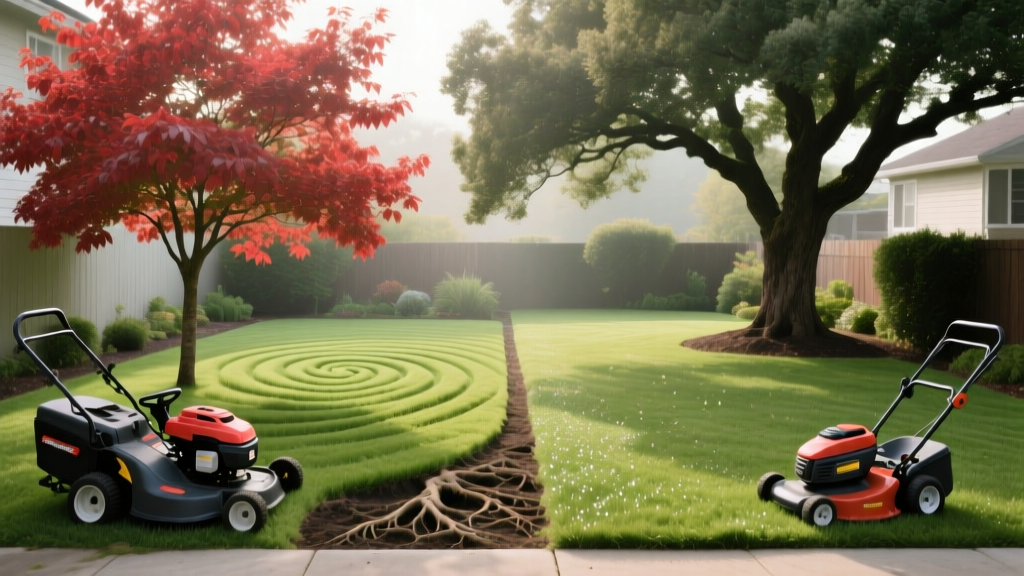
Red Maple vs Live Oak: 2026 Small Yard Mowing Guide
Emily WatsonPublished
The Intersection of Shade Tree Selection and Mowing Patterns
When designing a small yard, selecting the right shade tree goes far beyond curb appeal and seasonal color. In 2026, savvy homeowners and lawn care professionals recognize that your choice of canopy directly dictates your mowing techniques, turf survival, and equipment wear. Two of the most popular shade trees—the Red Maple (Acer rubrum) and the Southern Live Oak (Quercus virginiana)—offer vastly different challenges for lawn maintenance. While both provide exceptional shade, their unique root architectures and canopy densities require entirely different mowing patterns and turf management strategies. If you are working with a compact urban or suburban lot, understanding how these trees interact with your lawn mower is critical for maintaining a healthy, manicured landscape.
Subterranean Obstacles: Root Systems and Mower Deck Clearance
The most immediate impact a shade tree has on your mowing routine happens below the soil surface. In small yards, trees are often planted closer to property lines, patios, and primary walking paths, which accelerates how quickly roots interact with your turf zone.
The Live Oak: Navigating Surface Roots
Southern Live Oaks are renowned for their massive, sprawling lateral root systems. According to the University of Florida IFAS Extension, Live Oak roots frequently breach the soil surface as the tree matures, especially in compacted urban soils. In a small yard, these surface roots create 'scalp zones'—areas where the soil is raised, making it incredibly easy for a standard mower deck to catch, stall, or scalp the turf down to the dirt.
Mowing Pattern Adaptation: When mowing around a mature Live Oak, you must abandon standard straight-line overlapping patterns. Instead, utilize a spiral-out mowing technique. Begin your mowing pass at the outer edge of the tree's drip line and spiral inward, keeping the mower's discharge chute pointed away from the trunk. This allows you to visually track surface roots and adjust your steering before the anti-scalp wheels drop into a root void. Furthermore, turning a zero-turn mower sharply over Live Oak roots can tear the turf; wide, sweeping turns are mandatory.
The Red Maple: Fibrous Roots and Turf Competition
Red Maples, as noted by the University of Minnesota Extension, feature a shallow, highly fibrous root system. While they do not typically produce the massive, woody surface roots of the Live Oak, their dense mat of feeder roots aggressively competes with turfgrass for water and nutrients. The ground beneath a Red Maple remains firm but uneven due to minor root swelling and soil heaving from frost.
Mowing Pattern Adaptation: Standard overlapping, striped mowing patterns work well under Red Maples, provided your mower deck is equipped with heavy-duty anti-scalp rollers. Because the roots compete heavily for moisture, the turf is often thinner and more prone to tearing. To prevent turf damage during tight turns, use a three-point turn technique at the end of your rows rather than pivoting on a single drive wheel, which can rip the shallow-rooted grass right out of the soil.
Canopy Density: Adjusting Mowing Heights and Frequencies
Shade trees alter the microclimate of your lawn, fundamentally changing how grass grows and, consequently, how it must be cut.
- Red Maple Canopy: Red Maples produce a very dense, almost impenetrable canopy that blocks a significant percentage of sunlight. Turfgrass beneath a Red Maple grows slower and is highly stressed. You must raise your mowing height to a minimum of 3.5 to 4.0 inches to maximize the grass blade's photosynthetic surface area. Mow less frequently—only when the grass reaches 5 inches—and never remove more than one-third of the blade.
- Live Oak Canopy: Live Oaks offer dappled, filtered shade. This allows for a wider variety of shade-tolerant grasses, such as fine fescues or specific 2026 cultivars of Zoysia. You can maintain a standard mowing height of 2.5 to 3.0 inches and stick to a regular weekly mowing schedule during the peak growing season.
Red Maple vs. Live Oak: Small Yard Mowing Comparison
| Feature | Red Maple (Acer rubrum) | Southern Live Oak (Quercus virginiana) | Mowing Impact & Technique |
|---|---|---|---|
| Root Profile | Shallow, fibrous, dense mat | Massive lateral, surface-breaching | Maple: Avoid tight pivots to prevent turf tear. Oak: Spiral mowing to avoid scalping. |
| Shade Density | Dense, heavy shade | Dappled, filtered light | Maple: Mow high (4'). Oak: Mow standard (3'). |
| Leaf Drop Timing | Autumn (heavy drop) | Late Winter / Early Spring | Maple: Fall mulching required. Oak: Spring cleanup before heavy mowing begins. |
| Trunk Flare | Moderate base flare | Wide, buttressed trunk base | Maple: Standard mulch ring. Oak: Large, irregular mulch ring needed to protect trunk. |
| Turf Survival | Poor (requires shade-tolerant seed) | Moderate to Good | Maple: Expect bare spots requiring overseeding. Oak: Sustained turf cover possible. |
2026 Mowing Technology: Navigating Shade and Surface Roots
The lawn care equipment market in 2026 has introduced several innovations specifically designed to mitigate the challenges of mowing around mature shade trees in confined spaces.
Robotic Mowers and Root Navigation
If you have a Live Oak with extensive surface roots, traditional robotic mowers with boundary wires often get 'high-centered' or stuck on the woody roots. The 2026 lineup of satellite-guided robotic mowers, such as the Husqvarna Automower EPOS series, utilizes centimeter-accurate GPS mapping. This allows you to digitally map out the exact locations of surface roots and the wide buttressed trunk of the Live Oak, creating virtual 'no-go' zones that prevent the mower from attempting to climb the roots, thereby protecting both the tree's bark and the mower's chassis.
Zero-Turn Anti-Scalp Innovations
For Red Maples, where the issue is uneven soil heaving and thin turf, the 2026 Toro TimeCutter models feature independently suspended anti-scalp wheels with enhanced articulation. This allows the deck to float over the minor undulations caused by the Maple's fibrous root system without dropping the blades low enough to scalp the fragile, shade-stressed turf.
Leaf Drop Dynamics and Mulching Techniques
Your mowing routine is heavily dictated by how your chosen tree sheds its leaves. Using your mower as a mulcher is a core tenet of modern lawn care, but leaf composition matters.
Red Maple Leaves: Maple leaves are relatively thin and decompose rapidly. During the autumn drop, use a dedicated mulching blade and mow frequently. The small clippings will filter down to the soil line, providing a nitrogen boost to the turf before winter dormancy.
Live Oak Leaves: Live Oak leaves are small, thick, and highly leathery. They do not break down easily and can form a dense mat that suffocates the grass, blocking what little early-spring sunlight reaches the turf. When mowing under a Live Oak in late winter, you must use a high-lift bagging blade to remove the leaves entirely, or use a specialized micro-mulching deck that chops the leathery leaves into dust. Leaving whole Live Oak leaves on the lawn will result in severe fungal issues and turf die-off by early summer.
Establishing Mower-Friendly Mulch Rings
The most effective mowing technique for both Red Maples and Live Oaks in small yards is knowing when not to mow. Attempting to maneuver a mower deck tight against the trunk of either tree risks 'mower blight'—bark damage caused by string trimmers and mower decks, which invites fatal pathogens.
The Morton Arboretum strongly advocates for proper mulching to protect tree health. For small yards, establish a mower-friendly mulch ring using the 3-3-3 rule: a 3-foot radius (minimum), 3 inches deep, keeping mulch 3 inches away from the trunk flare.
- For the Live Oak: Because the trunk base is wide and buttressed, your mulch ring may need to be an irregular oval rather than a perfect circle to accommodate the trunk flare and immediate surface roots. This eliminates the need for dangerous string-trimming around the roots.
- For the Red Maple: A clean, circular mulch ring defined by a steel or poly edging border allows you to run the edge of your mower wheel right up to the border, creating a crisp, professional stripe pattern without ever touching the tree's bark.
Conclusion
Choosing between a Red Maple and a Live Oak for a small yard in 2026 requires a careful assessment of your willingness to adapt your mowing techniques. If you prefer dappled shade, standard mowing patterns, and a wider variety of turfgrass, the Live Oak is an excellent choice, provided you are willing to manage its surface roots and leathery spring leaf drop. If you desire brilliant autumn color and don't mind raising your mower deck to accommodate shade-stressed grass, the Red Maple is a stunning alternative. By aligning your tree selection with your mowing strategy, you ensure a harmonious, healthy landscape for decades to come.